Whaling: Meaning, Phishing Techniques, CEO Fraud, and BEC

Whaling: what it is, how an attack on executives works, the differences between spear phishing and BEC, real-world cases of deepfakes, and corporate cybersecurity defense.
- Posted on 2026-10-30
- Reading time: 6 min
Whaling: What Is Executive Attack and How Does It Work? #
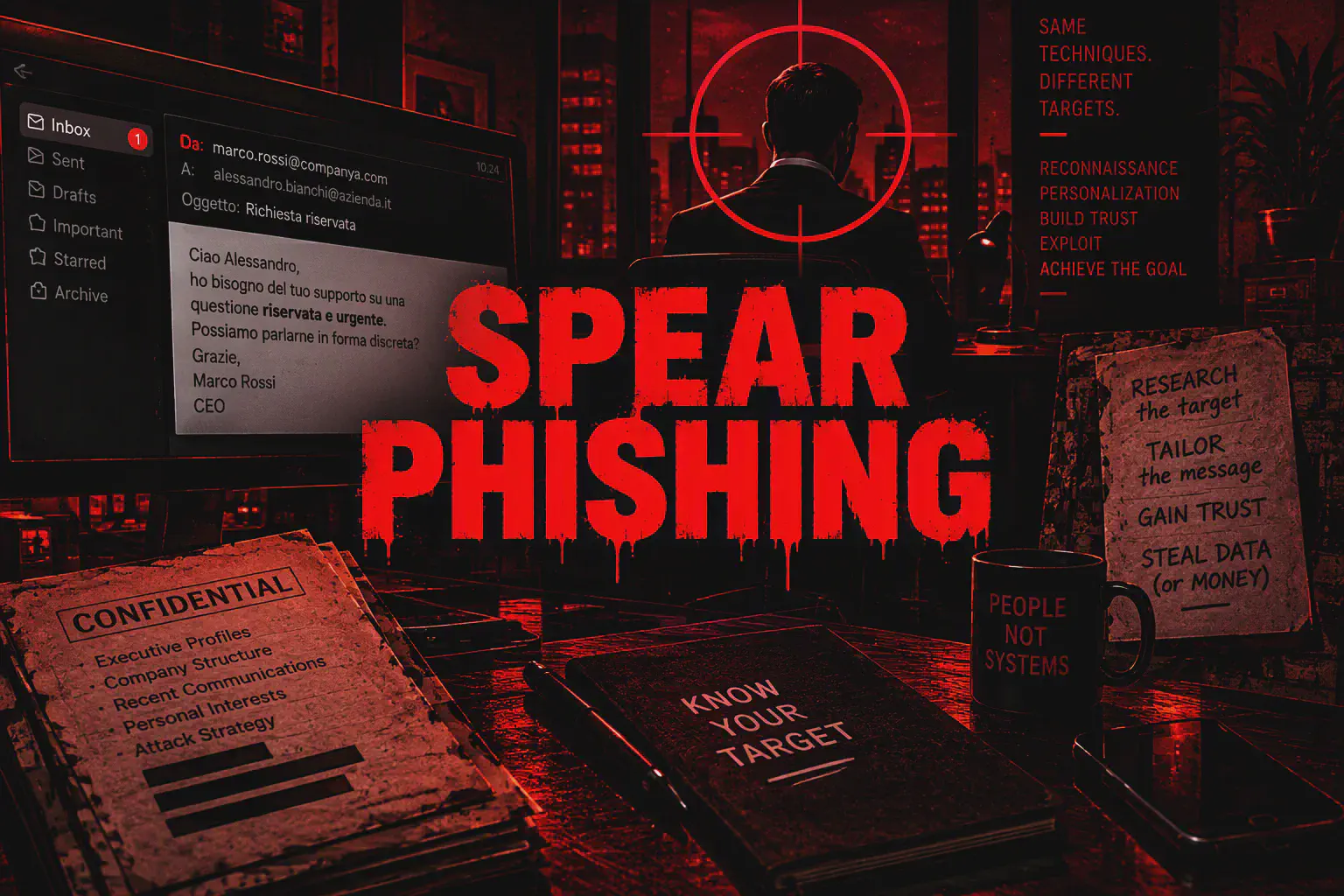
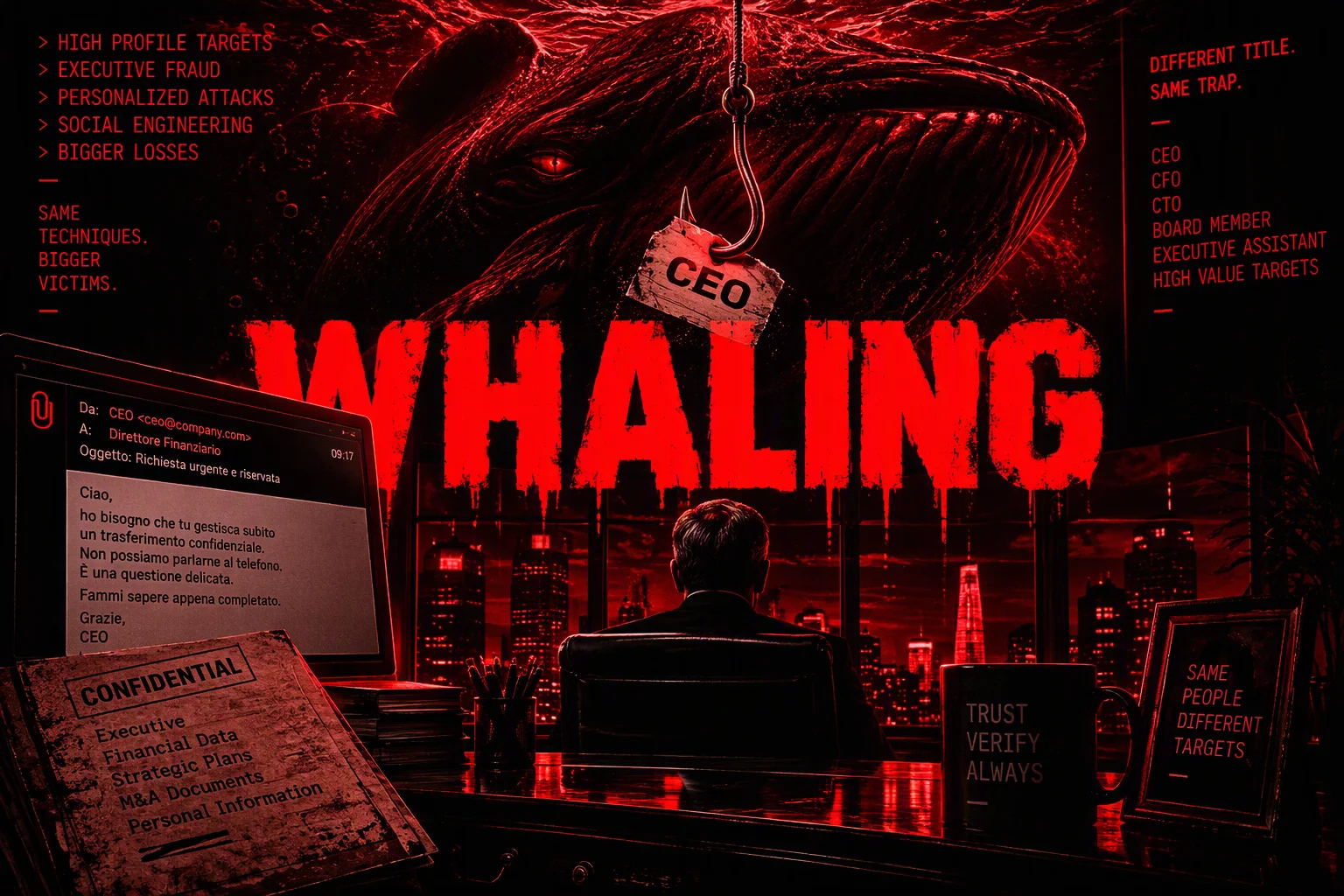
Whaling is a form of spear phishing specifically targeting executives, CEOs, CFOs , and board members—the "whales" from which it takes its name, high-value targets due to their authority and access within an organization. It works in two ways: an executive can be the direct target of a deceptive message, or an attacker can impersonate that executive to issue orders to those under their authority, typically the finance department.
With the advent of voice clones and deepfake videos, whaling has evolved from simple spoofed emails to video calls that mimic the look and sound of a real executive in real time, with losses in some cases exceeding tens of millions of dollars in a single incident.
Whaling: The Two Directions of Attack #
An often misunderstood point: not every attack involving an executive is whaling. The most rigorous definition distinguishes:
| Direction | What happen |
|---|---|
| The manager as a target | The attacker directly deceives the CEO or another executive, for example with a tailored credential collection page or a fictitious legal request |
| The manager as an embodied identity | The attacker pretends to be the executive to convince someone else (typically finance) to make a payment or grant access |
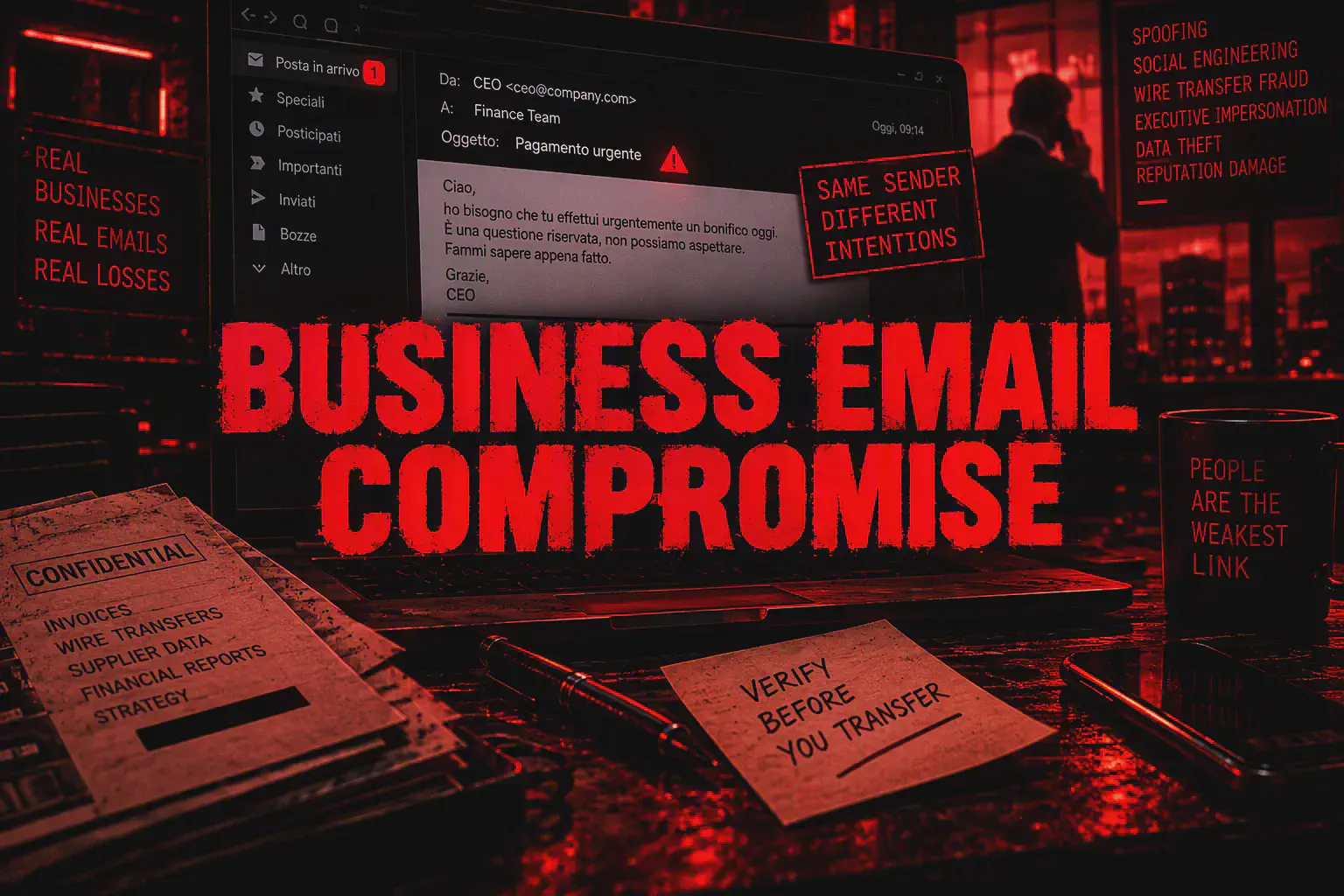
Only the first case falls within the narrower definition of whaling; the second, while closely related and often discussed together, is more specifically a form of Business Email Compromise based on the impersonation of a senior executive. In practice, the two schemes are often discussed together because they share the same rationale: exploiting the authority of a senior figure.
How a whaling attack works #
- In-depth reconnaissanceThe attacker studies the target through LinkedIn, public statements, interviews, the company website, and, when available, public audio or video recordings (conferences, earning calls, interviews).
- Choice of the moment: The attack is often synchronized with real events: a change of CEO, an ongoing acquisition, a business trip by the executive, a period of increased activity (quarter end).
- Construction of the pretext: a request that uses the authority of the manager involved, often with elements of confidentiality and urgency.
- CanaleIt could be a simple email, but increasingly it could be a WhatsApp message, a cloned voice call, or a deepfake video call.
- execution: the victim, believing they are responding to a legitimate instruction, authorizes a transfer, access, or sharing of sensitive information.
A key psychological factor is the so-called authority bias: a request perceived as coming from someone with superior decision-making power tends to receive less verification and more automatic obedience, even when something in the message should raise suspicion.
Whaling with Artificial Intelligence: From Voice to Video #
Whaling has evolved rapidly in recent years: from spoofed emails (the classic, pre-2020 form), to phone voice clones, to the entirely deepfake video calls of recent years.
The best-known and best-documented case is that of the engineering firm Arup : an employee in the Hong Kong office participated in a video conference in which every other participant, including senior executives, was a digitally cloned identity, with images and voices artificially generated to impersonate real people. Convinced he was speaking to his real superiors, the employee made 15 wire transfers to five accounts , for a total loss of approximately $25 million (approximately HK$200 million). Arup confirmed that its internal systems had not been compromised: the attack was based entirely on multimedia deception, not a technical intrusion. The case, reported by the Financial Times, has become a benchmark for describing the evolution of whaling into multi-channel attacks.
Another well-known case, thwarted before it could cause any damage, involved an attempt to clone the voice of the Ferrari CEO on WhatsApp, including his southern Italian accent, to pressure a manager about a supposedly undisclosed acquisition. The attempt failed when the manager asked, as a check, which book the CEO had recommended to him a few days earlier, a question to which the attacker was unable to answer.
Whaling Before AI: The Mattel Case #
Whaling isn't a phenomenon that originated with deepfakes. In 2015, shortly after Mattel appointed a new CEO , a finance executive received an email that appeared to come from the new CEO, requesting authorization for a $3 million payment to an account in China. The message arrived during an internal transition, when procedures were less consolidated, and closely mirrored the company's normal approval process. No malware, no technical vulnerabilities: just timing, knowledge of internal processes, and credible impersonation. In this case, unlike many others, the company was able to recover the money thanks to rapid collaboration between banks and authorities.
Examples of the most common whaling tactics #
| Tactics | How it looks |
|---|---|
| CEO's wire transfer order | An email or message that appears to be from the CEO, requesting an urgent and confidential payment |
| Reserved acquisition | A fake legal advisor or CEO involves the target in a “secret” operation that requires a wire transfer |
| Request for tax/payroll data | A message, apparently from HR or the CEO, asks for employee tax forms or pay stubs |
| Call or video with cloned voice | An urgent approval request comes via a call or video call that mimics the voice and appearance of a real executive. |
| Tailored credential theft | A spoofed login page, specifically crafted to mimic tools used by the target executive |
| Fake IT support | A request to access or reset credentials addressed to the help desk, exploiting the perceived authority of the impersonated manager |
It's worth noting that not all whaling attempts are aimed at money: some are simply looking for credentials or logins, which can be exploited later.
Why whaling is particularly profitable #
- Highest authority: An order that appears to come from the CEO is rarely questioned by the recipient.
- Privileged access: A compromised or impersonated executive can unlock payments of much higher amounts than an ordinary employee.
- Large public area: executives often have a strong public presence (interviews, conferences, social media), which provides attackers with abundant material for reconnaissance and, today, even for cloning their voice and appearance.
- Less monitored channelsWhatsApp, SMS, and personal calls often slip through corporate security controls designed only for email.
How to recognize a whaling attempt #
| Signal | Why should it arouse suspicion? |
|---|---|
| Request for maximum confidentiality | A legitimate financial transaction rarely requires you to not tell anyone about it. |
| Urgency combined with the absence of the royal executive | “I'm traveling, I can't be called” is a common excuse to prevent verification. |
| Unusual channel | A large order that arrives only via WhatsApp or chat, never confirmed on a verified company channel |
| Bypassing normal procedures | “Do it just this once, I'll confirm it later” |
| Request impossible to verify in real time | A video call that strangely stops as soon as you ask personal control questions |
How to protect yourself from whaling #
- Independent verification procedureAny significant financial request must be confirmed on a different channel than the one it came through, by calling a number known in advance, not the one provided in the message.
- Agreed control request: for the most exposed managers, establish in advance a question or code that only they know, useful precisely against voice and video clones.
- Double approval for relevant payments: no single authorization, especially if the request comes "from above" in a hurry.
- Specific training for managers: not generic anti-phishing training aimed at all employees, but scenarios built on the real channels and situations that a manager encounters (WhatsApp, video calls, requests for confidential acquisitions).
- Limit unnecessary public exposure: every interview, conference or public video of an executive is material that can be used to clone their voice and appearance.
- Monitoring similar domains and profiles: Register or monitor company domain variants and social media profiles that impersonate company executives.
Frequently Asked Questions about Whaling #
What is whaling? #
A form of spear phishing specifically targeting executives and board members, which may involve them as the direct target or impersonating other employees.
What is the difference between whaling and spear phishing? #
Whaling is a subset of spear phishing: the same targeted phishing technique, but specifically aimed at very high-level figures in an organization.
What is the difference between whaling and BEC? #
When an attacker impersonates an executive to order a payment to a third party, the scheme is more properly a form of Business Email Compromise based on executive impersonation; the two terms are often used together because they share the same logic.
Does whaling always require sophisticated tools like deepfakes? #
No. The 2015 $3 million Mattel case used only timing, knowledge of internal processes, and email impersonation—no malware or advanced tools.
How much can a whaling attack cost? #
Documented losses range from a few hundred thousand to tens of millions of dollars in a single incident, as in the Arup case (around $25 million).
How do you protect yourself from a deepfake CEO on a video call? #
With independent verification through a separate channel and, for the most sensitive cases, a pre-agreed verification request that only the actual manager can know.
Is whaling a form of spear phishing? #
Yes. Whaling is generally considered a subtype of spear phishing where the target is specifically a high-profile person, such as a CEO or other executive.
How do I verify that a message or call from the CEO is authentic? #
Don't rely solely on email, phone number, voice, or video: for financial or confidential inquiries, always use a second, pre-established channel and an independent approval process.
Are executives aware that they are high-risk targets? #
Often less than it should be: Safety training is still too often generic and aimed at all employees equally, rather than addressing the specific scenarios a manager encounters.
Does whaling only use email as a channel? #
No. The most recent campaigns combine email, SMS, WhatsApp, voice calls, and video calls, often sequentially in the same attack.