Stuxnet: The History of the Virus Used as a Cyber-Weapon

Stuxnet, the virus used as a cyberweapon: what it is, how it sabotaged the Natanz centrifuges, the four zero-days exploited, the damage, and the impact on cybersecurity.
- Posted on 2026-11-04
- Reading time: 6 min
Stuxnet: How the Malware That Hit Iran Worked #
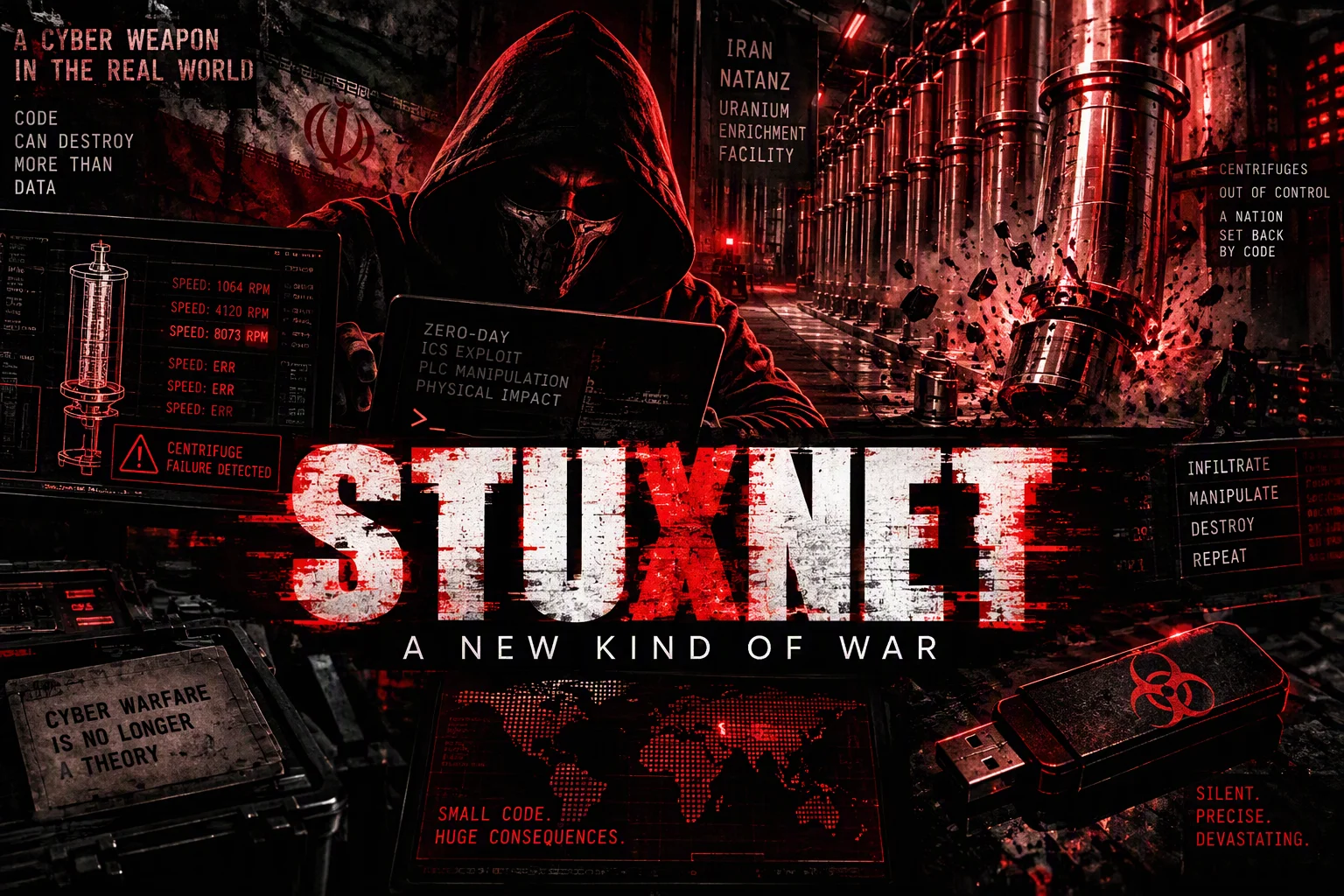
Stuxnet is a computer worm discovered in June 2010, commonly considered the first publicly known cyberweapon capable of causing actual physical damage to industrial infrastructure by manipulating a control system. Its target was the Natanz uranium enrichment facility in Iran: it did not steal data, did not demand a ransom, but instead physically destroyed the centrifuges used for nuclear enrichment, causing them to spin at dangerous speeds while displaying completely normal data to operators on control monitors.
It is a textbook case of how the digital world can affect the physical world, and has set the standard for all subsequent attacks against industrial control systems (ICS/SCADA).
The target: the Natanz centrifuges #
The Natanz plant used cascades of thousands of IR-1 centrifuges to enrich uranium, spun at extremely high speeds by frequency converters (manufactured by Vacon and Fararo Paya). If a centrifuge is stopped or accelerated abruptly while spinning at that speed, it will be damaged or destroyed.
Stuxnet didn't attack "computers" in general: it was designed to recognize a very specific configuration. The code contained logic related to two Siemens PLC families, the S7-315 and the S7-417 , but according to analysis by the Institute for Science and International Security (ISIS), only the payload for the S7-315 was actually active in the analyzed samples, while the one for the S7-417 was present but not triggered: the actual attack on the Natanz centrifuges was via the former. In both cases, if the worm didn't find the desired configuration—a specific number of Vacon or Fararo Paya frequency converters, connected via a CP 342-5 PROFIBUS communication module—it remained inactive.
How it worked: Four zero-days in a single attack #
What made Stuxnet exceptional, even today, is the number of unknown vulnerabilities used in a single attack: typically, a group possessing a zero-day exploit uses it sparingly, precisely to avoid "burning" it and letting it be discovered. Microsoft has identified four Windows vulnerabilities exploited by Stuxnet, all unknown at the time of the attack:
| Vulnerability | What did it allow? |
|---|---|
| CVE-2010-2568 | Autorun via file manager .LNK/.PIF (Windows shortcuts), the initial carrier via removable media |
| CVE-2010-2729 | Vulnerability in Windows Print Spooling Service used for network propagation |
| CVE-2010-2743 | Elevation of privilege in the Windows kernel |
| CVE-2010-3338 | Elevation of Privileges Using Windows Task Scheduler |
Added to this was a zero-day application vulnerability in Siemens software ( CVE-2010-2772 ), due to a hard-coded password in the WinCC/PCS 7 system, which could be exploited locally to access the backend database, as well as a known network flaw, previously used by the Conficker worm, for spreading on local network shares.
How he punctured a system isolated from the Internet #
For security reasons, Natanz wasn't directly connected to the Internet (an air gap ). Stuxnet overcame this isolation in the simplest way possible: an infected USB stick , inserted by someone (knowingly or not) into a computer on the internal network. From there:
- The worm spread laterally between workstations on the network via the Windows vulnerabilities listed above.
- He was looking for the Field PG, the Siemens engineering workstations used to program PLCs.
- When one of these connected to a Siemens S7-315 PLC for programming, Stuxnet injected its malicious payload directly into the controller's logic.
- Once in the PLC, the worm monitored PROFIBUS connections (the industrial protocol used by PLCs) for approximately 13 days, observing normal operation.
- After that observation phase, he altered the rotation speed of the centrifuges for about 27 days, then returning to normal operation for another 27 days, in a cycle designed to look like a random failure rather than sabotage.
According to ISIS's analysis, the first attack sequence increased the rotation frequency to approximately 1.410 Hz for 15 minutes (well beyond safety parameters), followed approximately 27 days later by a second sequence that dramatically lowered the frequency, with further cycles occurring at approximately 27-day intervals. Such a timed behavior, rather than a single sudden failure, was intended to resemble natural mechanical deterioration rather than deliberate sabotage.
Meanwhile, the worm falsified the data shown to the operators: according to the technical documentation collected by MITRE ATT&CK for ICS, Stuxnet intercepted communications between the supervisory software (WinCC) and the PLC by replacing the system library s7otbxdx.dll, normally used for those communications, with its own modified version. In this way the worm could hide its injected code in the PLC program blocks (particularly in the blocks OB1 e OB35, used for cyclic execution of control logic) and show operators completely normal process values, while the centrifuges were damaged from the inside. MITRE classifies this behavior as a rootkit
at the PLC level: it did not just hide files on disk, but the entire representation of the real state of the industrial process.
The damage: approximately 1.000 centrifuges compromised #
According to estimates by the Institute for Science and International Security, Stuxnet likely damaged approximately 1.000 IR-1 centrifuges between late 2009 and early 2010 , equivalent to about 10% of those operating at the facility at that time. IAEA (International Atomic Energy Agency) inspectors had observed an anomalous increase in centrifuge replacements at Natanz as early as January 2010, even before the worm was discovered and publicly analyzed.
Who discovered Stuxnet and how #
Stuxnet was identified in June 2010 by a Belarusian security firm, after industrial systems around the world (not just in Iran) exhibited anomalous behavior caused by the worm's unintended spread beyond its original target. In-depth technical analysis followed in the following months: Symantec published a detailed technical dossier (the famous W32.Stuxnet Dossier ), while industrial security expert Ralph Langner was among the first to publicly decipher the payload's true purpose, linking it specifically to the Natanz centrifuges.
Who is behind Stuxnet? #
The attribution has never been officially confirmed by any government, but technical analysis converges on one point: an operation of this complexity, involving four Windows zero-days, digital certificates stolen from two Taiwanese companies (Realtek and JMicron, used to make the worm's drivers appear legitimate), and detailed and specific knowledge of the Natanz facility, requires resources and intelligence typical of a state actor. The widespread consensus among researchers and investigative journalists attributes the operation to a collaboration between the United States and Israel, but this attribution is based on independent analysis and has never been officially confirmed by the parties involved.
Why Stuxnet changed everything #
Before Stuxnet, a "destructive" cyber attack was more theory than documented practice. After Stuxnet, it became a concrete and studied precedent:
- It proved that the air gap is not an absolute protection: A removable medium remains a valid carrier, regardless of how isolated a system is from the grid.
- It set a pattern for subsequent ICS/SCADA attacksMalware specifically designed for industrial control systems, such as Industroyer (2016, against the Ukrainian power grid), TRITON/TRISIS (2017, against the security systems of a petrochemical plant) and Industroyer2 (2022), share with Stuxnet the goal of directly manipulating a physical process through its control systems.
- He popularized the concept of cyber-kinetic attack: a purely digital intrusion with direct physical consequences, not just data theft.
- It has normalized the massive use of zero-days in a single attack by high-resource actors, changing expectations about what an advanced group is willing to “burn” for a high-value goal.
The Defensive Side: What OT/ICS Security Workers Learn #
For those involved in industrial systems security (OT, Operational Technology ), Stuxnet remains an essential case study. Some defense principles derived from it, which are worth knowing even just at a theoretical level, are:
- Removable media remains a real vector, even in isolated environments: USB port control policies and media scanning before use are minimum, non-optional measures in critical industrial environments.
- Monitoring must include the integrity of the PLC logic, not just network logs: Stuxnet bypassed monitoring by falsifying the data displayed to operators, a principle that still applies today against modern ICS malware.
- Segmentation between IT and OT networks It should be designed with the assumption that a single point of contact (an engineering workstation, a maintenance laptop) can bridge the two worlds.
For those who want to publicly study PLC programming logic and the PROFIBUS/PROFINET protocol for educational purposes, there are open resources such as Siemens' own documentation and academic research projects on ICS honeypots (decoy environments that simulate industrial systems to study ongoing attacks), a field of study born in part from the legacy of Stuxnet.
Frequently Asked Questions about Stuxnet #
What is Stuxnet? #
A computer worm discovered in 2010, considered the first cyber weapon in history capable of causing real physical damage, sabotaged centrifuges at Iran's Natanz nuclear facility.
How did Stuxnet spread in a facility isolated from the Internet? #
Via an infected USB stick, which allowed the worm to bypass the air gap and then spread laterally within the internal network by exploiting various Windows vulnerabilities.
How many zero-day vulnerabilities did Stuxnet use? #
Four Windows zero-day vulnerabilities (including CVE-2010-2568 for execution via removable media and CVE-2010-2743 for elevation of privilege), plus one application zero-day vulnerability in Siemens software (CVE-2010-2772), an exceptional number for a single attack.
How much damage did Stuxnet cause? #
It is estimated that it damaged approximately 1.000 IR-1 centrifuges at Natanz, about 10% of those operational at the time of the attack.
Who created Stuxnet? #
The attribution has never been officially confirmed by any government. The consensus among independent researchers attributes the operation to a collaboration between the United States and Israel.
Why is Stuxnet considered so important in the history of cybersecurity? #
Because it concretely demonstrated that a cyber attack can cause direct physical damage, it established a template for subsequent attacks against industrial systems, and it changed expectations about how many vulnerabilities an advanced actor is willing to exploit in a single operation.
Did Stuxnet steal data like traditional malware? #
No. Its purpose was not information theft but physical sabotage: it altered the speed of the centrifuges until they were damaged, while falsifying the data displayed to the operators to conceal the ongoing sabotage.
Are there any malware similar to Stuxnet that appeared after 2010? #
Yes, the case opened a trail of research and real-world attacks against industrial control systems, from Shamoon against Saudi Aramco in 2012 to several subsequent malware families specifically designed for ICS/SCADA environments.