NIS2: What it is, Obligations, Requirements, and 2026 Deadlines

NIS2 explained simply: what the NIS 2 directive is, who it applies to, obligations, 24-hour incident reporting, fines up to €10 million, and 2026 deadlines.
- Posted on 2026-10-05
- Reading time: 9 min
NIS 2 Directive (NIS2): What It Is, Who It Applies To, and Deadlines in Italy #
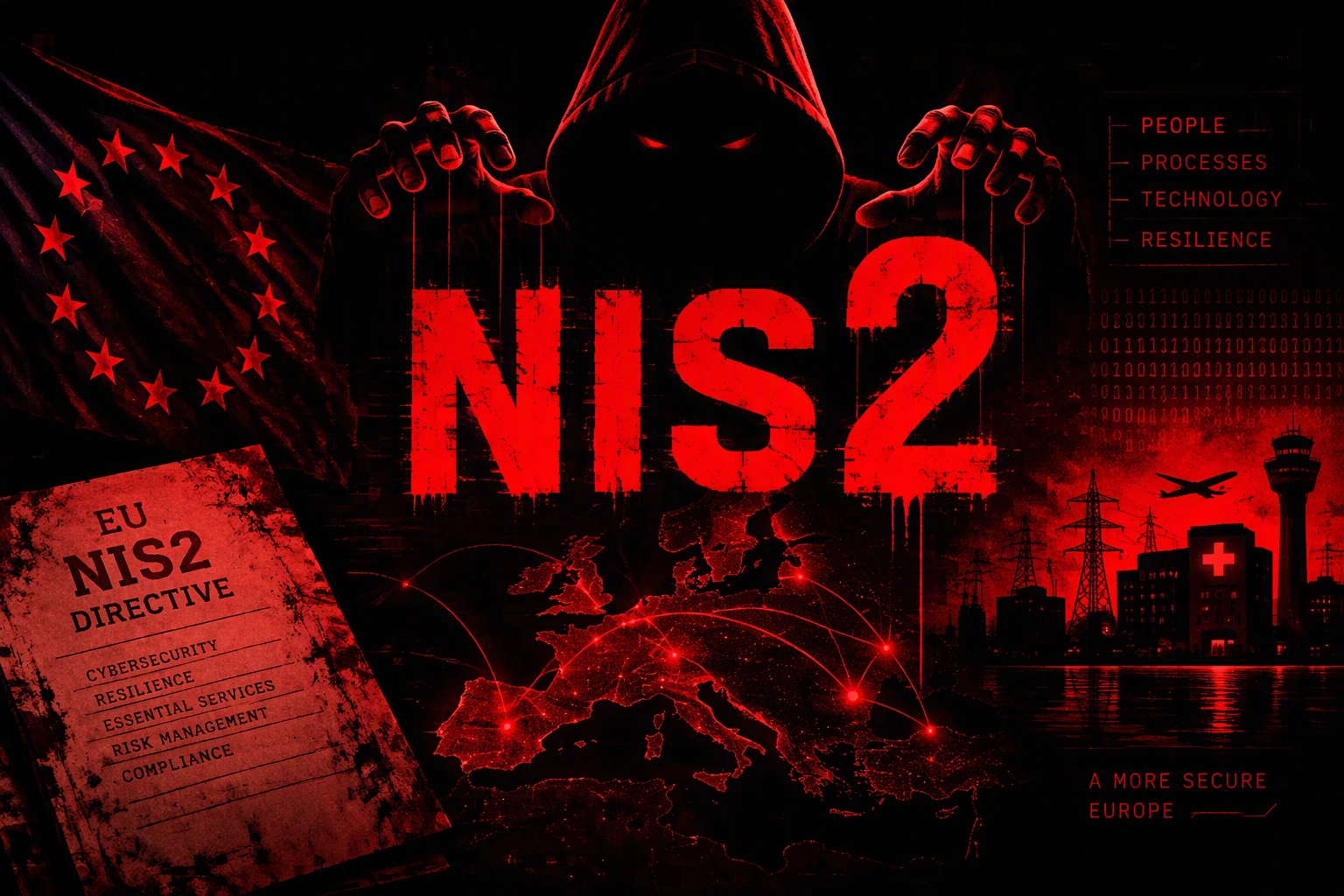
The NIS 2 Directive , or NIS2 (EU Directive 2022/2555), is the European cybersecurity regulation that requires companies and organizations in sectors considered critical to adopt minimum cybersecurity measures and to report serious cyber incidents to the authorities. In Italy, it is in force through Legislative Decree 138/2024 and is overseen by the ACN , the National Cybersecurity Agency. For entities already included in the list in 2025, the deadline for implementing basic security measures is October 31, 2026 : from November, the ACN can initiate audits and inspections.
If you own a business, work in IT, or are just getting started with cybersecurity, this guide explains what NIS2 says, who it applies to, what deadlines and penalties there are, and what it means in practice for those involved in offensive and defensive security.
NIS2: What is it in simple terms? #
NIS stands for Network and Information Security . NIS2 is the second version of the NIS Directive and expands the scope of the first: more sectors, more companies, more precise rules, and real penalties.
The underlying idea is simple: if a cyberattack on a company can shut down a hospital, a power grid, a port, or a supply chain, that company can no longer treat security as an optional extra. It must demonstrate a minimum level of protection and notify the authorities when something serious happens.
In a nutshell: NIS2 transforms cybersecurity from a corporate choice to a legal requirement for thousands of European organizations.
NIS2: who does it apply to? #
NIS2 applies to two categories of entities: essential and important . The difference isn't just in name: the level of control by the authority and the maximum amount of fines vary.
Generally, those operating in one of the eligible sectors and at least a medium-sized enterprise (50 employees or more than €10 million in annual turnover or balance sheet) are eligible. There are exceptions: some entities, such as certain DNS service providers or domain name registration providers, are eligible regardless of their size.
| Categories | Sectors (examples) |
|---|---|
| High criticality | Energy, transport, banking and financial markets, healthcare, drinking and waste water, digital infrastructure, ICT service management (MSP), public administration, space |
| Other critical sectors | Postal and courier services, waste management, chemicals, food, manufacturing (medical devices, electronics, machinery, vehicles), digital services (marketplaces, search engines, social networks), research |
A point that many underestimate: even if your company doesn't directly fall under NIS2, you could indirectly fall under it if you're a supplier to someone who does. The regulation requires monitoring supply chain safety, and large clients are already starting to ask you for contractual clauses, audits, and certifications.
Essential and important subjects: what changes #
- Essential: larger entities in highly critical sectors. They are subject to more stringent controls and higher sanctions.
- important: other entities within the scope. Lighter controls, same basic obligations.
The classification is carried out by the ACN. Each entity must register and update its data on the Agency's platform: the annual window runs from January 1st to February 28th . You can consult the ACN 's official website and the text of the directive on EUR-Lex.
NIS2 Italy: What Legislative Decree 138/2024 Provides #
Legislative Decree 138/2024 is the decree with which Italy implemented NIS2. It does three main things:
- Designates theACN as the competent national authority NIS.
- Indicates the CSIRT Italy as a reference point for receiving incident notifications.
- It establishes obligations, deadlines, and penalties for essential and important subjects.
The operational details (which measures, with what level of detail, and with what deadlines) come from the ACN's decisions , which are updated over time. Therefore, before making decisions, it's always a good idea to check the current decision for your category.
NIS Directive 2: entry into force #
The NIS 2 Directive entered into force at European level on 16 January 2023. Member States had until 17 October 2024 to transpose it into their national law. Italy did so with Legislative Decree 138/2024, which entered into force on 16 October 2024.
NIS 1 and NIS 2 Directives: the differences #
The NIS 1 Directive (EU Directive 2016/1148) was the first European law on network and information systems security, implemented in Italy with Legislative Decree 65/2018. NIS2 replaces it.
| NIS 1 | NIS 2 | |
|---|---|---|
| Sectors | Few, limited to essential operators | Many more, including digital services, manufacturing and public administration |
| Subjects | Essential service operators and digital service providers | Essential and important subjects, based on sector and size |
| Security measures | General indications | Precise list of areas to be covered |
| Incident Reporting | Without such a rigid sequence | 24 hours, 72 hours, one month |
| Management | Little involved | Direct liability of the administrative bodies |
| Sanctions | Leave it to the Member States | Minimum ceilings set at European level |
NIS Directive 2 PDF: Where to find the official text #
The full text of the directive, also available for download in PDF, is published on EUR-Lex in all EU languages. For application in Italy, the references are Legislative Decree 138/2024 and the ACN decisions.
NIS2 Obligations and Requirements: Required Security Measures #
The directive lists the areas that each entity must cover with "appropriate and proportionate" measures to the risk. Translated into practical language:
| Reserved | What does this mean in practice? |
|---|---|
| Risk analysis | You know what you have, what can go wrong, and how much it would cost. |
| Incident management | Do you have a written process for detecting, managing, and reporting an attack? |
| Business continuity and backup | If systems crash, restart. Backups exist and you've tested them. |
| Supply Chain Security | Control the vendors who have access to your systems or data |
| Vulnerability Management | You know what's out of date and fix it in a priority order. |
| Evaluation of effectiveness | Verify that the measures actually work (assessment, testing, audit) |
| Computer hygiene and training | People know how to recognize an attack, the configurations make sense |
| Cryptography | Sensitive data and communications are encrypted where needed. |
| Access control and asset management | You know who accesses what, with what privileges, on which devices |
| Multi-factor authentication | MFA on critical access, especially remote and administrative |
Note that the list doesn't say "buy tool X." It says what you need to be able to demonstrate. And this is where the part that matters to those who work in security comes in: demonstrating means evidence, procedures, logs, and tests.
Incident notification: 24 hours, 72 hours, one month #
This is the most operational and most pressure-inducing part. When a NIS2 subject experiences a significant incident , they must follow a specific sequence towards CSIRT Italy:
| When | when |
|---|---|
| Within 24 hours from knowledge of the event | Pre-notification: initial reporting, even with partial information |
| Within 72 hours | Notification: initial assessment of the incident, severity, impact, and, if available, indicators of compromise (IoC) |
| On request | Interim reports on the status of the accident |
| Within a month | Final relation: cause, measures taken, actual impact |
The 24-hour count starts from when you become aware of the incident, not from when it began. This is why the ability to detect an attack (logs, monitoring, EDR, clear roles) is as important as the ability to prevent it.
A concrete example: a manufacturing company discovers on Saturday morning that its file servers are encrypted by ransomware. It must have already sent a pre-notification by Sunday morning. If no one knows who is supposed to do it, through which channel, and with what information, the problem compounds the attack.
NIS2 Deadlines in Italy (updated to October 2026) #
The timing depends on the year in which the subject was included in the ACN list :
| Subjects included in the 2025 | Subjects included in the 2026 |
|---|---|
| Incident Reporting: since January 2026 (already active) | Incident Reporting: from January 1 2027 |
| Basic security measures: by 31 October 2026 | Basic security measures: by July 31, 2027 |
The October 31, 2026, deadline marks the transition from the support phase to the verification phase: after that date, the ACN can verify whether the measures are truly operational. Arriving "with the document ready" isn't enough; they must work.
The timeframes are derived from the 9-month reporting period for incidents and the 18-month reporting period for basic measures, counted from the date of listing. Always check your date and the ACN determination applicable to your case.
NIS2 Sanctions: How Much Are You Risking? #
For violations of risk management measures or notification obligations, the directive provides for these maximum amounts. The ceiling is the higher of the two amounts.
| Categories | Maximum penalty |
|---|---|
| Essential subjects | maximum 10 million euro or 2% of annual global turnover |
| Important subjects | maximum 7 million euro or at1,4 % of annual global turnover |
Sanctions are not the only tool: the authority can also impose inspections, requests for information, deadlines, and other corrective measures.
Management Responsibility #
One of the most important changes: security becomes a boardroom issue . Management and executive bodies must approve risk management measures, oversee their implementation, and undergo dedicated training.
If a lack of diligence or oversight emerges, the responsibility can fall directly on the company's management, not just the company itself. For an IT department, this is a powerful argument: "We need a security budget" ceases to be a request and becomes an obligation with personal consequences for those who decide.
NIS2 and GDPR: Differences and Overlaps #
These are two different regulations, which often come into force together. For details on the privacy regulation, please see the GDPR guide.
| GDPR | NIS2 | |
|---|---|---|
| What it protects | People's personal data | The continuity and security of services and systems |
| Who is it concerned with? | Anyone who processes personal data | Entities of defined sectors and sizes |
| What is reported | Personal data breach | Significant Incident |
| To who | Privacy Guarantor | CSIRT Italy / ACN |
| Availability | Within 72 hours | 24 hours (pre-notification) and 72 hours |
A ransomware attack involving customer data exfiltration can trigger both notifications, to different authorities and with different deadlines. Having a single incident response process that manages them in parallel avoids errors at the worst possible time.
NIS2 seen by those who work in offensive security #
Those who work in red teams or pentests see NIS2 from a different angle: the measures required are, in fact, countermeasures to the techniques we use every day.
- “Vulnerability Management” and “Effectiveness Evaluation” This means periodic assessments and penetration tests, and rapid patches even against zero-day A service exposed as RDP on port 3389 It is one of the classic entry points for ransomware.
- “Access Control” and MFA are the answer to techniques such as password spraying e credential stuffing : without a second factor, a reused password is enough.
- “Training” and computer hygiene they serve against the Phishing , still among the most common initial vectors today.
- “Incident Management” requires understanding at what point in the Cyber Kill Chain the attacker is found, because the notification asks for impact and indicators of compromise.
- Risk Analysis in Windows Environments it means looking with critical eyes Active Directory : It is the heart of most corporate networks, and when it goes down, everything goes down.
Two quick checks to get you started with your inventory #
The first requirement is to know what you have. First, you look from within, with native tools.
On Linux, listening services:
ss -tulpnOn Windows (PowerShell), listening ports:
Get-NetTCPConnection -State Listen | Sort-Object LocalPortThen you look from the outside, like an attacker would. Only on your own systems or those you have written authorization to test:
nmap -sV --top-ports 1000 --open <IP-autorizzato>For a quick hardening audit on a Linux host, you can use Lynis , while to see what's visible from the outside on the Internet, you can start with Shodan . For more in-depth scanning, there's the Nmap guide.
These checks don’t make anyone “NIS2 compliant,” but they are the kind of hard evidence an inspection wants to see: a real inventory, not a forgotten Excel file.
NIS2 compliance: checklist to get started #
- Check if you fit the scope: industry, size, and membership on the ACN platform.
- Check your listing date and associated deadlines.
- Appoint those responsible: who decides, who notifies, who manages the incident.
- Conduct a gap analysis against the baseline measures required by the ACN.
- Write and test the 24-hour, 72-hour, and one-month notification procedure.
- Enable MFA on remote access, administrative, and privileged accounts.
- Check backup and restore: An untested backup is not a backup.
- Map critical suppliers and include security clauses in contracts.
- Plan training for employees and the board of directors.
- Gather evidence: logs, procedures, test reports. What you can demonstrate matters.
NIS2 Frequently Asked Questions #
What is the NIS 2 Directive in a nutshell? #
This is the European directive that requires companies and organizations in critical sectors to implement minimum cybersecurity measures and report serious incidents. In Italy, it is implemented by Legislative Decree 138/2024.
Who does NIS2 apply to? #
Key and important players in the targeted sectors, generally medium-sized businesses and above. Suppliers to these players may also be indirectly involved through contracts.
When did the NIS 2 Directive come into force? #
January 16, 2023, at European level. In Italy, Legislative Decree 138/2024, which implements it, has been in force since October 16, 2024.
What is the difference between NIS and NIS2? #
The NIS (2016) covered a few essential operators. The NIS2 extends the scope to more sectors and companies, lists mandatory measures, requires 24- and 72-hour incident reporting, and directly involves management.
Where can I find the text of the NIS 2 Directive in PDF? #
On EUR-Lex, the official portal of EU law, in Italian and all other languages.
What are the NIS2 obligations? #
Adopt risk management measures (risk analysis, incident management, backup and continuity, supply chain, vulnerabilities, MFA, encryption, training), report significant incidents to CSIRT Italy, and have them approved and overseen by management.
What are the NIS2 requirements? #
Fall within a designated sector, typically be a medium or large company, be included in the ACN list and demonstrate with documentary evidence that the basic measures are operational.
What is the NIS2 expiration date in Italy? #
For entities added to the list in 2025, basic safety measures must be implemented by October 31, 2026, and incident reporting is active from January 2026. For those added in 2026, the deadlines are January 1, 2027 (notifications) and July 31, 2027 (measures).
What are the NIS2 penalties? #
Up to €10 million or 2% of annual worldwide turnover for essential entities, up to €7 million or 1,4% for important entities.
How long does it take to report an accident? #
Pre-notification within 24 hours of becoming aware, notification within 72 hours, final report within one month.
Who controls NIS2 in Italy? #
The ACN as the competent national authority, with CSIRT Italy receiving incident notifications.
Does NIS2 replace the GDPR? #
No. They complement each other: the GDPR protects personal data, while NIS2 protects the security and continuity of networks and services. A single incident can trigger both.
Does a small business have to comply with NIS2? #
Generally, no, because the regulation applies to medium and large companies, but there are exceptions for certain categories of entities. If you are a supplier to a NIS2 entity, the requirements can still be specified via contract.