Kevin Mitnick: Hacker, Social Engineering, Arrest, and Career

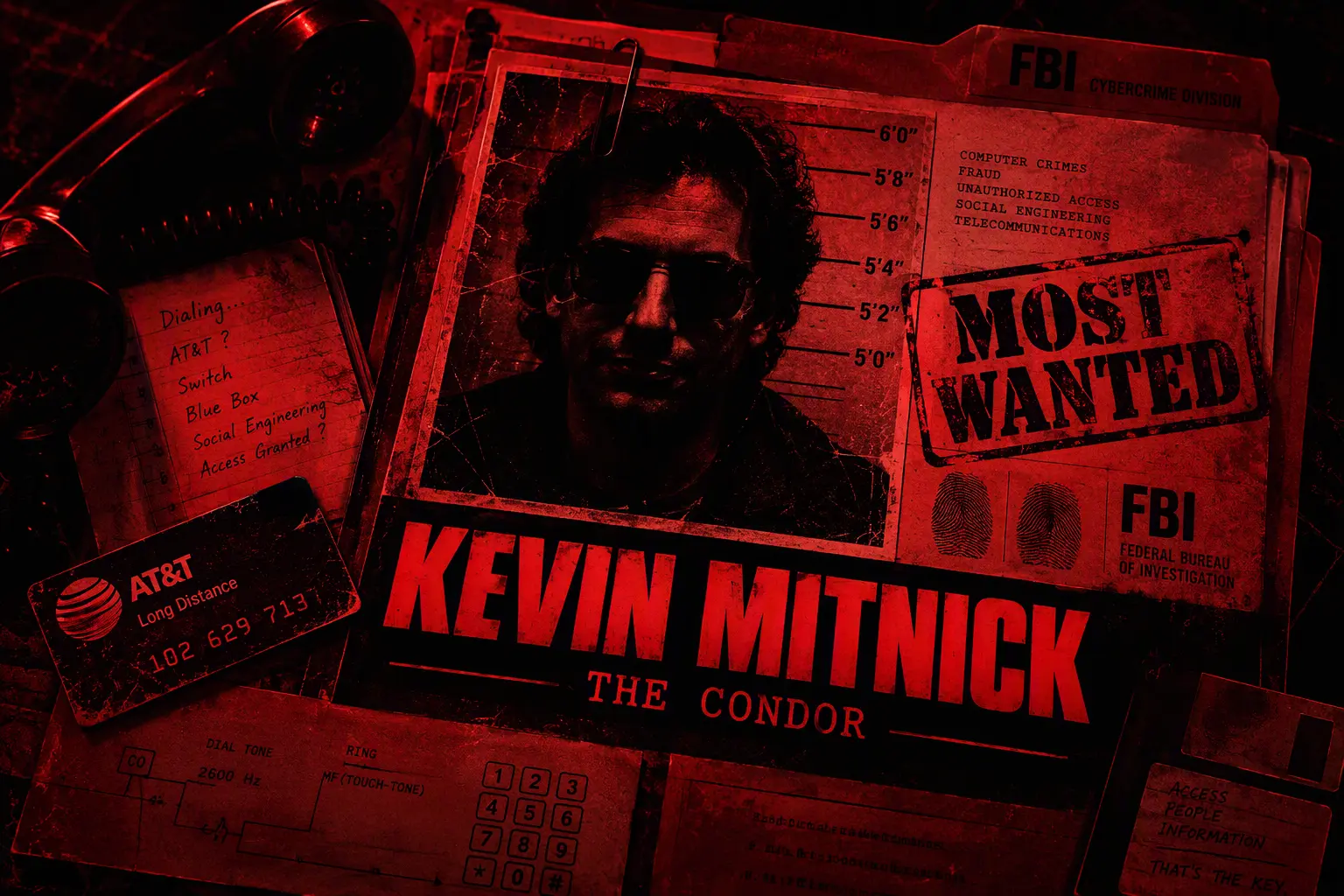
Kevin David Mitnick, known as The Condor and The Darkside Hacker, was one of the most famous hackers: social engineering, arrest, career, and death in 2023.
- Posted on 2026-10-07
- Reading time: 6 min
Kevin Mitnick: Who He Was, What He Did, and His Story #
Kevin David Mitnick was, for much of the 90s, one of America's most wanted hackers—a name the news used as a synonym for "cyber threat" before most people had even used the internet. But his most effective weapon wasn't code: it was the ability to convince someone on the phone to do what he wanted. His notoriety helped bring social engineering to the forefront of the cybersecurity conversation, demonstrating how the human factor could be exploited even when technical systems were well protected.
In short: Kevin Mitnick (1963-2023) was one of the most notorious hackers in the United States in the 90s, arrested in 1995 after a nearly three-year escape. After prison, he became one of the most sought-after computer security consultants in the world, specializing in the very social engineering that had made him famous.
What Kevin Mitnick Did #
In short, before getting to the details: Mitnick practiced phone phreaking as a teenager, hacked into telephone company networks and later the systems of major technology companies (DEC, Motorola, Nokia, Sun Microsystems) by copying their source code, used false identities to remain a fugitive for nearly three years, and relied primarily on social engineering—manipulating people, not just systems—as his signature technique. After prison, he put those same skills to work in corporate security, serving as a consultant and trainer.
Timeline #
| Year | Event |
|---|---|
| 1963 | Born in Van Nuys, California |
| 1980 | First arrest, at 17 years old |
| 1988 | One-year sentence for intrusion into DEC systems |
| 1992 | He goes on the run after his access to Pacific Bell's voicemail was discovered. |
| 1994 | Hack Tsutomu Shimomura's systems, triggering the hunt that will lead to his capture |
| 1995 | Arrested on February 15 in Raleigh, North Carolina |
| 2000 | Released from prison after nearly five years in custody |
| 2011 | Become Chief Hacking Officer of KnowBe4 |
| 2023 | He died on July 16, at the age of 59 |
The Beginnings: From Phone Phreak to “Condor” #
Kevin David Mitnick was born on August 6, 1963, in Van Nuys, California. As a teenager, he became involved in phone phreaking —the practice of manipulating telephone networks to obtain free calls or access restricted systems—with a circle of enthusiasts who gathered more for the intellectual challenge than for real financial gain. He was arrested for the first time in 1980, at just seventeen, for hacking into telephone network systems. The nickname that would follow him for years, "Condor," was inspired by a movie— Three Days of the Condor —that Mitnick loved.
In the years that followed, his reach expanded far beyond telephone companies: DEC (Digital Equipment Corporation), where he copied the source code of the VMS operating system, earned him his first real conviction, a year in prison in 1988. From then on, Mitnick hacked the systems of dozens of major technology companies—Motorola, Nokia, Sun Microsystems, among others—almost always without a financial motive: he was looking for access, the source code, and proof of his ability, not direct profit.
The Escape and the Fatal Error #
While still on parole after his 1988 conviction, authorities discovered that Mitnick had hacked into Pacific Bell's answering machine—which he used, among other things, to listen in on the communications of investigators monitoring him. Rather than risk re-arrest, Mitnick disappeared. For nearly three years, he lived under an assumed identity, moving between cities across the country, always one step ahead of the authorities.
The fatal mistake came on Christmas Day 1994: Mitnick hacked into the systems of security researcher Tsutomu Shimomura , one of the few experts in the world with the expertise and determination to actually hunt him down. Shimomura took the situation personally, and used his technical expertise to track Mitnick through the cellular network—analyzing cell tower signals until he narrowed the search to a single apartment.
The Arrest and the Trial #
Mitnick was arrested on February 15, 1995, in Raleigh, North Carolina. The ensuing trial was as controversial as his escape: prosecutors convinced a judge that Mitnick posed enough of a risk to warrant eight months of solitary confinement while awaiting trial, arguing—as Mitnick himself later stated publicly—that he could trigger a nuclear attack simply by whistling into a payphone connected to military systems. This claim had no technical basis, but it effectively painted Mitnick as an almost mythological threat in the eyes of the public at the time. The case dragged on for years before Mitnick pleaded guilty, ultimately resulting in a 46-month prison sentence; including his lengthy pretrial detention, he remained in custody for nearly five years, until his release in January 2000, with severe restrictions on his use of computers and telephones for the next three years.
After Prison: From Wanted to Consultant #
After serving his sentence, Mitnick did what very few former hackers of his caliber had ever managed: he turned his notoriety into a legitimate career. He founded Mitnick Security Consulting , a penetration testing and security training company, and later became Chief Hacking Officer of KnowBe4 , a platform specializing in anti-phishing and anti-social engineering training—the same ground on which he had built his reputation as a wanted man. He lectured around the world, often demonstrating live how easy it was to manipulate a person into obtaining information that no firewall could ever protect. He died on July 16, 2023, at the age of 59, from complications related to pancreatic cancer diagnosed about a year earlier.
Kevin Mitnick's Books #
After prison, Mitnick wrote several books that became benchmarks in their field. The Art of Deception (2002) is the best known: a social engineering manual built around realistic manipulation scenarios, it has become almost required reading for those working in corporate security. This was followed by The Art of Intrusion (2005), a collection of real-life intrusion cases recounted by the attackers themselves, and Ghost in the Wires (2011), his autobiography—a first-person account of the escape and hunt that made him famous, and probably the best starting point for those who want his version of events rather than the one portrayed by the media at the time.
Kevin Mitnick at the Movies: Myth vs. Reality #
Mitnick's fame transcended the world of computer security long before he told his own story. The film WarGames (1983)—a teenager who accidentally hacks into NORAD systems and nearly triggers a nuclear war—was born from the legend, never confirmed and always denied by Mitnick, that he had hacked NORAD systems as a boy. More directly related to him is Takedown (2000, also released as Track Down ), based on the book written by Shimomura and journalist John Markoff about his capture: the film went so far as to show Mitnick hacking into NORAD and the NSA, incidents that never happened, and was harshly criticized—by Mitnick himself and much of the hacker community—for dramatizing and exaggerating the true facts. The community responded in 2001 with Freedom Downtime , an independent documentary explicitly designed to debunk Takedown 's fabrications and tell a more faithful version of the story.
Why His Story Still Matters Today #
The most important point of Mitnick's story isn't his escape or arrest: it's that his method—manipulating people instead of machines—is still the most widely used attack vector in the world today. Every successful phishing scam , every call to a fake tech support team, every email exploiting urgency or perceived authority to obtain a password is a direct descendant of techniques Mitnick used in the 80s, when firewalls as we know them today didn't even exist. The lesson he left, for criminals and defenders alike, is that the most vulnerable system in any network remains the person working behind it—a lesson different from that of Gary McKinnon and Jonathan James , who exploited purely technical weaknesses, or a collective like Anonymous , where there isn't even a single person to manipulate or frame.
FAQ #
Who was Kevin Mitnick? An American hacker who became the most wanted man in the United States in the 90s, arrested in 1995 after nearly three years on the run, he later became one of the world's most renowned cybersecurity consultants.
What did Kevin Mitnick hack? Telephone systems, technology companies like DEC, Motorola, Nokia, and Sun Microsystems, almost always to gain access to source code rather than for direct financial gain.
How was Kevin Mitnick caught? After hacking into researcher Tsutomu Shimomura's systems in December 1994, he was tracked down through cellular signal analysis and arrested by the FBI on February 15, 1995, in Raleigh, North Carolina.
How long did Kevin Mitnick spend in prison? He was sentenced to 46 months after a plea bargain, but including extensive pretrial detention (including eight months in solitary confinement), he spent nearly five years in total, until his release in 2000.
What did Kevin Mitnick do after prison? He founded a cybersecurity firm, Mitnick Security Consulting, became Chief Hacking Officer of KnowBe4, wrote several books on social engineering, and lectured around the world until his death in 2023.
When was Kevin Mitnick born? August 6, 1963, in Van Nuys, California.
When did Kevin Mitnick die? July 16, 2023, at age 59.
How did Kevin Mitnick die? From complications related to pancreatic cancer, diagnosed about a year before his death. He was being treated at the University of Pittsburgh Medical Center.
Is Kevin Mitnick still alive? No, he died on July 16, 2023, from complications related to pancreatic cancer diagnosed about a year earlier.
Why was Kevin Mitnick so famous? Because he was the first hacker to become a public figure recognized far beyond the tech world—thanks to a nearly three-year escape from the FBI and media coverage that transformed him into an almost mythological threat, fueled by movies like Takedown that exaggerated his true abilities.