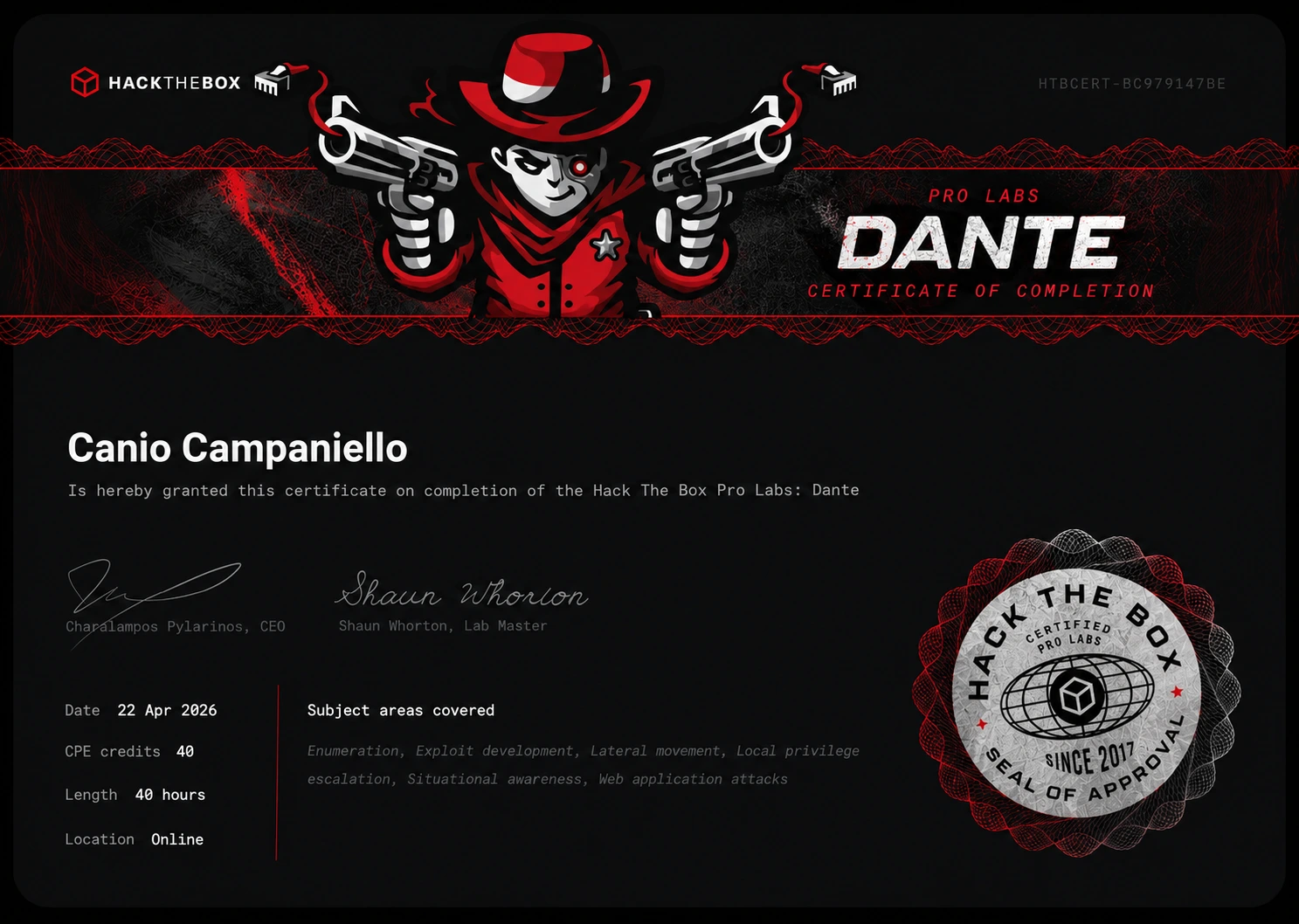
HTB ProLab Dante: Full Review 2026 – Is It Worth It?

HTB ProLab Dante review: lab structure, strengths of pivoting, real-world issues with older OSes and unintended CVEs. Who really needs it and when to skip it.
- Posted on 2026-06-02
- Reading time: 6 min
HTB ProLab Dante – Full Review: Is It Really Worth It? #
If you're looking for your first ProLab on Hack The Box, the answer you'll find everywhere is always the same: "Start with Dante." True, but is all that glitters gold? In this review, I'll tell you exactly what to expect—no filters, no hype.
Lab Structure #
Dante is HTB's entry-level ProLab, classified as Penetration Tester Level I. It simulates a fictional corporate infrastructure with Windows and Linux machines distributed across multiple segmented subnets , reachable only via progressive pivoting from a single entry point.
The numbers:
- 14 machines (Windows/Linux mix, ~7 Linux and ~6 Windows)
- 27 flags format
DANTE{...} - Multiple internal subnets not directly accessible from the VPN
- Access $49/month (flat subscription that includes all active ProLabs)
The Main Problem: Systems Aging #
Let's start with the sore point, because it's the one that changes everything else.
The Windows servers in Dante are all unpatched Windows Server 2012 R2. This isn't an estimate—it's the reality confirmed by those who ran the lab. The result is that CVEs published in the years following the lab's creation allow machines to be compromised, completely bypassing the challenges the designers had in mind.
Concrete example: on at least one machine, the intended path was to escalate privilege via a custom binary to be reversed or debugged. In practice? Just run getsystem From Meterpreter, you're up and running in two seconds. The old OS gives away permissions without you having to figure anything out.
On Linux, things are even worse. Nearly all of the lab's Linux machines are vulnerable to CVE-2021-3560 (Polkit Privilege Escalation). A tool like Traitor automatically identifies and exploits this and other OS aging vulnerabilities. This means that on many targets, the only real challenge is initial foothold—privilege escalation is automatic.
This is Dante's structural flaw: it's not that it became easy because it was better understood, it's that it became easy because time broke the challenges from the outside.
How to Approach the Lab: Methodology and Tools #
Before getting into the technical details, it's worth talking about how Dante actually works—because method is as important as skill.
Initial enumeration #
The entry point is a single exposed subnet. From there, you need to discover everything. The tools that work best in this context:
RustScan for initial port scanning: It's much faster than nmap on multi-host networks and gives you a quick overview of what's running where. Then you switch to nmap for details on specific ports.
Nuclei with updated templates: On older machines like Dante's, a Nuclei scan sometimes returns direct hits on CVEs with public exploits. This isn't a coincidence—it's exactly the aging we were talking about.
Gobuster with SecLists' raft wordlists: Dante's web surface is vast. Directory busting on every machine that exposes HTTP is mandatory, not optional. Many footholds pass through there.
Credential Management #
This is one of Dante's core mechanisms that almost no review explains well: credential reuse is ubiquitous . Every username/password pair you find on one machine must be tested on all the others. Immediately. Before moving on.
NetExec (formerly CrackMapExec) is the tool for doing this systematically—spraying over SMB, WinRM, and SSH across the entire reachable subnet. With admin credentials, you gain access to SMB shares with additional loot or direct lateral movement.
A concrete warning: always check the lockout policy before spraying . In Dante, there are AD environments with lockout configured. Accidentally unlocking accounts during the lab is an effective way to lock yourself out of critical paths.
Note-taking: Not optional #
Three hops deep, with different credentials for each machine and multiple open subnets, without documentation you're already lost . It's not a matter of style—it's a matter of lab survival.
The bare minimum for any compromised machine:
- IP and hostname
- Credentials found (user, password, hash)
- Exposed services and doors
- Subnets reachable from that pivot
- Active tunnels (tool, local port, remote port)
Obsidian and CherryTree are both good. Even a simple markdown file works. The key is to have everything in one place, updated in real time—when a tunnel goes down at 2 AM and you have to rebuild the chain, notes are the only thing that saves you.
The Real Strength: Pivoting #
Here Dante shines and there is no discussion.
If you're coming from single-box HTBs, this is your first real-world experience with multi-level segmented networks. You're not learning pivoting in theory—you're building real tunnel chains across multiple hops, managing instability, and rebuilding connections when they fail.
The tools you will actually use:
- Chisel —TCP/UDP tunnel over HTTP, useful when SSH is blocked but HTTP passes through. It becomes inconvenient on deep pivots because it introduces lag and instability, especially if you run it through a Meterpreter.
- SSH port forwarding — when SSH is available, it remains the most stable choice
- sshuttle — convenient for transparent routing, but wants SSH on the pivot
- Metasploit SOCKS proxy — useful for integrating routing with MSF exploits, but adds overhead
- Ligolo-ng — if you don't know it yet, it's probably the most convenient tool for Dante: it creates a real TUN interface instead of relying on SOCKS, which means you can use nmap directly without proxychains
For a practical guide on Chisel and when to use it versus Ligolo, read Chisel: TCP Tunneling over HTTP for Pivoting and Post-Exploitation on HackIta.
The critical point that many overlook: a Meterpreter routing through a Chisel tunnel is slow and unstable . If you want to use MSF on internal machines, you need to manage the chain well or you'll end up with sessions that die at the wrong time.
Drawing a real-time network diagram—even just on paper or in Draw.io—is not optional in Dante. At three pivot levels, without a visual map, you're already lost.
Active Directory: It's There, But It's Not the Focus #
Dante's AD component is real but limited. It features enumeration with BloodHound, classic misconfigurations to exploit, and credential spraying over SMB and WinRM via NetExec. The domain is present and functional, and compromising the Domain Controller requires going through multiple intermediate machines—which means AD is organically intertwined with pivoting.
BloodHound is useful, but it doesn't give you everything at a glance: you still need to understand what you're looking at and how to connect the nodes. If you've never used BloodHound on a real domain, here's some hands-on practice in a fairly guided context.
What you won't find: Advanced Kerberoasting, ACL abuse, RBCD, cross-domain attacks, delegation chains. That's the province of Zephyr and Offshore—completely different levels of AD complexity.
Web Application Attacks and Exploit Development #
The web side is the primary attack surface for initial footholds on many machines. The vectors you encounter are classic but varied: SQLi, RCE via file upload, applications with weak authentication, hidden virtual hosts that can't be detected without aggressive directory busting. Burp Suite is useful but not essential for everything—many footholds can be created manually once the pattern is understood.
One thing to note: some machines expose services on non-standard ports . If your initial scan is lazy and only covers the top 1000 ports, you'll miss out. A full scan of all ports on every target, always.
About buffer overflows : Both Windows and Linux have them, but at a basic level—vanilla stack overflow without stack canaries, without meaningful ASLR, without SEH. The learning value is there if you've never written shellcode from scratch or calculated an offset by hand. If you've already done the old-school OSCP BoF module, you won't learn anything new here. If you're aiming for OSED, this won't prepare you at all.
Stability, Time and Expectations #
A real problem you almost never find mentioned in positive reviews: connection stability isn't always reliable . Tunnels crash, machines respond poorly after a reset, pivots stop working for no obvious reason.
It's not a constant, but it happens enough to be part of the experience. And when you're three hops deep and the chain collapses, rebuilding everything without detailed notes is a disaster.
About time: Those who complete Dante in a week usually do so with a solid, established method. Those who are new to the game take 3-4 weeks. This isn't a measure of skill—it's simply that the lab requires exploration, and exploration takes time. There's no linear kill chain to follow: you only find some machines when you've compromised another one that reveals them. This is one of the most realistic aspects of the lab.
Who Needs Dante? #
It does it for you if:
- You already have a few HTB or TryHackMe boxes under your belt and want to switch to a network
- You are preparing OSCP, eCPPT or eJPT and want concrete practice on pivoting and methodology
- You have never managed a multi-host segmented network on your own
- You want to build the habit of documenting and working on multiple targets in parallel
You don't need it if:
- You already have solid experience on AD — Zephyr or Offshore give you a clear leap in quality
- Looking for serious exploit development?
- You are already OSCP and are aiming for OSCE3
- You want an environment with OPSEC, AV evasion and real detection
The verdict #
Dante is a good first ProLab. But its online reputation is inflated compared to what it actually offers in 2025.
The real value is in the pivoting : you leave with the ability to manage segmented networks, tunnel chains, and an orderly workflow. If you arrive without ever pivoting to multi-subnet networks, that leap alone is worth the price of a month.
The problem is that aging systems have destroyed some of the original educational value. Privesc challenges that were supposed to teach you something are solved with public CVEs and automated tools. HTB hasn't updated the machines, and it shows.
| Categories | Vote |
|---|---|
| Pivoting and networking | ★ ★ ★ ★ ★ |
| Active Directory | ★★★ ☆☆ |
| Exploit development | ★★☆☆☆ |
| Realism of the environment | ★★★ ☆☆ |
| Prep certification value | ★★★★ ☆ |
| Value for money | ★★★★ ☆ |
Overall rating: 7/10
Essential for beginners. Optional for those who already have the basics. If you already know what you're doing, consider Zephyr directly—the leap is clear and prepares you for much more realistic terrain.
Have you already completed Dante and want to know the next step in the OSCP → OSCE3 journey? Read our walkthroughs and discover the best VMs in order of difficulty.