Hacker: Meaning, Types (White Hat, Black Hat), and Cracker

What is a hacker, the difference between a cracker and an ethical hacker, the types (white, black, grey hat), when hacking is a crime, and how to become an ethical hacker.
- Posted on 2026-09-18
- Reading time: 8 min
Hacker: What It Is, Types of Hackers, and How to Become an Ethical Hacker #
In the movies, a hacker types in a burst for thirty seconds and hacks every system in the world. In reality, a hacker is simply someone who thoroughly studies the workings of computer systems, networks, and software to find their limitations—often beyond what their designers intended. The term itself doesn't imply anything illegal: it describes a technical skill, not a crime. It's how it's used that determines whether the person behind it is a security professional or a cybercriminal, and it's precisely this ambiguity that generates most of the confusion surrounding the word—the same ambiguity found in its Italian synonyms, pirata informatico and hacker informatico.
Hacker: The Original Meaning #
The term originated in the 60s in the MIT laboratories, where it referred to someone who found creative and non-obvious solutions to technical problems—a “hack” was an ingenious idea, not an attack. The Jargon File , the historical dictionary of hacker slang maintained by the technical community since the 70s, still records this original meaning as the first and most authentic, relegating the meaning of “computer criminal” to a “deprecated” usage, so the correct term would still be cracker. Only later, with the spread of the first unauthorized access to computer systems in the 80s, did the media begin to use “hacker” as a synonym for computer criminal, a definition that remains contested in the technical community to this day.
From here, the community itself felt the need to distinguish different roles — starting from a division older than the “hat” terminology we see today: that between hackers and crackers.
Hacker vs. Cracker: The Difference That Matters #
In the original technical jargon, a hacker is someone who explores and understands systems out of curiosity or to improve them; a cracker is someone who uses the same skills to violate other people's systems without authorization. It's a historic term, born in the same community that coined "hacker" to mark the distinction—today, in professional cybersecurity, it's more common to talk about a black hat , or simply a cybercriminal in journalistic parlance, even if the three terms aren't perfectly interchangeable. For a full discussion: White Hat, Black Hat, and Grey Hat: The Differences.
That binary distinction, however, is too simple to truly describe those who work in the sector today. Over time, nuances have been added, each with its own "color."
Types of Hackers #
In summary, before looking at them one by one:
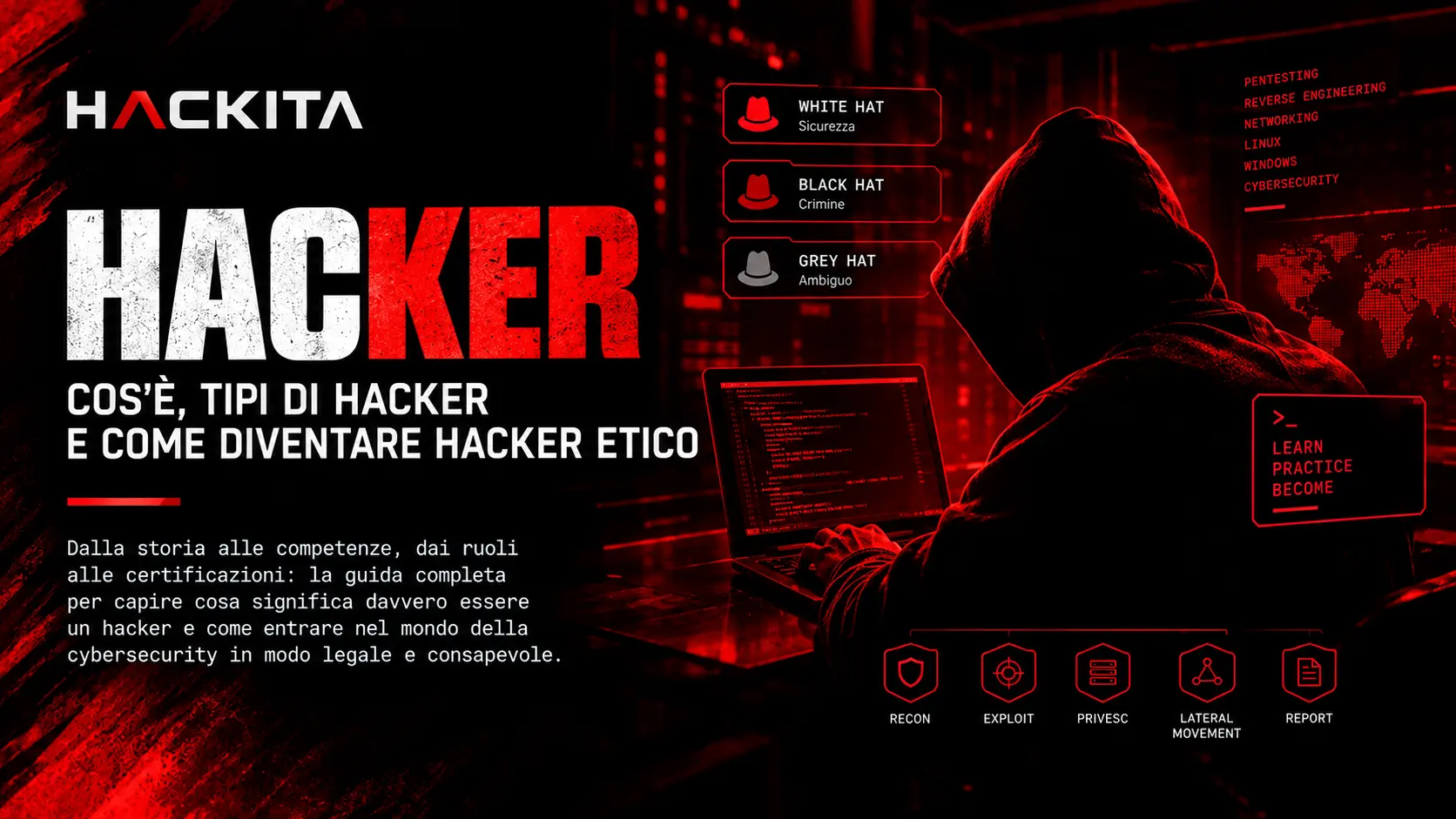
- White Hat (ethical hacker) — always operates with explicit authorization, to improve security
- Black Hat — accesses without authorization for profit or harm, often through virus or ransomware; in Italy it can integrate the crime of unauthorised access to a computer system (art. 615-ter cp), to which other offences can be added depending on what is done once inside
- Gray Hat — ambiguous middle ground, acting without permission but without malicious intent; however, the absence of malicious intent does not equate to having authorization, and legality still depends on the jurisdiction.
- Blue Hat, script kiddie, hacktivist, state-sponsored — minor categories that use different criteria (invitation, competence, motivation, affiliation) rather than a common authorization scale, and are not standardized terminologies at the same level as White/Black/Grey Hat
| Type | Authorization | Target | Typical activity |
|---|---|---|---|
| White Hat | Yes | Improve security | Penetration testing, security assessment |
| Black Hat | No | Profit or loss | Data theft, ransomware, fraud |
| Gray Hat | Ambiguous | Search not requested | Unauthorized vulnerability research |
Roles like red teamer and bug bounty hunter are not just other “colors”: they are professions that fall within the white hat category, with different objectives—we'll discuss these in more detail later.
For a complete discussion, with examples and legal nuances of each category: White Hat, Black Hat, and Grey Hat: The Differences.
Knowing the "color" of a permit holder isn't enough, however, to understand what they actually do at work: professional titles multiply here, and it's worth distinguishing them.
Ethical Hacker, Penetration Tester, Red Teamer: Different Roles #
The terms overlap in common parlance but indicate distinct roles—an ethical hacker can work as a penetration tester, red teamer, bug bounty hunter, or security researcher depending on the objective of the assignment. The full picture, with the differences between each role, can be found in: Ethical Hacker: What It Is and What It Does.
Regardless of the specific label, the typical day of someone working in this field is very similar.
What a (Professional) Hacker Really Does #
The day-to-day work of an ethical hacker is less cinematic than the word suggests. In practice: enumerating exposed systems and services with tools like Nmap , searching for known misconfigurations and vulnerabilities, developing or adapting exploits, privilege escalation , lateral movement—often within an Active Directory domain —and, finally, a detailed report detailing the impact and recommendations for the client. The writing and communication part often takes up more time than the actual "offensive" part.
The skills you really need: networks (TCP/IP, protocols), operating systems (Windows and Linux in depth), at least one scripting language (Python is the standard), programming fundamentals to understand the code you're attacking, and—often underestimated—the ability to write clear reports for a non-technical audience.
If all of this—finding vulnerabilities, exploiting them in a controlled way, documenting them—sounds like something you’d like to do for a living, the natural question is where to start.
How to Become an Ethical Hacker #
The most common path starts with the basics (networks, operating systems, a scripting language), moves on to practical training in legal environments like HackTheBox or TryHackMe, and leads to a recognized practical certification—OSCP, CRTO, and CPTS above all—and consolidates with a specialization ( web application security , Active Directory , mobile, cloud). A specific degree isn't necessary: demonstrable skills count, and a practical certification or a CTF writeup carries more weight than a generic degree.
The complete step-by-step guide, with the certification table, realistic timeframes and the most common mistakes to avoid: How to Become an Ethical Hacker: The Practical Guide.
If you prefer a guided path rather than navigating courses and certifications on your own, Hackita also offers study materials, support, and one-on-one training—including video calls—for those who want to get serious about ethical hacking: write to info@hackita.it or use the contact form at the bottom of this page.
If you want to get a practical idea of what it really means to “hack” a system, take a look at Hackita's walkthroughs : they are guided, step-by-step simulations of how to compromise a machine in legal environments like HackTheBox.
There is, however, a prerequisite that comes before any technical expertise, and it is the one that truly makes the difference between a career and a complaint.
Ethical Hacker: Is It a Legal Job? #
Yes, but good faith isn't enough: written authorization and a defined scope (what can and cannot be tested, and within what timeframe) are the elements that distinguish an authorized test from unauthorized access. The exact legal assessment, however, depends on the specific circumstances and applicable law. Without this document, even testing a site's security with the best intentions can constitute unauthorized access to a computer system: the legal risk exists regardless of the stated intentions.
A concrete case in which this boundary is crossed more often than one might think—almost always out of simple curiosity, not actual criminal intent—concerns home Wi-Fi.
Wifi Hacking: Why Cracking Someone's Password Is a Crime #
One of the most common searches related to the term is "WiFi hacker"—in most cases, it's driven by curiosity about how secure your own network is, not the intent to compromise someone else's. It's worth being clear about this: accessing a neighbor's or business's Wi-Fi network without permission falls under the same crime of unauthorized access to a computer system as described above, regardless of the technique used or whether the password is weak. Understanding how these techniques actually work is still useful—it's the only way to recognize them and defend yourself, not just with words.
Evil Twin: The Cloned Wifi Network #
Simply put: you create a fake WiFi network with the exact same name as the real one—the WiFi of a bar or a hotel—with a small device that functions as an access point. Then you bring down the real one, forcibly "disconnecting" everyone with an attack called deauthentication, which can be repeated continuously. The victim's phone or PC, no longer seeing the original network but seeing the copy with the same name, reconnects automatically, perhaps prompting them to re-enter their password, thinking it's a temporary glitch. At that point, whoever created the trap sees that password, or—if the fake network is open without a password—sees all the unencrypted traffic of anyone who connected to it. Tools like Wifiphisher automate the entire process: they create the fake network, bring down the real one, and even display a fake login page identical to the real provider's. This is precisely why a VPN active on public networks isn't a precaution for paranoid people: it makes traffic unreadable even if, unknowingly, you've connected to a cloned network.
Cracking a WPA2 Password: The Mechanism #
The other approach targets the password directly, exploiting a specific moment: when a device connects to the router, the two exchange a data packet called a handshake , which contains encrypted proof of the shared password. Hackers capture that exchange with a Wi-Fi adapter in monitor mode and a tool like aircrack-ng —sometimes forcing a reconnection with a deauthentication attack, which briefly disconnects a connected device, forcing it to repeat the handshake from the beginning. However, the captured file does not contain the cleartext password: it must be tested offline, attempting millions of combinations with a dictionary of common passwords or brute-force, often with hashcat and the processing power of a video card. The time required varies from a few minutes if the password is weak or common, to virtually never with a long, random passphrase: it is almost always the password chosen that makes the difference, not the attacker's skill. Suites like Wifite encapsulate the entire process—deauthentication, capture, dictionary attack—in a single command, but none of this circumvents the above crime unless the target is a proprietary or lab network.
The historical weakness has been WPS (Wi-Fi Protected Setup): its 8-digit PIN, due to a design flaw, can be reduced to two halves that can be attacked separately via brute force, making it crackable in a matter of hours even with modest hardware. WPA3 , the current standard, blocks most of these vectors thanks to the SAE protocol, which makes capturing the handshake unnecessary for an offline attack.
For those who simply want to protect their network, there are few concrete countermeasures that are well-known: disable WPS from the router control panel, use WPA3 if the device supports it (WPA2 with a long, random passphrase otherwise), and change the router's administration credentials from the default values — the most exploited vector by far is never WiFi encryption, but a management panel still protected by "admin/admin."
FAQ #
Who is a hacker? It's not (just) the hooded guy staring at lines of green code you see in movies: it's anyone with advanced technical skills in systems, networks, and software, regardless of how they use them. The "bad guy" is just one possibility.
What is a hacker? The term indicates a technical skill, not a fixed role: it describes someone who can understand and manipulate a computer system beyond its intended use. Their status as "good" or "bad" depends solely on intent and authorization.
What does a hacker do? It depends on the "hat" they wear. A white hat enumerates systems, searches for vulnerabilities, and reports them for fixes; a black hat exploits the exact same vulnerabilities to steal data or money. The technique is often identical—only the permissions vary.
What's the difference between hacker and hacking? A hacker is a person; hacking is the practice, the set of techniques that person uses. Just like "hacker," "hacking" is neutral unless the context is specified: it can refer to an authorized penetration test or a criminal attack.
What does it mean to be hacked? It means that a system, account, or device for which you are responsible has been compromised through unauthorized access—the practical consequence of the work of a black hat or cracker, seen from the perspective of the victim.
What's the difference between a hacker and a cracker? In the original technical jargon, a hacker explores and understands, while a cracker violates without permission to harm or profit. In everyday language, the two terms have merged.
What does hacking mean? Accessing or manipulating a computer system by exploiting a vulnerability. It can be legal (in an authorized penetration test) or illegal (unauthorized access), depending solely on the authorization.
Can you become a hacker without a degree? Yes. The industry values demonstrable skills—practical certifications like OSCP, CTF writeups, an active HackTheBox profile—more than academic training.
What's the most sought-after certification to become an ethical hacker? It depends on the role, experience, and target market rather than a single universal standard: CEH is the most popular general entry point, while OSCP, CPTS, and CRTO are the most commonly cited practical certifications for operational roles—a complete comparison is in the dedicated guide.
What can a hacker do with my phone number or IP address? A phone number alone primarily allows for social engineering attacks (SIM swapping, targeted phishing via SMS); an IP address provides a rough indication of geographic location and, if the device exposes vulnerable services to the outside world, a starting point for scanning. But neither data alone provides direct access to an updated and properly configured device.
How much does an ethical hacker earn? In Italy, to give real numbers rather than a vague answer: a junior hacker averages €25.000-35.000 gross annually, rising to €40.000-55.000 with a few years of experience, while a senior with practical certifications (OSCP, CRTO, CPTS) often exceeds €60.000-70.000, with higher peaks as a consultant or freelancer. Those working alongside bug bounty programs can add thousands more per year, even if it's not a continuous income. Abroad (USA, UK, Germany), the figures are generally higher for the same experience.
Can a white hat get into legal trouble? Yes, if they go outside the authorized scope or don't comply with the agreed-upon conditions—authorization only covers what's written, not every action taken during the assignment.