The 10 Most Famous and Powerful Hackers in the World (2026 Guide)

Who are the 10 most famous and powerful hackers in history? From Kevin Mitnick to Anonymous: true stories, famous attacks, secrets and curiosities, and what they do today.
- Posted on 2026-10-04
- Reading time: 6 min
True Stories of the 10 Strongest Hackers of All Time #
From the 80s to today, certain names have defined the collective imagination of hacking: teenagers who hacked telephone networks for fun, masterminds of credit card heists worth hundreds of millions of dollars, faceless gangs, and even a researcher who accidentally stopped one of the most destructive ransomware attacks in history. Their stories tell the evolution of hacking better than any technical definition: from the phone phreaking of the 80s to today's organized cybercrime.
1. Kevin Mitnick: The Condor #
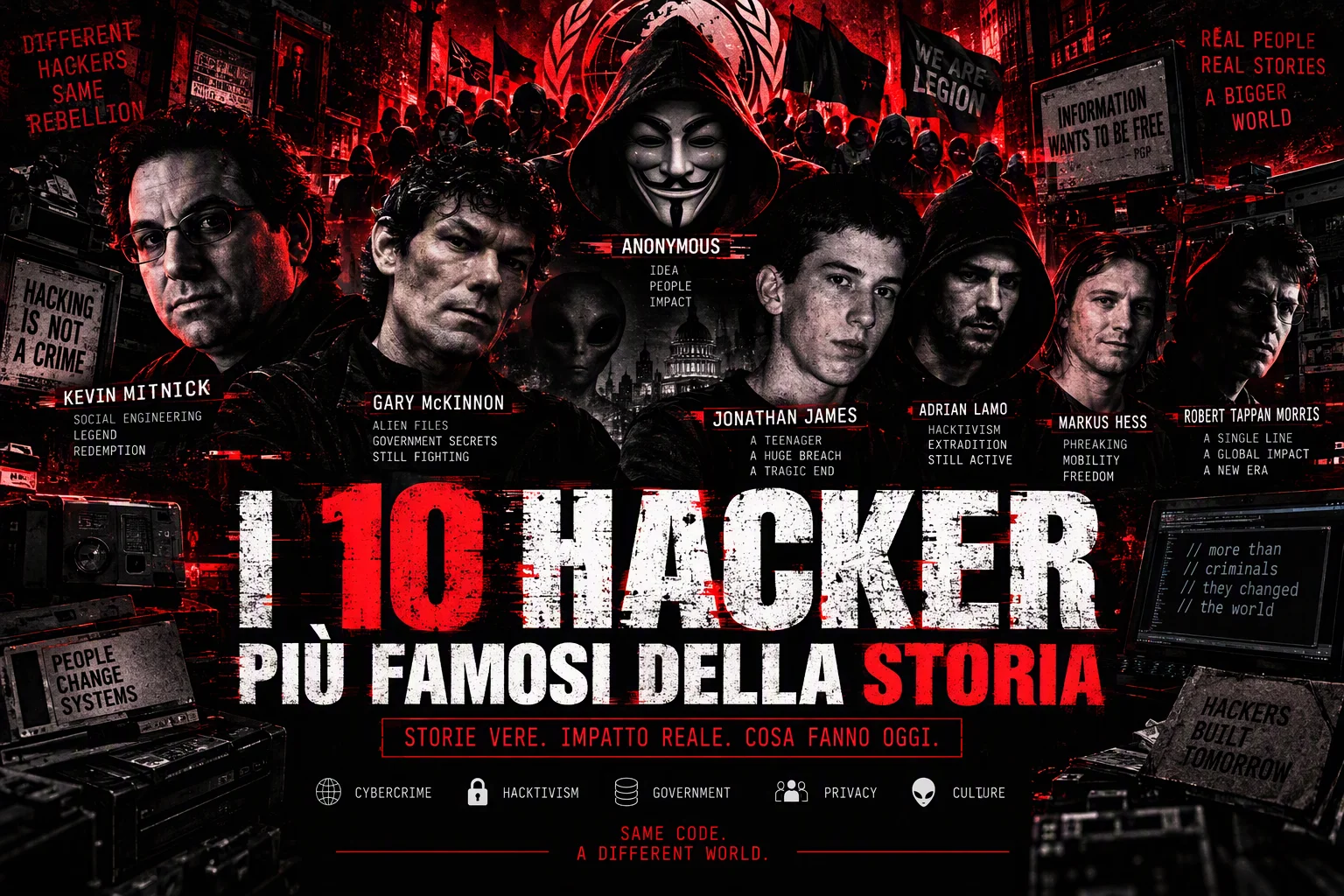
Kevin Mitnick (1963–2023) is probably the most famous name in the history of hacking. In the 80s and 90s, he breached the networks of companies like Motorola, Nokia, and Pacific Bell, relying more on social engineering than sophisticated technical exploits: persuading a person to reveal a password often worked better than any vulnerability. In 1995, the FBI designated him the most wanted cybercriminal in the United States. After five years in prison, Mitnick reinvented himself as a security consultant, author of several books, and founder of his own security company, becoming one of the most cited examples of the shift from offensive to defensive. He died in 2023. We have dedicated a comprehensive feature to Kevin Mitnick.
2. Kevin Poulsen: Dark Dante #
Kevin Poulsen , known by the pseudonym “Dark Dante,” rose to fame in 1990 by hacking the phone lines of a Los Angeles radio station to ensure he was the 102nd caller in a contest, thus winning a Porsche 944 S2. An expert in phone phreaking (the manipulation of telephone systems, a precursor to modern network hacking), he was sentenced to 51 months in prison. After prison, he embarked on a career in investigative journalism and cybersecurity, writing for years for Wired and then for The Daily Beast as a national security correspondent: one of the first examples of a hacker becoming a chronicler of his own world.
3. Adrian Lamo: The Homeless Hacker #
Adrian Lamo (1981–2018), nicknamed "the homeless hacker" for his nomadic lifestyle, became known for hacking into the networks of companies like Microsoft and the New York Times website, often reporting the vulnerabilities himself. He became a controversial figure in 2010 when he reported Chelsea Manning to the authorities after she confided in him that she had provided classified documents to WikiLeaks: a move that drew accusations of treason from one segment of the hacker community and defense from others. He died in 2018 under circumstances that have never been fully clarified publicly.
4. Albert Gonzalez: The Largest Paper Theft in History #
Albert Gonzalez organized what remains one of the largest payment card data thefts ever documented: the attacks against TJX, Heartland Payment Systems, and other retailers between 2005 and 2008, involving over 170 million payment card numbers, according to the indictments and reconstructions at the time. A detail that makes his story particularly complex: for part of that period, he also worked as an informant for the U.S. Secret Service, while simultaneously orchestrating the attacks. He was sentenced to 20 years and one day in prison, one of the harshest sentences ever handed down in the United States for a cybercrime.
5. Gary McKinnon: The Greatest Military Intrusion in History #
Between 2001 and 2002, Gary McKinnon , a Scottish hacker, unauthorizedly hacked into military and NASA systems, allegedly searching for evidence of UFOs and hidden alien technologies. According to the US indictment, 92 computers from the Army, Navy, Air Force, Department of Defense, and NASA were involved, along with six other systems from private organizations. US authorities at the time described it as the largest attack on government military systems ever recorded, a characterization that remains the prosecution's, not an objective fact comparable over time. McKinnon fought a lengthy extradition process from the United Kingdom for years, which was then blocked in 2012 by the British government for humanitarian reasons related to his health. We discuss this in detail in our in-depth feature on Gary McKinnon.
6. Jonathan James: the first juvenile convicted in the USA #
Jonathan James , using the pseudonym “c0mrade,” hacked into NASA and the Department of Defense systems in 1999 at just 15 years old, even downloading the source code for software used on the International Space Station. This forced NASA to temporarily shut down its systems to investigate. In 2000, at 16, he became the first minor in the United States convicted of a cybercrime. His story ended tragically: he took his own life in 2008, at 24, amid further federal investigations against him that he believed were unjust. We explored his story in more detail in our article on Jonathan James.
7. Robert Tappan Morris: The Inadvertent Father of the Modern Worm #
In 1988, Robert Tappan Morris , then a student at Cornell University, released what has become known as the Morris Worm , generally considered the first computer worm to spread widely across the Internet. According to Morris, the purpose was to measure the size of the network, not to cause damage, but a flaw in the replication code caused the worm to repeatedly infect the same machines, slowing down or crashing thousands of computers—a significant portion of the Internet at the time. It was the first case prosecuted under the US Computer Fraud and Abuse Act. Today, Morris is a professor at MIT, where he teaches distributed systems and computer science: another example of a journey from the wrong side of the law to an academic chair.
8. Anonymous: the faceless collective #
Anonymous is not a person but a decentralized collective that emerged in 2003 from the ecosystem of 4chan and other imageboards. It took on a strong hacktivist identity, especially starting in 2008, becoming known globally for campaigns against Scientology, government institutions, corporations, and, more recently, for operations related to geopolitical conflicts. Without a central hierarchy or identity, anyone can act "on behalf of Anonymous," making the collective both powerful and difficult to precisely define: its actions range from relatively harmless digital protests to large-scale intrusions and data leaks. We discuss this in our in-depth look at Anonymous.
9. Marcus Hutchins: The Accidental Hero of WannaCry #
Marcus Hutchins , a British researcher known online as “MalwareTech,” rose to prominence in 2017 for helping slow and disrupt a significant portion of the initial spread of the WannaCry ransomware by identifying and registering a domain that served as a kill switch in the malware’s code. A few months later, he was arrested in the United States; in 2019, he pleaded guilty to creating and distributing the Kronos banking Trojan and the UPAS Kit malware years earlier, as a teenager . He accepted a plea bargain and is now an active and respected security researcher: a story that shows how thin the line can be between past and present, between harm and defense, in the hacker world.
10. Evgeniy Bogachev: The wanted man who was never found #
Unlike many names on this list, Yevgeniy Bogachev has never been caught. Considered by the FBI to be the mastermind behind Zeus and GameOver Zeus , a banking Trojan spread via a botnet with a peer-to-peer command-and-control architecture, which is more difficult to dismantle than traditional botnets with central servers: the FBI estimates over a million infected computers and over $100 million in losses attributable to GameOver Zeus alone. Bogachev has been wanted by the United States since 2014, with a reward of up to $3 million, one of the highest ever offered for a cybercriminal. He is believed to be living in Russia, beyond the reach of US extradition: a reminder of how organized cybercrime can go unpunished when operating from jurisdictions that do not cooperate with international investigations.
What these 10 hackers have to say about the evolution of cybersecurity #
Put together, these ten stories also provide a summary of the evolution of hacking itself:
| Epoca | Dominant technique |
|---|---|
| 80s | Phone phreaking and manipulation of telephone systems |
| 90s | Social engineering and targeted intrusions |
| 2000-2010 | Web hacking, carding, first large-scale botnets |
| 2010-2020 | Hacktivism and increasingly industrialized cybercrime |
| Today | Malware research, ransomware and structured criminal groups |
A few elements recur in almost all the stories: technical curiosity as the initial driving force, often stronger than financial gain (especially in older cases); the young age of many of the perpetrators at the time of the events; and a recurring fork in the road between a criminal career and a career in cybersecurity, with a significant portion of these individuals ending up working, in one way or another, on the defense side. It's the same fork in the road that today takes shape, legally and explicitly, in the journey from hacker to ethical hacker , with the crucial difference of authorization.
Frequently asked questions about the most famous hackers in history #
Who is considered the most famous hacker in history? #
Kevin Mitnick is generally considered the most famous, due to his notoriety in the 90s and his subsequent transformation into an internationally recognized security consultant.
What was the first computer worm in history? #
The Morris Worm, released in 1988 by Robert Tappan Morris, is generally considered the first worm to spread widely on the Internet.
Who is the most wanted cybercriminal still at large? #
Evgeniy Bogachev, believed to be behind the Zeus and GameOver Zeus botnets, has been wanted by the FBI since 2014 and has never been caught.
Are today's most famous hackers all in cybersecurity? #
Many do: Kevin Mitnick, Kevin Poulsen, and Marcus Hutchins are well-known examples of this transition, but it is not a universal rule; some have served long prison sentences, and others have never been caught.
Is Anonymous a single hacker or a group? #
It is a decentralized collective with no fixed hierarchy: anyone can act publicly on its behalf, which makes it difficult to talk about it as a single coherent entity.
What was the largest military intrusion in history? #
Gary McKinnon's attack, between 2001 and 2002, against dozens of computers at NASA and the US Department of Defense, described by the US as the largest attack on government military systems ever recorded up to that time.
Who was the youngest hacker convicted in the United States? #
Jonathan James, sentenced to 15 years in 1999 for hacking into NASA and Department of Defense systems, was the first juvenile convicted of computer crimes in the US.