Flipper Zero: What is it, what is it for, and is it legal in Italy?

Flipper Zero: what it is, how it works, and what it can do with RFID, NFC, Sub-GHz, and BadUSB. Learn about custom firmware and what's legal and illegal in Italy.
- Posted on 2026-10-11
- Reading time: 6 min
Flipper Zero: How It Works and What It Can Really Do #
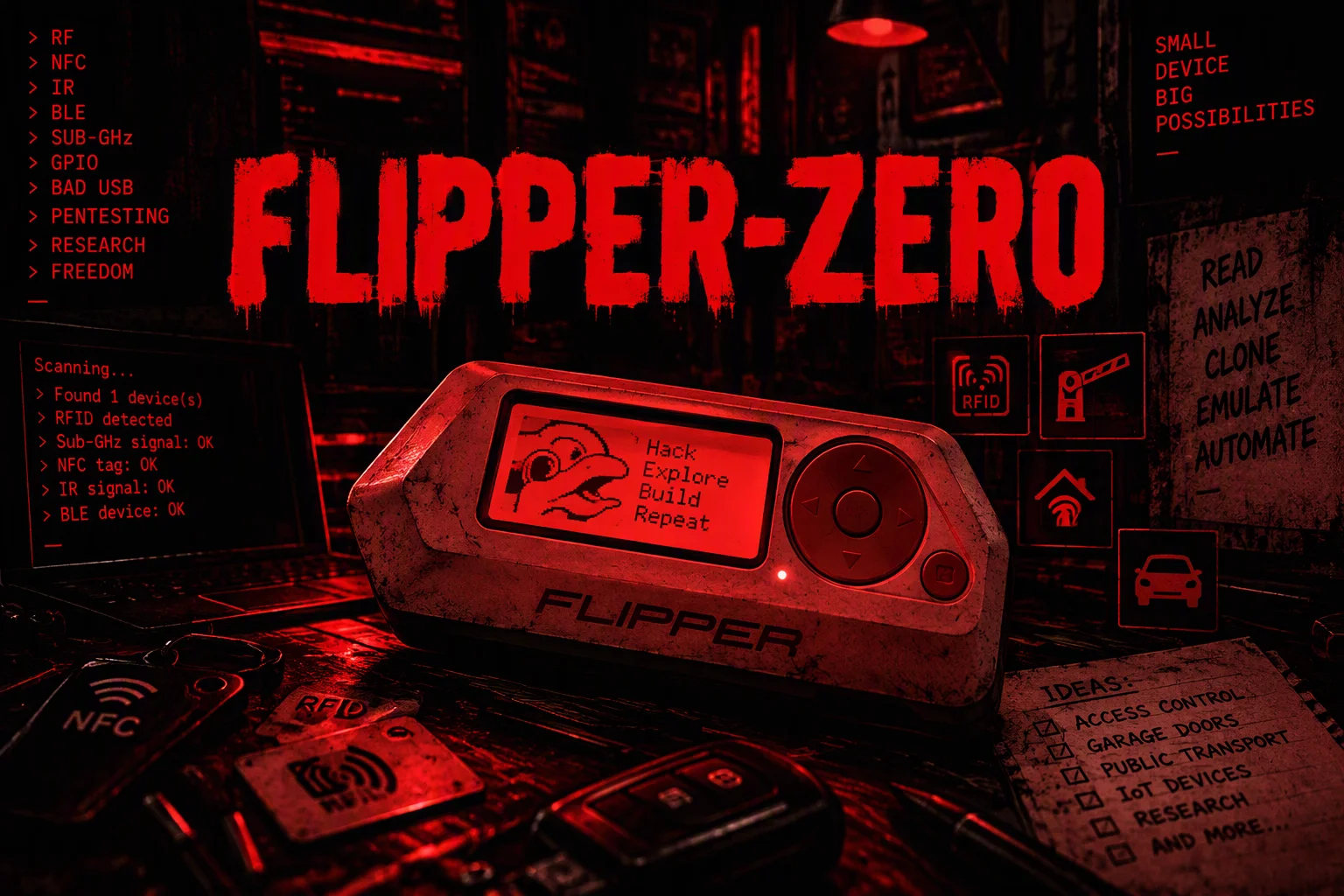
The Flipper Zero is a portable multitool-style device, produced by Flipper Devices , designed to study, read, save, and in some cases play wireless signals and protocols: Sub-GHz , NFC , 125 kHz RFID , infrared , Bluetooth Low Energy , and GPIO . It has gone viral on social media for its ability to “clone” remote controls and cards, but much of what you see online is exaggerated or misunderstood.
It's a legitimate tool for hobbyists, security researchers, and pentesters, with open hardware and open-source firmware. The problem isn't the device itself; it's how and where it's used.
Flipper Zero: What it is: Hardware and Specifications #
The Flipper Zero was born from a 2020 Kickstarter campaign and is sold on the official store (shop.flipper.net) for $169 , plus shipping; price and availability may vary by market and time of year. Inside:
| Components | Function |
|---|---|
| STM32WB55 | Main microcontroller, dual-core, with integrated Bluetooth |
| CC1101 | Sub-GHz Transceiver: Receives in the 300-348, 387-464, and 779-928 MHz bands; transmission is limited to frequencies allowed in the set region |
| ST25R3916 | NFC chip, for tags and cards at 13,56 MHz |
| 125 kHz RFID antenna | For older badges and keys (EM4100, HID, T5577) |
| IR Receiver/Transmitter | Emulate remote controls |
| GPIO pins | Allows you to connect external modules and interact with hardware (UART, SPI, 1-Wire) |
| iButton / 1-Wire | Reads, saves and emulates supported contact keys |
| microSD Slot | Required for full use of the device: not included in the package |
The microSD is not included in the package and is required for full use of the device: many applications, including NFC, RFID, Sub-GHz and BadUSB, use it to save data and databases.
What it's really for: the modules one by one #
Sub-GHz: Gates, Remote Controls, and Sensors #
Flipper listens to the most common frequencies used by remote controls for gates, barriers, car control units, and some wireless sensors. If the protocol doesn't use a code that changes with each use ( rolling code ), it can record the signal and retransmit it. The official firmware recognizes dozens of protocols, but intentionally blocks the replay of known rolling codes used by cars and many modern gates, precisely to limit the most obvious abuses.
NFC and RFID: cards and badges #
The NFC module reads 13,56 MHz tags and cards: transportation passes, hotel keys, company badges, and, to some extent, contactless payment cards (the Flipper reads the data exposed by the protocol; it does not clone a working credit card). The 125 kHz RFID module works with older technologies such as EM4100 and HID Prox, which can often be written to a blank T5577 card.
Infrared #
It works like a universal remote control: it learns and reproduces IR signals from TVs, air conditioners and other infrared devices.
Bluetooth Low Energy #
It can interact with nearby BLE devices. Some demo features (such as spamming BLE notifications to smartphones) have been largely neutralized by recent iOS and Android updates.
GPIO and BadUSB #
The GPIO pins allow you to connect external modules (Wi-Fi cards, additional readers) and use protocols like UART and SPI to interact with electronic boards. BadUSB mode emulates a USB keyboard and automatically types commands when connected to a computer: the same technique used in devices like the Rubber Ducky.
Can Flipper Zero clone cards, badges, and remote controls? #
It depends on the technology. There's no one-size-fits-all answer.
| Subject | Can you read it? | Can you emulate it or write it? |
|---|---|---|
| 125kHz RFID supported (EM4100, HID Prox) | Yes | In many cases, on card T5577 |
| NFC supported (e.g. MIFARE Classic with known key) | Yes | In some cases, it depends on the type of paper |
| Sub-GHz remote controls without rolling code | Yes | Yes, via replay |
| Modern rolling code remote controls | Limited | No, not as a simple replay |
| EMV bank cards | Reads only the data exposed by the protocol | No, not as a functioning payment card |
Even for NFC the difference is technical: for some types of cards the Flipper can emulate the entire content, for others only the UID (the identifier), which is not enough to reproduce a more sophisticated access system.
What Flipper Zero Can NOT Do #
Many viral videos exaggerate. Flipper Zero:
- does not clone credit cards for real payments: EMV chips use encryption that Flipper does not;
- It doesn't open most modern cars: rolling codes cannot be replicated with a simple replay;
- does not “hack” a smartphone alone: BLE functions are demonstrations of interference, not an intrusion into the device;
- it's not an SDR (Software Defined Radio): the CC1101 chip covers a narrow band and does not display the radio spectrum like a HackRF One ;
- does not bypass encryption of modern systems: it works well against old or unencrypted protocols, much less against updated ones.
Flipper Zero vs HackRF One vs Proxmark3 #
| Zero pinball machine | HackRF One | Proxmark3 | |
|---|---|---|---|
| Type | Integrated multitool | SDR proper | Specialized RFID/NFC tool |
| Portability | High | Media | Media |
| Ease of use | High | It requires more expertise | Longer learning curve |
| Strength | Variety of protocols in one object | Broadband, spectrum analysis | Depth on RFID/NFC for security research |
In short: the Flipper is the pocket-sized generalist, the HackRF is the tool for those who need to view and analyze the radio spectrum, the Proxmark3 is the reference for those who work seriously on RFID and NFC.
Firmware: official and community #
The official firmware is open source (GPLv3 license) and is deliberately conservative: it releases features carefully and respects regional radio frequency restrictions. One of the most active firmware communities in open hardware has sprung up around Flipper:
| Firmware | Setting |
|---|---|
| Official | Stable, regional limits respected, cautious updates |
| Unleashed | Stable base, with regional blocks removed |
| Momentum | Firmware derived from the Official/Unleashed ecosystem and continuation of the Xtreme project, with advanced customization and plugin manager |
| RogueMaster | The richest package of apps and animations, combines Unleashed and Xtreme |
Status as of October 2026: Official firmware remains developed by Flipper Devices, Unleashed and Momentum are active community projects, and Xtreme has ceased independent development since late 2024.
An important point: no firmware changes what is legal to do . Removing a regional block doesn't mean that broadcasting on that frequency is permitted in your country: the responsibility remains with the user of the device, not the firmware.
Is Flipper Zero legal in Italy? #
Owning and purchasing a Flipper Zero is legal in Italy. There's no ban on the device itself: it's general-purpose hardware, like a computer or a soldering iron.
It all changes based on usage:
- read or test your devices, badges and gates it is legal;
- test third-party systems with written authorization (penetration test, physical audit) is legal;
- use the device on another's systems, accounts, or property without authorization (cloning a colleague's badge, opening a gate that isn't yours) is not covered by any legality and, depending on the case, may be criminally relevant.
The device itself is not prohibited: its legality depends on the activity performed, the authorization of the system owner, and, for radio transmissions, the applicable frequency and power regulations. In Italy, frequency use is regulated by the Electronic Communications Code , and Flipper itself applies regional limits to Sub-GHz transmissions based on the country setting. Furthermore, abroad, some customs authorities have in the past detained shipments of the device for further investigation: if you travel, check the regulations of the destination country.
Flipper Zero for Security: Legitimate Uses #
In physical and offensive security work, the Flipper is useful for:
- audit of company RFID/NFC badges, to check if they use weak or easily cloneable technologies;
- gate and barrier testing in an authorized physical penetration test context;
- BadUSB simulations to evaluate an organization's USB policies (blocked ports, device allowlists);
- didactics: It is a practical tool for understanding how RFID, NFC and low-level radio protocols work, before even talking about attack or defense.
It should always be used on your own systems or with explicit written permission, like any other red team tool.
Where to buy it and what to know beforehand #
In Europe, it can also be found through resellers like Lab401 or, intermittently, on Amazon through third-party sellers: be wary of excessively low prices, as clones of uncertain quality are circulating. It requires a microSD card (Class 10 recommended), which is not included.
Flipper One: It's not just a more powerful Flipper Zero. #
Flipper Devices announced the Flipper One on May 21, 2026: a pocket-sized Arm Linux minicomputer with a Rockchip RK3576 SoC, 8GB of RAM, and a 6-TOPS NPU. It's a distinct project from the Flipper Zero , not an update: the company itself presents it as a different platform, designed for a more advanced audience, with a stated target price of under $350 for the base configuration. The Flipper Zero remains the model available today and the reference for beginners.
Flipper Zero Frequently Asked Questions #
What is Flipper Zero? #
A portable device for reading, analyzing and in some cases reproducing Sub-GHz, NFC, RFID, infrared and Bluetooth Low Energy signals, with open source firmware.
Is Flipper Zero legal in Italy? #
Yes, owning and purchasing it is legal. The only problem is using it against systems you don't own and without authorization.
Can Flipper Zero clone any card or badge? #
No. It works well on older or unencrypted technologies (125 kHz RFID, some NFC). Credit cards and badges with modern encryption cannot be cloned with a simple replay.
Can Flipper Zero open cars? #
In the vast majority of cases, no: modern car opening systems use rolling codes that change with each use, and the official firmware deliberately blocks their replay.
Do you need a microSD to use Flipper Zero? #
Yes, it is required for full use of the device and is not included in the box: many functions, including NFC, RFID, Sub-GHz and BadUSB, use it to store data.
What's the difference between Flipper Zero and HackRF One? #
The Flipper is a practical and straightforward multitool, with sub-GHz reception in specific bands and no spectrum display. The HackRF is a true SDR, with much wider bandwidth and spectrum analysis capabilities, but requires more expertise to use.
Is it legal to install custom firmware? #
The firmware itself does not change the laws: removing a regional block does not make it legal to broadcast on that frequency if it is not already legal in your country.
What is Flipper Zero for when working safely? #
For company badge audits, physical access control tests, BadUSB simulations, and RFID/NFC protocol training, always with authorization.
How much does Flipper Zero cost? #
On the official store it sells for $169 plus shipping; price and availability vary over time and from market to market.