
Ethical Hacker: Who He Is, What He Does, and How Much He Earns

Who is an ethical hacker, what they do every day, what skills and tools they use, how much they earn in Italy, and how to become one step by step.
- Posted on 2026-09-23
- Reading time: 4 min
Ethical Hacker: What It Is and What It Does #
An ethical hacker uses exactly the same techniques as an attacker—enumeration, exploitation, privilege escalation—but always with explicit authorization and for a stated goal: to improve the security of a system, not compromise it. They are, in effect, someone paid by a company to access their systems without permission—a contradiction on paper, but in practice, the only thing separating a career from a lawsuit.
Ethical Hacker vs. Hacker: The Difference in One Sentence #
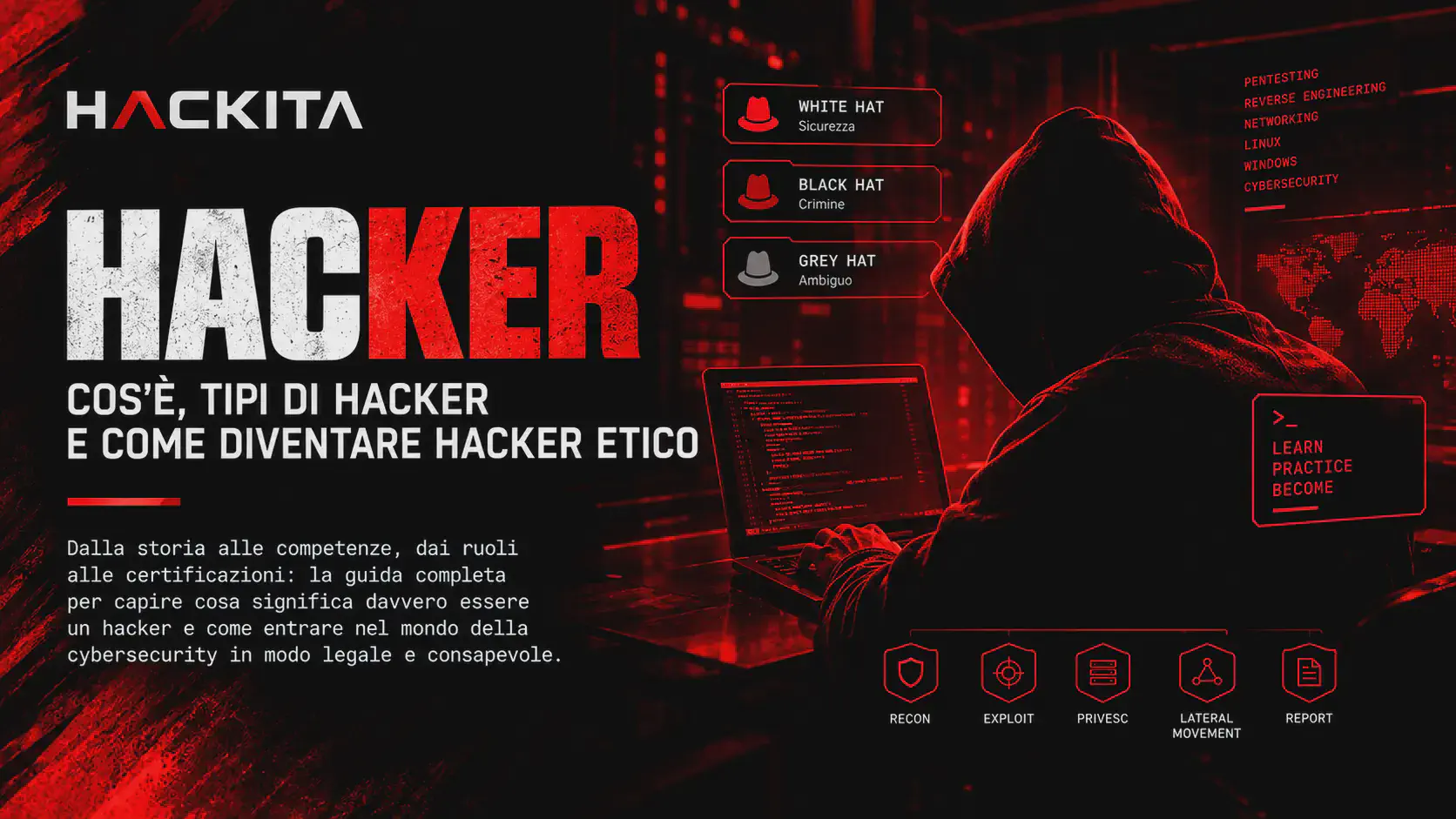
"Hacker" is a broad and neutral term, referring to anyone with advanced technical skills on systems and software, regardless of how they use them. "Ethical hacker" narrows the term to those who always use them with permission, within an agreed-upon scope, with the goal of reporting—not exploiting—the vulnerabilities they find. For a complete classification of the various "colors" of hackers, see White Hat, Black Hat, and Grey Hat: The Differences.
Once the boundary has been defined, it remains to be seen how it translates into practice during a working day.
What an Ethical Hacker Actually Does #
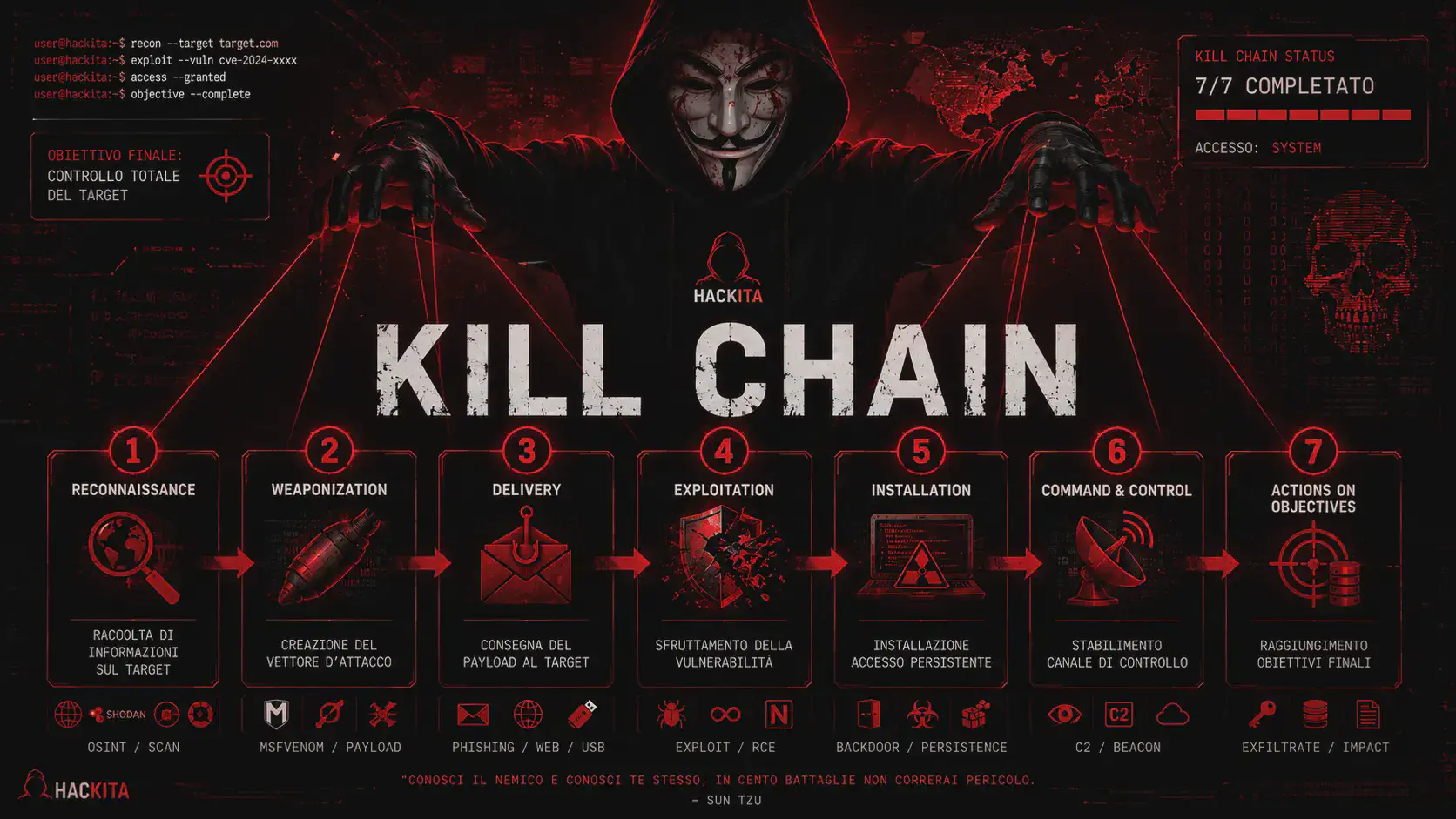
The work is almost always carried out within a written assignment with scope, timelines, and rules of engagement, often following recognized methodologies such as the OWASP Web Security Testing Guide for the web component. Typical phases:
- Reconnaissance — collection of public information and enumeration of systems in scope
- Scanning and vulnerability assessment — identification of services, versions and possible carriers
- Exploitation — controlled exploitation of the vulnerabilities found, to demonstrate their real-world impact
- Post-exploitation escalation of privileges and lateral movement, to see how far a real attacker could reach from that point
- Reporting — detailed documentation of each finding, estimated impact, and remediation recommendations
Reporting isn't just an administrative detail: it's often the part that judges the quality of work, because it's what the client will actually use to correct problems.
All of this happens within a specific perimeter. An ethical hacker can test, exploit vulnerabilities in a controlled manner, and document everything they find—but only within the systems in scope. They cannot leave that perimeter, retain or use data beyond the scope of their assignment, or continue accessing systems after the activity has ended: these are precisely the conditions that separate work from a crime, seen from the perspective of those who practice it every day. But "ethical hacker" is an umbrella term that covers quite different roles, depending on how these phases are applied.
The Main Specializations #
- Penetration tester — structured tests with a defined scope, generally on direct assignment from a client
- Red teamer — simulation of a real and prolonged attack, often without notifying the defense team (blue team)
- Bug Bounty Hunter — independent vulnerability research on public programs, paid for by results
- Security researcher — research into new techniques and vulnerabilities, often published to the community
In practice, the roles often overlap—a penetration tester sometimes works in a red team when the assignment requires it—but the fundamental difference is the objective of the engagement: covering as many vulnerabilities as possible (pentesting) versus testing an organization's detection and response capabilities (red teaming). Whatever the specialization, however, the underlying skills are always the same.
What Skills Are Needed? #
- Foundations — networking, the two main operating systems (Windows and Linux), authentication
- Offensive security — enumeration, vulnerability assessment, exploitation, privilege escalation, Active Directory, web security
- Scripting — Python above all, Bash and PowerShell are also useful for automating and adapting existing exploits
- Communication Team — clear reporting for a non-technical audience, often underestimated compared to the “offensive” part
What Tools Do You Use? #
They vary in specialization, but a core group is found almost everywhere: Nmap for network enumeration, Burp Suite and ffuf for the web, Metasploit for exploitation, BloodHound and Certipy for attacks in Active Directory environments, Hashcat and John the Ripper for cracking hashes and passwords.
Ethical Hacker vs Cybersecurity #
They're not synonymous: cybersecurity is a broad field that also encompasses defense (SOC, incident response, threat hunting), governance, and vulnerability management. Ethical hacking—and with it penetration testing, red teaming, and vulnerability hunting—is a specific part of that field, geared toward simulated attacks rather than defense. However, it remains a requirement that clients and employers almost always demand, just to take our word for it.
Ethical Hacker: Do You Need Certification? #
It's not required by law, but in practice, it's often requested by clients and employers as verifiable proof of skills. CEH (Certified Ethical Hacker) is among the most popular, but it's not the only option: a complete comparison, including a table of certifications and realistic timeframes, is in How to Become an Ethical Hacker: The Practical Guide.
FAQ #
What does an ethical hacker do on a daily basis? Listing systems, searching for vulnerabilities, conducting controlled exploitation to demonstrate their impact, and issuing a final report with recommendations—not isolated "attacks," but a structured process with a defined scope.
What's the difference between an ethical hacker and a penetration tester? An ethical hacker is the general category—anyone who operates with authorization for defensive purposes. A penetration tester is one of the specific roles within that category, focused on structured, scope-based testing.
Does an ethical hacker need to know how to program? It's not mandatory to start, but it quickly becomes necessary: reading code to understand a vulnerability, adapting a public exploit, or writing an automation script are daily tasks of the role.
How much does an ethical hacker earn? It varies greatly based on experience, role, industry, and country—salary data should always be interpreted in light of the market and seniority, rather than a single figure that applies everywhere.
Is a degree needed to become an ethical hacker? It's not mandatory: practical skills, workshops, portfolios, and certifications are what the industry actually uses to evaluate a candidate's abilities.
Where does an ethical hacker work? Cybersecurity firms, consulting firms, in-house security teams at larger companies (banks, fintechs, software houses), or freelance on bug bounties and direct assignments.
Is ethical hacking legal? Yes, but only with explicit authorization and within the agreed-upon scope—good intentions alone aren't enough; written permission from the system owner is required. The full legal framework, including the consequences of going outside the scope, is in the article "Hackers: What They Are, Types of Hackers, and How to Become an Ethical Hacker ."