Basilicata Data Center: The Kraken Case and the Hacker Mystery

Were data centers in Basilicata hacked? Russian pages and Kraken indicate a hacker attack: what happened to the Basilicata Region, healthcare system, and hospitals?
- Posted on 2026-10-04
- Reading time: 8 min
Basilicata's healthcare system and hospitals hacked? What do we really know about the Kraken case? #
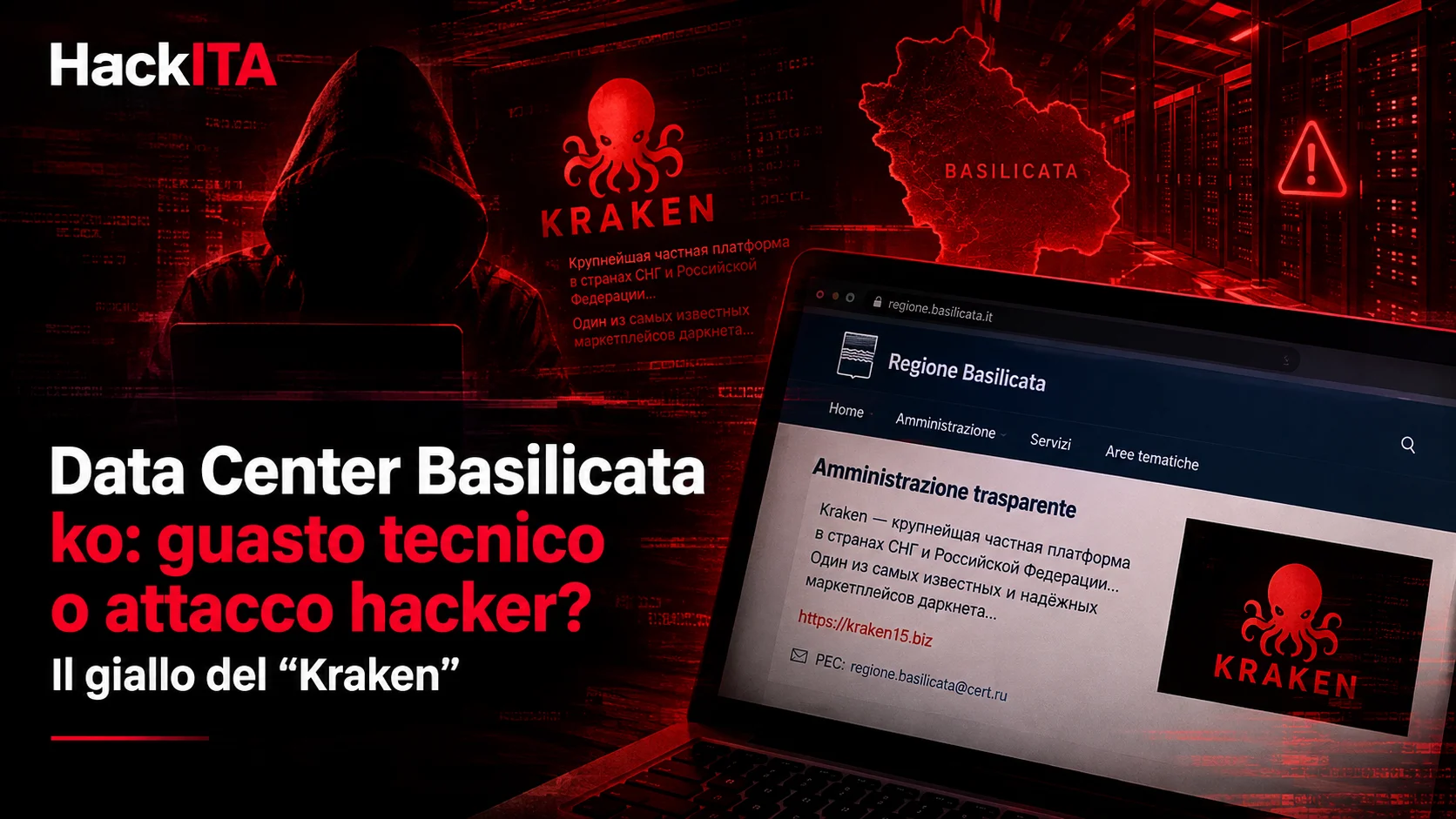
Have Basilicata's healthcare and hospitals** been hacked?** This is the question thousands of residents of Basilicata have been typing into Google in recent days, after days of blocked CUP (Italian National Health Service) offices, impossible to book appointments, and a regional website that has disappeared from the internet. The official answer is no: the Region is citing a technical glitch. But in the meantime, a word that a hardware glitch alone cannot explain has appeared on the institutional website: Kraken , written in Russian, along with links to a dark web marketplace.
In short: there is currently no public evidence that the Regional Data Center outage was caused by a hacker attack. The Region attributes the outage to a cooling system anomaly and a failed backup, ruling out unauthorized access or theft of personal data. Separately, pages on the institutional website containing content in Russian and references to Kraken have been documented: a connection between the two events has not been proven, but the two events occurred on the same website in the same week.
Since September 27, 2026, Basilicata has experienced one of the most extensive digital disruptions in recent years, directly impacting CUP (Central Italian Public Service Call Center), healthcare bookings, the regional payment portal, and the University website.
Chronology of events #
- September 23th: First anomalies reported in the "Transparent Administration" section of the regione.basilicata.it website.
- September 27 (Sunday): the institutional website becomes unreachable.
- September 28 (Monday)First official statement via WhatsApp: "Technical block at the data center." The Region immediately rules out the possibility of an external hacker attack. Delays in outpatient services and laboratory tests have been reported.
- September 29thBasilicata24 documents the string “Kraken” and Russian-language content in the “Transparent Administration” section of the site.
- September 30thThe Region declares the CUP operational again and affirms that no evidence of a cyber attack, unauthorized access, or personal data leak has emerged.
- 1 OctoberThe Region updates its technical reconstruction of the fault—an anomaly in the data center's cooling system and failure to start the backup system. ACN and the Privacy Guarantor have been informed; regional tax payments remain suspended.
What is confirmed, what is declared, what is only observed #
In reconstructing this case, it is best to keep three levels separate, because they have often overlapped in the reports:
Confirmed (observable fact): The Regional Single Data Center has been out of service for days, impacting CUP, healthcare bookings, regional payments, and the University website.
Declared (source: Basilicata Region): the cause appears to be a cooling system anomaly combined with the failure to initiate backup; no unauthorized access or theft of personal data has been identified.
Observed by third parties (source: Basilicata24): Russian-language content and references to the darknet marketplace Kraken appeared in the "Transparent Administration" section of the institutional website.
The cooling failure explains the system outage. It alone does not explain the appearance of Russian-language content on the regional portal: these are two observations that concern different levels of the infrastructure (data center hardware on the one hand, website content on the other) and which, according to the current state of public documentation, do not appear to be linked by any official source.
Summary table #
| Element | Status |
|---|---|
| Data Center Out of Service | Confirmed |
| Cooling system fault | Official statement |
| Backup failed to start | Official statement |
| Russian content on the portal | Documented by journalistic sources |
| References to Kraken | Document yourself |
| CMS/Site Compromised | Technical hypothesis compatible with the evidence |
| SEO poisoning | Hypothesis, not publicly attributed |
| Cyber attack on the Data Center | Not proven |
| Theft of personal data | There is no public evidence |
| Kraken connection ↔ blackout | Not proven |
What is Kraken, and why might it appear on a PA site? #
Kraken is a dark web marketplace, one of the main successors to Hydra (the Russian illegal trading giant shut down by authorities in 2022), widespread in the CIS countries for the sale of illicit goods and services. To circumvent blocks and be found, these marketplaces rely on mirror networks and aggressive search engine promotion techniques.
Google explicitly classifies this type of phenomenon as hacked content : content inserted without authorization by exploiting a vulnerability, which includes categories such as page injection and content injection aimed at manipulating search results. A common variant is so-called SEO poisoning : a vulnerable page is compromised—often an outdated or poorly protected public CMS, as is often the case with public administration websites—and text and links to the site being promoted are injected into it, in the target audience's language. The compromised domain unwittingly lends its authority (in this case, a government .it) to help the target site climb the rankings in Russian search results.
The content observed on the Basilicata Region portal is consistent with this scenario. However, based on the currently available public documentation, it is not possible to definitively determine the intrusion vector or attribute the modification to a specific author.
A necessary clarification: There is also a malware called “Kraken”, discovered in 2020, which hides in the legitimate Windows process WerFault.exe to execute code while evading antivirus programs. The name coincidentally matches that of the darknet marketplace: they are two completely separate threats. Nothing in the public documentation on the Basilicata case links the outage to this specific malware.
How the Region's page could have been compromised #
A possible chain of events, purely reconstructive and compatible with what has been publicly observed — not an attribution, but the minimum scheme that explains the documented facts:
Initial Access → CMS Compromise → Content Injection → SEO Poisoning → Indexing- Initial accessA flaw in the CMS that manages the site—unvalidated uploads, weak or reused admin credentials, or an outdated plugin/extension. Sections powered by automatic uploads (such as "Transparent Administration," which continuously posts resolutions and published documents) are typical targets because they are more permissive and less monitored.
- CMS Compromise: With valid access or an exploitable flaw, the attacker gains the ability to write content to the affected section.
- Content Injection: no malware is installed or code executed on the server — static text is simply written in Russian, with keywords typical of darknet marketplaces, and links to mirrors of the site to be promoted.
- SEO PoisoningThe compromised domain (government-owned .it, high trust score) unwittingly lends its authority to help that content climb the rankings in Russian search results.
- IndexingGoogle indexes the compromised page, the marketplace gains free organic visibility, without a single data center system being touched.
The technical evidence that should be verified to confirm or exclude this scenario is:
- Administrative authentication logs on the CMS, to identify anomalous accesses
- Out-of-pattern HTTP POST/PUT requests to affected section endpoints
- changes to templates or databases not related to the normal editorial pipeline
- files created or modified outside of the standard publishing workflow
- presence of Russian-language URLs actually indexed by Google
- eventual cloaking, that is, different content served to Googlebot than that shown to human users — a technique that Google explicitly reports as a possible vehicle for hacked content
None of these elements have been publicly confirmed at the time of writing. If a real compromise were to emerge, it would still be a security incident requiring notification under the GDPR (if it involves personal data) and NIS2 (if the organization is a notifying entity)—regardless of whether it constitutes a true data breach or not.
Operational checklist for a team that needs to verify a similar case:
CMS → account admin → log HTTP → DB/template → indicizzazione → persistenceIn order: check the CMS version and plugins for known CVEs; check admin authentication logs for out-of-hours access or access from anomalous IPs; look for POST/PUT requests not related to the editorial workflow; compare database and template hashes and timestamps against the last known legitimate deployment; run queries. site: on Google to identify unexpected indexed content; finally, verify that no backdoor or ad hoc service account has been left behind to ensure future re-entry.
Technical failure or personal data breach? The difference matters. #
A point often misunderstood in the coverage of these cases: a service interruption does not automatically equate to a personal data breach under the GDPR. A system downtime certainly constitutes an availability incident. It would also become a personal data breach only if ongoing investigations establish a real impact on the availability, integrity, or confidentiality of personal data—which, at present, the Region excludes.
This is also why the Region, ACN, and the Privacy Guarantor were involved in parallel: the notification is a precautionary measure that does not in itself imply confirmation of a violation.
Regarding digital infrastructure security, the regulatory framework is Legislative Decree 138/2024, transposing the NIS2 Directive. This directive identifies specific categories of regional public administrations among potentially relevant entities (Annex III). However, the specific classification as "essential" or "important" requires a specific, case-by-case assessment. For incidents deemed significant, the decree requires pre-notification to CSIRT Italia within 24 hours and more detailed notification within 72 hours.
If it were ransomware: what would change (and why paying isn't the solution) #
It should be reiterated: there is no public evidence that this case is a ransomware attack . But since the suspicion has circulated, it's worth briefly clarifying how that scenario would work, for informational purposes only.
In a "classic" ransomware attack, data is encrypted and the attacker demands a ransom (often in cryptocurrency) to provide the decryption key; in double-extortion variants, the attacker also threatens to publish the stolen data on the dark web if payment is not made. Italian authorities (Postal Police, ACN) and international practice advise against paying the ransom for three specific reasons: it does not guarantee actual data recovery, it directly funds criminal organizations, enabling new attacks, and it does not prevent the potential publication of data already exfiltrated. The recommended defense strategy remains restoring from offline/immutable backups, not negotiating with the attacker.
In the Basilicata case, the Region has publicly stated that it excludes this scenario, attributing the blockage to an infrastructural cause.
The real impact on citizens #
Despite the technical reconstruction, the disruptions were tangible: counters and cash registers were closed, healthcare agencies' calendars were frozen, appointments that had been awaited for months were no longer rescheduled, the regional payment portal was inaccessible, and the Regional Council meeting was postponed. Regional Health Service staff managed emergencies and emergencies using manual procedures in the Potenza and Matera facilities, pending full restoration.
For a public administration that concentrates almost all of its digital services—through RUPAR and the Single Regional Data Center—in a single infrastructure, a single point of failure, whether technical or malicious, becomes a single point of failure for an entire region. This is the same principle underlying disaster recovery plans, which have been discussed several times for the Basilicata regional infrastructure.
Hackita Analysis #
If the appearance of Russian content in the "Transparent Administration" section were indeed attributable to SEO poisoning, the pattern would be consistent with a targeted compromise of the site's application/web layer alone, separate and independent from the reported data center infrastructure failure. In other words: two parallel problems, not necessarily the same cause.
What would make this case interesting for those involved in public administration security is not so much "was it a hacker attack yes or no", but the fact that - failure aside - there was still an unmonitored attack surface (a section of the site vulnerable to content injection) which, if truly exploited, would merit interventions independent of the restoration of the Data Center: audit of the CMS, rotation of administrative credentials, checking the differences between content served to crawlers and users.
FAQ #
Was the Basilicata data center hacked? There's no public evidence of this. The region attributes the outage to a technical failure (cooling and backup failure) and rules out unauthorized access.
What exactly happened? The Regional Data Center has been out of service since Sunday, September 27, blocking CUP (Central Online Payments), healthcare reservations, regional payments, and the University website.
What is Kraken and why is it listed on the regional website? Kraken is a popular dark web marketplace in Russia. The Russian-language content found on the regional website is consistent with an SEO poisoning technique aimed at exploiting the authority of a government domain to promote that marketplace.
Were citizens' data stolen? The Region states that it has found no evidence of theft or exfiltration of personal data. Technical checks were still ongoing at the time of writing.
Are the data center failure and the Russian content related? There's no proven link. These are two observations referring to different levels of the infrastructure (hardware vs. website content), and, at this time, no official source links them.
What is a data center? It's a physical facility that houses servers, storage systems, and networking equipment used to run digital services. In the case of the Basilicata Region, the Single Regional Data Center centralizes the IT systems that govern CUP (Central Payments), regional payments, the institutional website, and other services for regional, municipal, and healthcare organizations. If it goes down, all the services that rely on it go down with it.
What is SEO poisoning? A technique that exploits vulnerabilities in a legitimate website to inject content (text, links) with the aim of boosting the search engine rankings of a third-party, often illegal, site, parasitically undermining the compromised domain's authority.
Sources #
- Basilicata Region, official announcements dated September 28 and October 1, 2026
- Basilicata24, investigation of September 29, 2026, into the discovery of Russian content and reference to Kraken
- ANSA Basilicata, October 1, 2026
- Google Search Central documentation on hacked content categories (page injection, content injection, cloaking)
Article updated October 4, 2026. The matter is still being investigated by the competent authorities; this article will be updated if new official developments arise.