Business Email Compromise (BEC): Scams, Techniques, and Defense

BEC explained simply: What is CEO scam, how does a Business Email Compromise attack work, a real-life case, and how to protect your business.
- Posted on 2026-10-26
- Reading time: 5 min
Business Email Compromise: How Corporate Fraud Works #
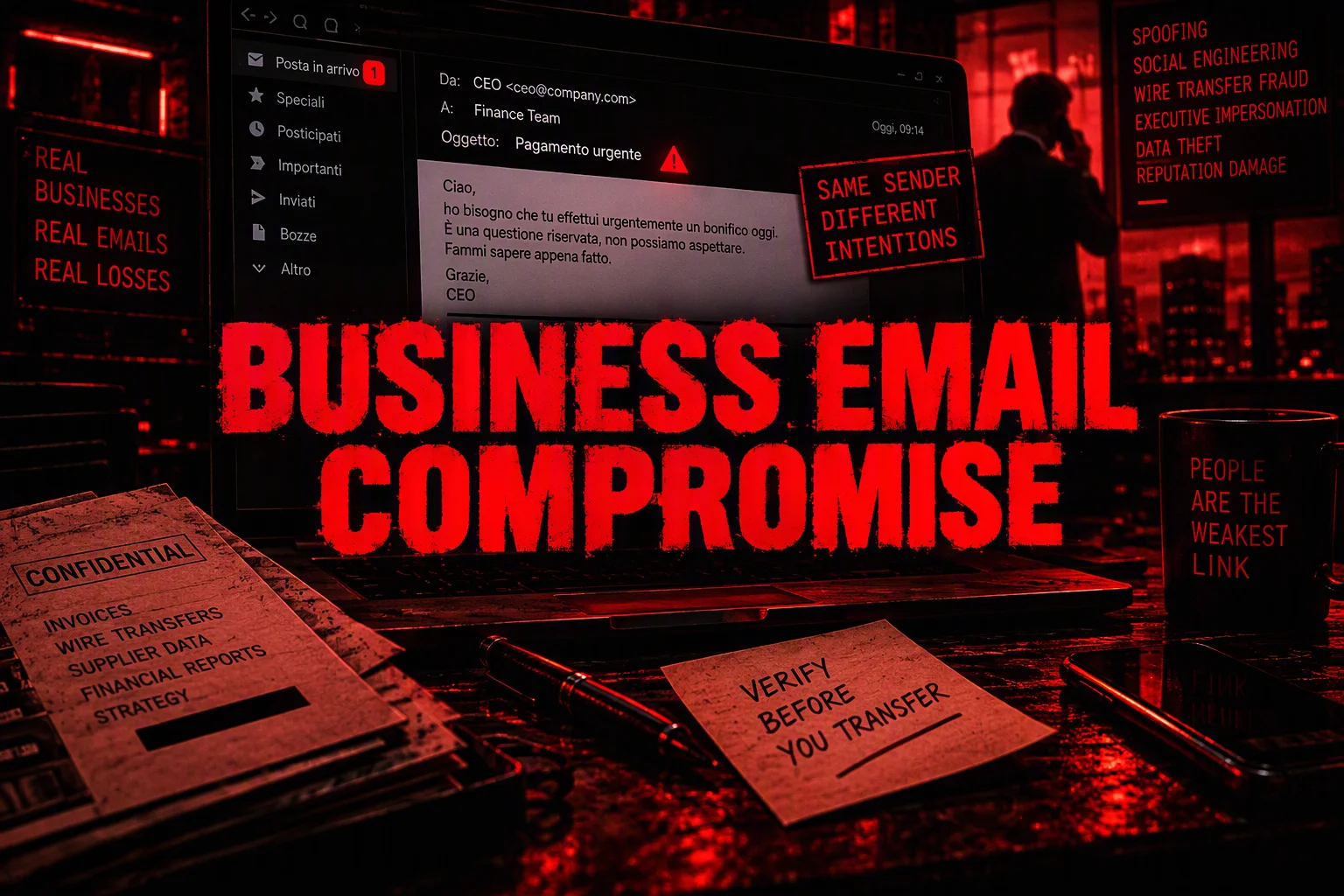
Business Email Compromise ( BEC ), also known as CEO scam , is a targeted attack in which criminals compromise or spoof a company email address to convince an employee to make a wire transfer, change a supplier's bank details, or send confidential data. There's no malware, no link to click: just a well-written email, at the right time, to the right person.
It is one of the most profitable cyber scams in the world. According to the FBI, in its 2025 report published in April 2026, the Internet Crime Complaint Center received 24.768 BEC complaints , for over $3 billion in reported losses, up from $2,77 billion in 2024. Between 2013 and 2023, the estimated cumulative losses exceed $55 billion.
BEC meaning: why it's not just your average phishing scam #
BEC is a form of targeted phishing ( spear phishing ), but with a crucial difference: BEC emails almost never contain infected attachments or malicious links , the elements that spam filters are trained to recognize. They are clean, well-written messages, often crafted after weeks of observation of the target company: organizational chart, communication style, internal hierarchies, operating habits, even the typical language of the CEO or CFO.
This is why BEC bypasses traditional technical controls: it doesn't exploit a software vulnerability, it exploits trust between people.
How a BEC attack works, step by step #
- ReconnaissanceThe attacker studies the company through social networks (primarily LinkedIn), the website, press releases and, if possible, already compromised emails.
- Access or impersonation: or actually compromises an email account (via phishing, stolen credentials, or a data breach
previous), or create a domain and address very similar to the real one (for example
azienda-spa.cominstead ofaziendaspa.com). - Silent observation: if he has real access to the mailbox, he often monitors conversations for weeks, waiting for the right moment, such as an ongoing business negotiation.
- The shot: sends (or inserts into a real conversation) a message requesting an urgent bank transfer, an IBAN change for an already scheduled payment, or confidential data.
- Psychological pressure: urgency, confidentiality (“don’t tell anyone else”), authority (the message appears to come from the boss or a trusted partner).
- Debt collection: The money ends up in an account controlled by criminals, often quickly moved to other accounts to make it difficult to recover.
The most common variants of BEC #
| Type | How it works |
|---|---|
| CEO Fraud | An email that appears to be from the CEO or an executive requests an urgent and confidential wire transfer, often while “he is in a meeting and can't be reached.” |
| Fake invoice / compromised supplier | The attacker impersonates a real supplier and announces a change in IBAN for future payments. |
| Attack on the lawyer | A fake lawyer, involved in a confidential transaction (acquisition, contract), asks for an urgent bank transfer to "close the deal" |
| Employee data theft | The email, apparently from the CEO or HR, asks for employee tax information or pay slips. |
| Actual mailbox compromise (EAC) | The most dangerous variant: the attacker actually gains access to the email and inserts himself into a genuine transaction, replacing the IBAN at the time of payment. |
A real case: the travertine scam #
A case that clearly illustrates the mechanism involved an Italian and an American company, both involved in the supply of stone materials for a project worth approximately $1,4 million. Criminals had managed to gain control of the Italian company's email inbox, observing communications and transactions in progress. Upon payment, the American company transferred approximately $700.000 to an IBAN that had been substituted by the scammers, believing it was paying its real partner. Only collaboration between the Italian police and the U.S. Secret Service allowed them to recover part of the funds.
The detail worth noting: no links, no suspicious attachments. Just a genuine commercial conversation, hijacked at the right time.
Why BEC works so well #
- Bypass technical filters: no malware to detect, no suspicious URLs to block.
- Exploit authority: An employee rarely questions a request that appears to come from his or her boss.
- Exploit the urgency“It’s needed today” pushes people to skip the usual checks.
- Take advantage of privacy: “don't talk about it with others” isolates the victim from discussions with colleagues, which would often bring the anomaly to light.
- It's targeted, not massUnlike spam, each message is tailored to the target company and individual.
Warning signs of a BEC email #
| Signal | Why should it arouse suspicion? |
|---|---|
| Urgent bank transfer request | Especially if outside of normal company procedures |
| Invitation to confidentiality | “Don't tell anyone” is not a legitimate payment practice |
| Sudden change of bank details | A genuine supplier will not change IBAN via email without independent verification. |
| Similar but different domain | Always check the exact sender address, not just the display name |
| The sender “cannot be called” | A common excuse to prevent phone verification |
| Unusual request for that role | A CEO asking for tax information on a single employee is an atypical pattern |
How to protect yourself from BEC: companies #
- Check on a different channelAny bank transfer or IBAN change request must be confirmed by phone, calling a number known in advance, never the one indicated in the suspicious email.
- Double approval procedures: no significant payments authorized by a single person upon request via email.
- Email authentication: Implement SPF, DKIM, and DMARC to reduce enterprise domain spoofing.
- MFA Everywhere: especially on the email accounts of managers and administration, the main targets.
- Targeted training: not the usual generic anti-phishing training, but specific scenarios on urgent and confidential financial requests.
- Monitoring similar domains: Register or monitor variations of your business domain that could be used for impersonation.
- Check OAuth forwarding rules and appsIf an account has been truly compromised, the attacker can create hidden email rules or exploit authorized applications to maintain visibility into communications even after a password change. It's worth periodically checking the most exposed accounts.
- Culture of safe errorEmployees should feel free to ask an extra question or refuse a suspicious payment without fear of retaliation, even if the request appears to come from above.
What to do if you have been a victim of BEC #
- Contact the bank immediately, asking you to contact the institution that received the transfer: a fraudulent transfer can sometimes be blocked or recovered if reported within a few hours.
- Report to the Postal PoliceInternational cooperation between law enforcement agencies has already enabled the recovery of funds in similar cases.
- Change credentials of all affected email accounts and enable MFA if it wasn't already enabled.
- Check the extent of the compromise: If an account has actually been compromised, check for hidden forwarding rules in the email, which attackers often use to monitor conversations without being noticed.
- Notify your business partners involved in the compromised conversation: they could be the next target with the same pattern.
BEC and artificial intelligence #
BEC is evolving with generative AI: increasingly natural-sounding emails, free of the grammatical errors that were once a telltale sign, and in some cases even voice or video deepfakes to bolster the credibility of an urgent request (a technique that overlaps with vishing ) . The FBI has already attributed over $30 million in BEC losses in 2025 to schemes with a confirmed AI component. The defense remains essentially the same: no urgent financial request should be authorized without independent verification, regardless of the medium used.
Frequently Asked Questions about Business Email Compromise #
What is Business Email Compromise? #
A targeted attack in which criminals compromise or spoof a business email to convince someone to make a wire transfer, change bank details, or send confidential data.
What is the difference between BEC and phishing? #
BEC is a highly targeted form of phishing (spear phishing) that almost never uses malicious links or attachments: it relies on a convincing email and context, not on a file to be opened.
What is the CEO scam? #
This is the most well-known variant of BEC: an email appearing to come from the CEO or a manager requests an urgent and confidential wire transfer to an employee.
How do I recognize a BEC email? #
Urgent and confidential request for a bank transfer or IBAN change, sender who "cannot be called," similar but different domain name, unusual requests for that role.
How do you know if a payment request is legitimate? #
By calling a phone number known in advance, never the one indicated in the suspicious email, and always following a double-approval procedure for relevant transfers.
How much do BEC scams cost businesses? #
According to the FBI, reported losses in the United States exceeded $3 billion in 2025 alone, from nearly 25.000 reports.
What should I do if I've already made a transfer due to a BEC scam? #
Contact your bank immediately to attempt to block or recover the funds, report the incident to the Postal Police, and change the credentials of the affected email accounts.
Has artificial intelligence worsened BEC risk? #
Yes. It makes emails more natural and convincing and can add deepfakes of voice or video to support the claim, but the defense remains the same: always verify on an independent channel.