The Biggest Hacker Attacks in History (2026 Guide)

The biggest hacker attacks in history: Yahoo, Stuxnet, WannaCry, NotPetya, Equifax, SolarWinds, Colonial Pipeline, and the lessons learned.
- Posted on 2026-10-31
- Reading time: 7 min
7 Cyber Attacks That Changed the History of Cybersecurity #
Some cyberattacks have done much more than compromise a computer or steal data: they have forever changed the way businesses, governments, and professionals think about cybersecurity.
This list features the largest hacker attacks in history , from data breaches that exposed billions of accounts to operations capable of causing real-world physical damage. Ransomware attacks have paralyzed hospitals in dozens of countries, supply chain attacks have turned a single supplier into a gateway for thousands of organizations, and simple, weak passwords have helped bring down critical infrastructure.
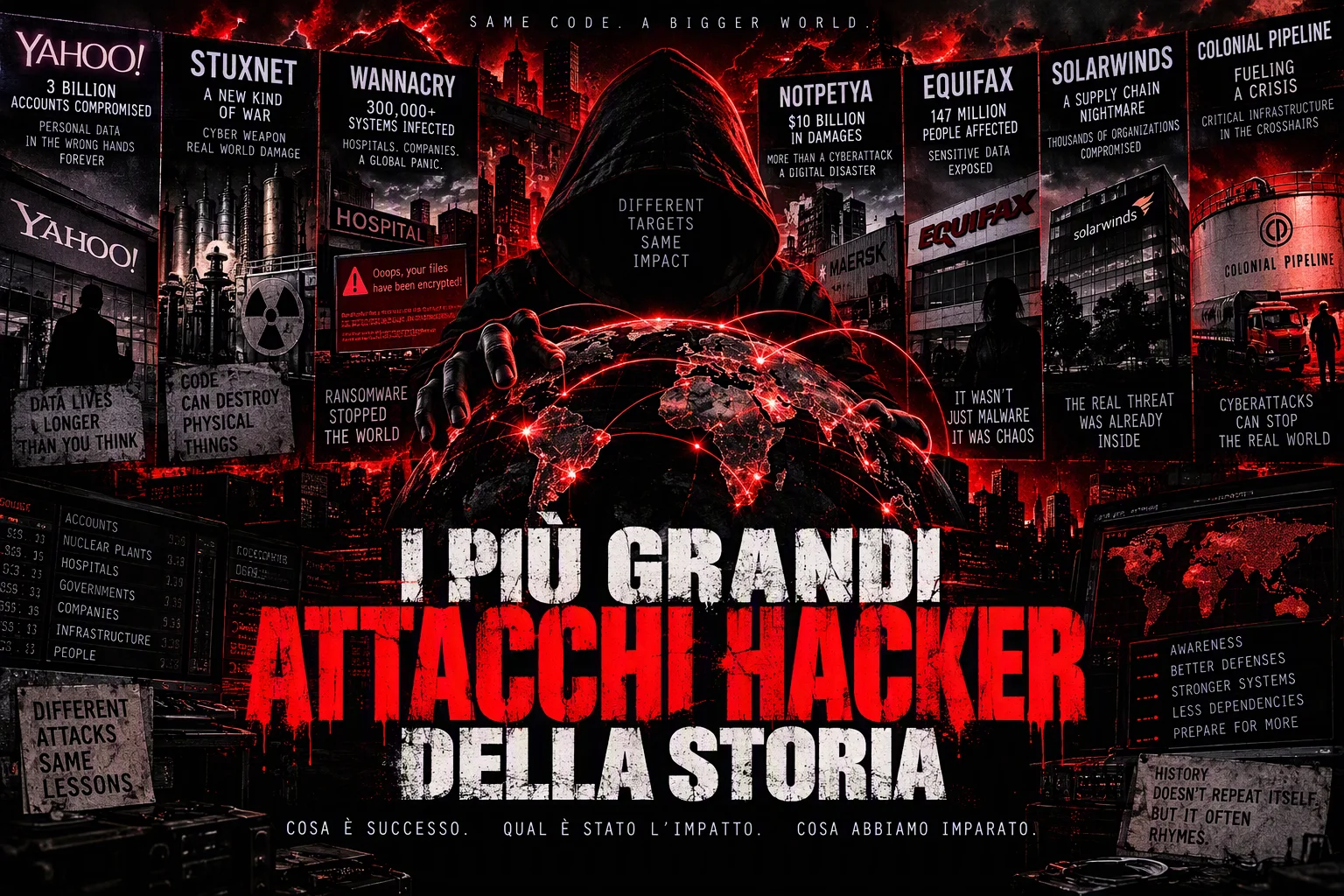
Yahoo, Stuxnet, WannaCry, NotPetya, Equifax, SolarWinds, and Colonial Pipeline tell seven very different stories, but with one thing in common: behind every major incident is a vulnerability, a bad decision, or a weakness that someone managed to exploit.
Let's see what happened, how these attacks were conducted, what damage they caused and, above all, what lessons they left for modern cybersecurity.
Yahoo (2013-2014): The Largest Data Breach in History #
Yahoo has suffered two separate breaches, both of which were only made public years after the fact. The first, in August 2013 , was initially estimated to involve over a billion accounts, but in 2017, after further analysis, Yahoo reassessed it to include all 3 billion accounts on the service at the time, making it the largest data breach ever documented. The second, a separate incident in 2014 , involved approximately 500 million accounts . In both cases, names, emails, phone numbers, dates of birth, and security questions ended up in the hands of the attackers. The case remains a landmark example of the consequences of a breach discovered and disclosed years after its actual origin: the delay in disclosure caused the price of Verizon's acquisition of Yahoo to drop by $350 million, according to documents filed with the SEC.
Stuxnet (2010): When a cyber attack destroys real machines #
Stuxnet deserves a special place on this list: it didn't steal data or demand a ransom, but it physically sabotaged the centrifuges at Iran's Natanz nuclear facility, exploiting four Windows zero-day vulnerabilities and one in Siemens software. This case demonstrated, first and with documentary evidence, that a purely digital attack can have direct physical consequences. We discussed it in detail in our in-depth analysis of Stuxnet.
WannaCry (2017): One Worm, One Weekend, 150 Countries #
On May 12, 2017, the WannaCry ransomware began spreading like a worm, without anyone clicking a link: it exploited EternalBlue , an exploit for a vulnerability in the Windows SMBv1 protocol, developed by the NSA and publicly leaked a few weeks earlier by the Shadow Brokers group. In just a few hours, it infected over 200.000 computers in at least 150 countries , hitting the British National Health Service (NHS) particularly hard, with hospitals forced to postpone operations and divert ambulances. Total damages were estimated at around $4 billion , with actual ransoms paid amounting to just a few hundred thousand dollars: this disproportionate figure shows that the real cost of an attack of this type lies in operational disruption, not in the ransom itself. The spread was slowed when researcher Marcus Hutchins discovered and registered a domain that acted as a kill switch in the malware's code.
NotPetya (2017): The ransomware that didn't want money #
A few weeks after WannaCry, in June 2017, NotPetya arrived : it was disguised as ransomware, complete with a ransom demand, but the decryption mechanism was purposely broken. It wasn't designed to make money, but to destroy data on a large scale, disguised as a financial attack. The initial vector was a compromised update of the Ukrainian accounting software MeDoc. Once inside a network, NotPetya moved laterally by combining EternalBlue and EternalRomance (two SMB exploits from the same family leaked by Shadow Brokers) with credential theft via Mimikatz -style techniques , which were then reused with legitimate administration tools like WMI and PsExec : a technical detail documented in detail in the Mandiant/Google Cloud analysis , and which shows that the exploit alone was not the sole driver of its spread. It affected companies in over 60 countries, with the most notable case being the shipping company Maersk, which was forced to reinstall thousands of servers and workstations from scratch. The U.S. government called it the "most destructive and costly" cyberattack ever recorded; independent estimates of the overall damage exceed $10 billion.
Equifax (2017): One patch not applied, 147 million people exposed #
In 2017, the credit bureau Equifax suffered a breach that exposed the personal and financial data of approximately 147 million people : names, Social Security numbers, dates of birth, addresses, and, in many cases, driver's license numbers. The cause is among the most mundane and instructive on this list: a known vulnerability in the Apache Struts framework ( CVE-2017-5638 ), for which a patch had been available for months, had never been applied to an application exposed on the internet. From there, the chain is textbook: exposed application → RCE on Struts → internal lateral movement → database access → data exfiltration. The Equifax case has become the standard by which patch management is one of the most underrated and critical security measures of all. Under the global settlement with the FTC, CFPB, and 50 U.S. states , the company has agreed to pay at least $575 million, with a potential outlay of up to $700 million.
SolarWinds (2020): When the Vendor Becomes the Target #
In December 2020, it emerged that attackers (attributed to a group linked to Russian intelligence) had compromised the build process of SolarWinds' Orion software , an IT management platform used by thousands of US companies and government agencies. The malicious code, a backdoor known as SUNBURST , was injected directly into the software build process via a preliminary implant ( SUNSPOT ) in the SolarWinds build environment and then distributed via an official, digitally signed update , reaching approximately 18.000 organizations, including US federal agencies. An often overlooked technical detail: not all organizations that received the infected update were actually exploited beyond the initial backdoor. The attackers had actively selected a subset of targets to pursue with lateral movement and abuse of legitimate credentials, as documented by CISA , which issued an emergency directive to US federal agencies. The attackers had remained hidden in the SolarWinds network for over a year before their discovery. This is the reference case for the concept of a supply chain attack : compromising a single trusted supplier, with a regularly signed update, to reach hundreds of final targets.
Colonial Pipeline (2021): One Password Without MFA #
In May 2021, the DarkSide ransomware group hit Colonial Pipeline, the operator of the largest US oil pipeline, responsible for approximately 45% of the East Coast's fuel supply . The company shut down the entire pipeline for days as a precaution, causing lines at filling stations and fuel price hikes in several states. The initial cause was disarmingly simple: a legacy VPN account no longer in use but still active, protected by a reused password and lacking multi-factor authentication . The password was found to be present in a set of credentials previously leaked online, although it was never definitively established that the attackers obtained it from that source. Colonial paid a ransom of approximately $4,4 million in bitcoin; the FBI later managed to recover a significant portion of it by tracking its movements on the blockchain. The case remains the main reference for explaining why MFA for every remote login is not an optional detail.
What do these attacks have in common? #
| Case | Main cause | Lesson |
|---|---|---|
| Yahoo | Breach undetected for years, late disclosure | Detection and transparency matter as much as prevention |
| Stuxnet | Multiple zero-days, air gap overcome via USB | No environment is isolated by definition |
| WannaCry | Unpatched SMB vulnerability, exploit leaked | Patch management is a race against time |
| NotPetya | Supply chain software + credential theft | A “money” attack can be a diversion |
| Equifax | Known vulnerability (CVE-2017-5638), patch available but not applied | Knowing the risk is not enough if you don't act |
| Solarwinds | Vendor build process compromise | Trusting a signed update is no longer enough |
| Colonial pipeline | Legacy VPN account, reused password, no MFA | A single weak access can bring down an entire sector |
The techniques behind the biggest attacks #
| Connection | Type | Key techniques |
|---|---|---|
| Yahoo | Data breach | Database compromise, credential exfiltration |
| Stuxnet | Cyberweapon / ICS | Multiple zero-days, removable media, lateral movement, PLC manipulation, rootkits |
| WannaCry | Worm / Ransomware | SMB Exploit (EternalBlue), Autonomous Propagation, RCE |
| NotPetya | Destructive Malware / Supply Chain | Vendor compromise, credential theft, WMI, PsExec |
| Equifax | RCE / Data breach | Exposed application, known vulnerability not patched, exfiltration |
| Solarwinds | Supply chain / APT | Build system compromise, signed backdoor, credential abuse |
| Colonial pipeline | Ransomware / Initial access | Legacy accounts, reused credentials, no MFA |
The common thread is almost never pure technical sophistication: it is almost always a combination of a known weakness, a failed procedure, and an excessively long reaction time.
Frequently asked questions about the largest hacker attacks in history #
What was the largest hacker attack in history? #
It depends on the criteria: Yahoo by number of accounts affected, NotPetya by economic impact, Stuxnet by physical and strategic impact, WannaCry by speed and global spread, SolarWinds by depth of supply chain compromise, Colonial Pipeline by impact on critical infrastructure.
What is the largest data breach in history? #
The 2013-2014 Yahoo breach, disclosed in 2016, affected all 3 billion accounts then existing on the service.
What was the most expensive cyber attack ever? #
NotPetya (2017) is generally considered the costliest, with overall damage estimates exceeding $10 billion globally.
What was the first cyber attack to cause documented physical damage? #
Stuxnet, discovered in 2010, which sabotaged centrifuges at Iran's Natanz nuclear facility.
Why did WannaCry spread so quickly? #
Because it exploited a vulnerability in the Windows SMB protocol (EternalBlue) to spread itself like a worm, without anyone needing to click on a link or attachment.
What is a supply chain attack? #
An attack in which criminals compromise a trusted vendor (software, hardware, or services) to reach, through that single point, many organizations that use it: the SolarWinds case is a prime example.
How was Colonial Pipeline hacked? #
Through a reused password on a no longer active VPN account, lacking multi-factor authentication: no sophisticated technical vulnerability, just weak, unprotected access.
Could these attacks have been prevented? #
In most cases on this list, yes, at least in part: Equifax with a patch already available, Colonial Pipeline with MFA, Yahoo with more timely detection and disclosure.
Are attacks like this still common today? #
Yes. Ransomware, supply chain attacks, and weak credential breaches remain among the most widespread vectors today, often with more sophisticated variants but the same underlying logic.