Anonymous Hacker: Mask, Operations, and Current Events

Who are Anonymous, where the Guy Fawkes mask came from, their most famous operations (Chanology, Payback, Tunisia), and what they're still doing today in 2026.
- Posted on 2026-10-08
- Reading time: 6 min
Anonymous: Who They Are, Their History, and Their Main Operations #
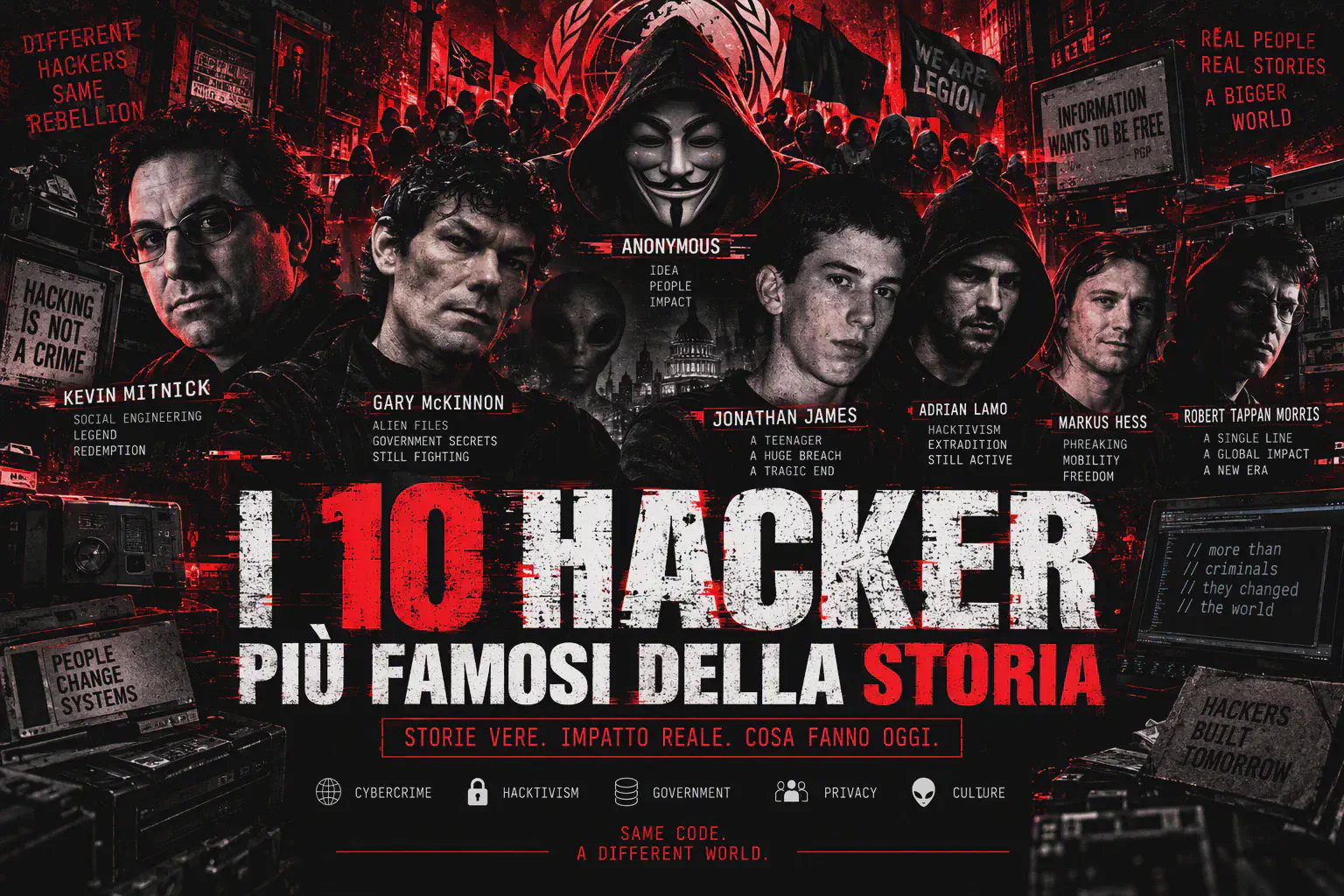
Anonymous is often described as a hacker group , and is the world's best-known name among hacker and hacktivist collectives—though calling it that simply is an oversimplification: it has no leaders, no hierarchy, and not even a way to verify who is truly part of it. It's a label anyone can wear, literally along with the mask that has made it famous worldwide. And it's precisely this lack of structure that has made it, for nearly twenty years, one of the most difficult forces to pin down—and stop—in the global hacktivist landscape.
In short: Anonymous is a decentralized hacktivist collective founded in 2003 on the forum 4chan, with no discernible leadership or hierarchical structure. Having transitioned from online trolling to political activism since 2008, it has conducted operations against governments, corporations, and religious organizations, becoming globally recognizable thanks to its Guy Fawkes mask inspired by the film V for Vendetta.
The Origins: From 4chan to the Collective #
Anonymous was born in 2003 on 4chan , an image forum where anyone posting without registering was automatically labeled “Anonymous”—hence the name. In the early years, the collective that formed around that shared anonymity was primarily dedicated to trolling, online pranks, and coordinated raids against targets chosen more for fun than for political conviction. The quantum leap came in 2008, when a Fox television report described the group as a domestic threat bordering on terrorism. The reaction was a video posted to YouTube on January 21, 2008, titled “Message to Scientology,” which introduced the collective for the first time as a public and political voice rather than a mere forum subculture.
The Guy Fawkes Mask: From Comic Book to Global Symbol #
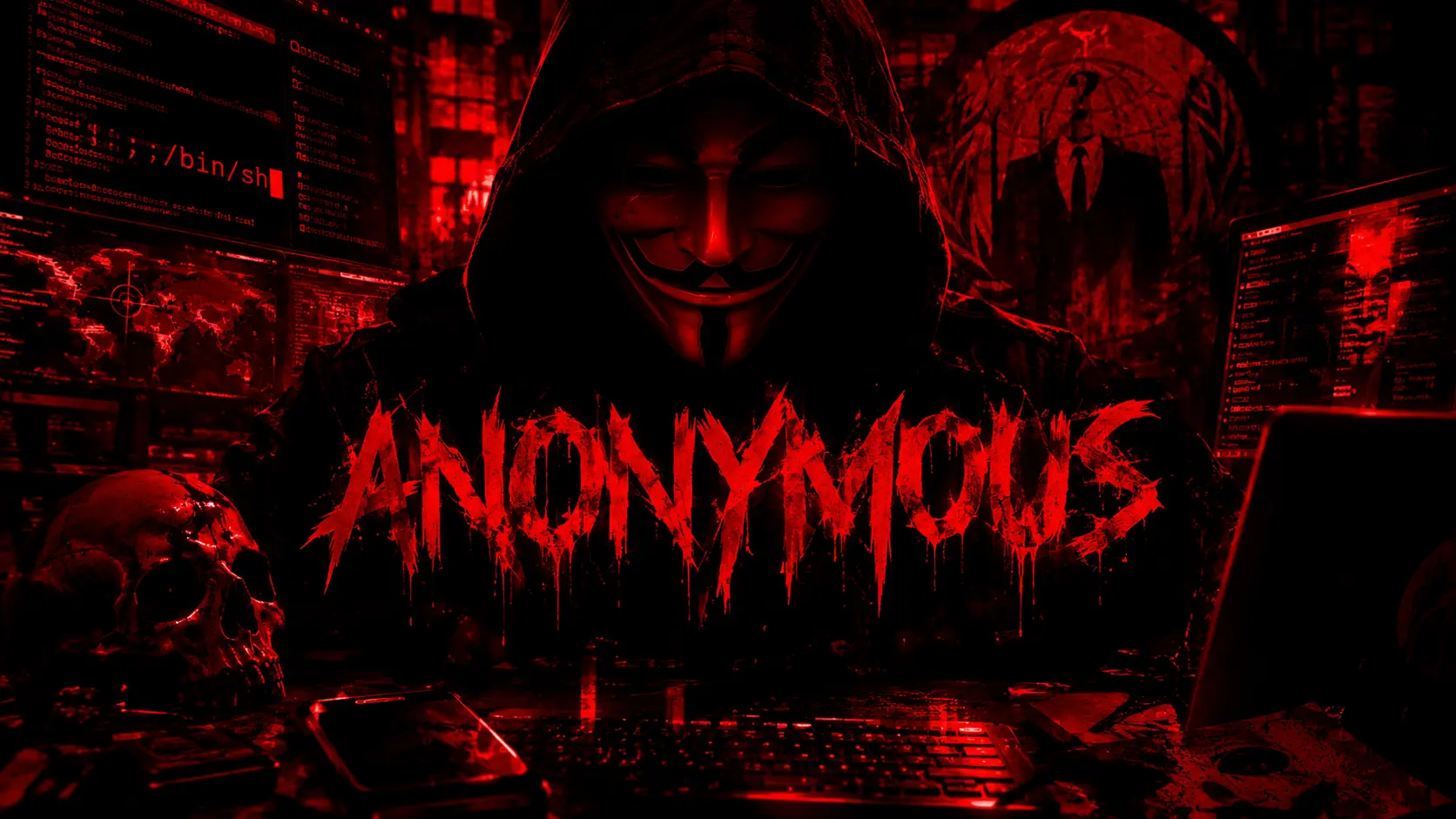
The image that identifies Anonymous worldwide—the white face, the mocking smile, the thin mustache—originates from the graphic novel V for Vendetta by Alan Moore and David Lloyd (1982–1989), itself inspired by Guy Fawkes, the conspirator who attempted to blow up the English Parliament in 1605. The 2005 film based on the comic brought the image to the general public, and in 2008, during the street protests against Scientology, demonstrators began wearing it for two reasons: to protect themselves from detection by the organization's internal investigative services, and to symbolically affirm that behind the mask could be anyone—not a leader, not a spokesperson, but an idea that anyone who chose to wear it could share.
Project Chanology: the Political Turning Point #
In January 2008, a Scientology promotional video starring Tom Cruise leaked online, and the organization attempted to have it removed everywhere, citing copyright infringement. Anonymous responded with Project Chanology : distributed denial-of-service attacks against Scientology websites, mass black faxes to deplete the organization's printers, and—most importantly—coordinated physical protests in dozens of cities around the world, with thousands of masked protesters taking to the streets on the same day in over 40 countries. It was the first time Anonymous demonstrated its ability to mobilize real, not just digital, action on a global scale—and the moment the Guy Fawkes mask became its definitive symbol.
Operation Payback: The WikiLeaks Defense #
In 2010, Anonymous launched Operation Payback , initially targeting anti-piracy groups (RIAA, MPAA) that were prosecuting file-sharing sites. The operation escalated a few months later when WikiLeaks began publishing thousands of classified American diplomatic cables, and PayPal, Visa, Mastercard, and the Swiss bank PostFinance cut their services to the platform under political pressure. Anonymous responded by launching DDoS attacks against the websites of all four, in what was also dubbed Operation Avenge Assange , in defense of WikiLeaks founder Julian Assange. The attack temporarily brought down the websites of PayPal, Visa, and Mastercard, and the news contributed to a roughly $1 billion drop in the stock of eBay, PayPal's then-owner. At least 14 arrests followed in the United States after PayPal shared the attackers' IP addresses with the FBI.
Operation Tunisia: When Anonymous Met the Arab Spring #
In January 2011, days before Western media coverage of what would become the Tunisian Revolution began, Anonymous launched Operation Tunisia : DDoS attacks that took down at least eight Tunisian government websites—including those of the presidency, the prime minister, and the stock exchange—in response to internet censorship imposed by the Ben Ali regime. The collective also distributed a “digital survival pack” translated into Arabic and French, with tools like Tor to circumvent censorship and protect the identities of protesters online. One of the Tunisian Anons involved, blogger Slim Amamou , was arrested on January 6, 2011, during the operation—and in an almost cinematic reversal, after the fall of the regime, he served for several months as a deputy minister in Tunisia's transitional government, only to resign shortly thereafter in protest against the new government's online censorship.
LulzSec vs. Anonymous: What's the Difference? #
In 2011, a group of people also active within Anonymous formed LulzSec , a separate collective, smaller, more aggressive, and less concerned with the overt political motivations of the parent group—the name itself, a portmanteau of “lulz” (a variant of LOL) and “security,” summed up its spirit well. Within months, LulzSec claimed intrusions against Sony Pictures, Fox.com, the United States Senate, and even the CIA, before voluntarily disbanding after about 50 days of activity. Rather than a clear split, the relationship between the two was a fluid overlap of people and goals: that same summer, LulzSec and Anonymous openly collaborated in Operation AntiSec , demonstrating that the boundaries between the two names were more fluid than their separate identities might suggest—further proof of how the “Anonymous galaxy” is actually a collection of groups and individuals that form, operate, and dissolve without any central authorization.
Anonymous in Italy: Operation "New Generations" #
Italy, too, has had its own legal cases linked to the Anonymous name. In July 2015, the Postal Police concluded Operation "New Generations ," identifying two crews posing as "Anonymous IAG" and "THC Squad ," responsible for dozens of attacks against institutional websites (including those of the Postal Police itself and the Army), critical infrastructure, and private companies, as well as school computer systems in Perugia. The investigation, coordinated by the National Cybercrime Center for the Protection of Critical Infrastructure, led to searches in 10 Italian regions and the filing of 15 charges—mostly young people, some minors, and a 40-year-old man—on charges ranging from unauthorized access to computer systems to damaging public data. The case clearly illustrates a point that applies to Anonymous everywhere: anyone can act under that name, from the most politically motivated groups to simple young people seeking visibility, and it is up to the judiciary to distinguish between them on a case-by-case basis.
Anonymous and the Russia-Ukraine War #
Anonymous is not a purely historical phenomenon. In late February 2022, in the days immediately following Russia's invasion of Ukraine, accounts linked to the collective publicly declared "cyber war" against the Russian government, claiming responsibility for attacks against government websites, state media, and Russian television stations in the following weeks. As always with Anonymous, it remains impossible to determine how much of this activity was coordinated by a recognizable core and how much was the work of independent sympathizers who simply used the name.
A more recent case confirms how this ambiguity is structural, not an exception: between 2023 and 2026, a Spanish group called Anonymous Fénix , active since April 2023 and claiming to be affiliated with the international collective, conducted DDoS attacks against ministries, political parties, and public institutions in Spain and South America, intensifying their activity after the Valencia floods of October 2024. The Spanish Guardia Civil arrested the group's administrator and moderator in May 2025, and the last two active members in February 2026. As with any group that adopts this name, there is no way to verify a real organizational connection with the culture and network that gave rise to the name Anonymous in the 2000s: declaring oneself affiliated does not equate to being so in any verifiable sense.
How a Leaderless Collective “Works” #
There's no membership card, no membership list, no way to prove you're truly Anonymous—and that's precisely the point. Anyone who adopts the name and acts in its name is part of it, for that moment; there's no one with the authority to deny or confirm it. This horizontal structure is both the collective's strength (no arrest or wiretap can "decapitate" it, because there's no head) and its main analytical weakness: definitively attributing an operation to "Anonymous" as a coherent entity is almost always imprecise, because the name itself is a container that anyone can fill—the exact opposite of individual hackers like Kevin Mitnick or Gary McKinnon , whose identity, once discovered, left no doubt as to who to prosecute.
FAQ #
Who is Anonymous? Anonymous is a hacker group, more precisely a decentralized hacktivist collective, founded in 2003 on 4chan, with no discernible leadership or organizational structure—anyone can claim actions in their name.
Why does Anonymous use the Guy Fawkes mask? The mask, taken from the 2005 film V for Vendetta , was first adopted during the 2008 protests against Scientology: it served to hide the identities of the protesters and to symbolize that anyone, without distinction, could be part of the collective.
What was Anonymous's first major action? Project Chanology, in 2008: a campaign against Scientology consisting of DDoS attacks and coordinated physical protests in over 40 countries, which marked the collective's shift from online trolling to political activism.
What was Operation Payback? A series of DDoS attacks launched in 2010, first against anti-piracy associations and then against PayPal, Visa, Mastercard, and PostFinance, which Anonymous blamed for cutting off WikiLeaks funding under political pressure.
Does Anonymous still exist today? The name continues to be used by various groups and individuals—Anonymous Fénix in Spain is a recent example—but there is no central structure that would allow us to say that all these activities emanate from a single, coherent collective: calling oneself Anonymous demonstrates no organizational connection to those who used the same name twenty years ago.
Why is it so difficult to attribute an action to Anonymous? Because there is no official membership, recognized leadership, or way to verify who is behind a claim: anyone can declare an action "in the name of Anonymous," and a claim is never equivalent to proof.
Is Anonymous a hacker group? This is a common but imprecise simplification: the more accurate term is a collective or decentralized network of hacktivists—people who use digital tools for political or social purposes, not necessarily hackers in the technical sense of the term, and without any traditional group structure.
Are Anonymous's activities legal? It depends on the specific conduct, not the name. Displaying or disclosing public information is legal; DDoS attacks, unauthorized access to computer systems, or data corruption are crimes in almost all jurisdictions, and several individuals identified over the years—including the Italian and Spanish cases cited above—have been arrested and convicted for specific conduct, not simply for membership in the collective.