Active Directory Pentesting 2026: Complete Guide to Kerberos, NTLM and Privilege Escalation

Active Directory Pentesting operationally explained: AD architecture, Kerberos vs NTLM, BloodHound, Kerberoasting, AS-REP Roasting, NTLM Relay, ACL abuse, AD CS, DCSync, Golden Ticket, Shadow Credentials and real defenses.
- Posted on 2026-03-03
- Reading time: 11 min
Active Directory Pentesting is the process by which a pentester identifies a real-world path from standard user to Domain Administrator by analyzing identities, permissions, relationships, authentication, and trusts in a Windows domain. In Active Directory, it doesn't matter how many tools you use. What matters is how well you understand attack paths, ACLs, Kerberos tickets, NTLM, delegations, and trusts.
The Active Directory Pentesting it's not “hacking Windows”.
It's understanding how they fit together Kerberos
, NTLM
, LDAP, ACL, GPO, delegations, trusts and Certipy
(AD CS) to transform a minimal access into privilege escalation, lateral movement, and dominance control.
This guide is a pillar page : it shows you the correct mental model, the attacks that really matter, and how to tie everything together into a single offensive stream using techniques like Kerberoasting , NTLM Relay , ACL Abuse , and DCSync.
If you study AD seriously, the order is this:
model → attack path → attacks → tool
To really visualize attack paths use BloodHound – it’s the key tool to move from enumeration to domain compromise.
Index #
- Active Directory Pentesting in 30 seconds
- What is Active Directory Pentesting and why is it the primary target?
- Active Directory Architecture: Forests, Domains, OUs, Objects, and Trusts
- Key components: Domain Controller, LDAP, Kerberos, DNS, SYSVOL, and GPO
- Kerberos vs. NTLM: The Difference You Need to Understand Now
- Active Directory Attack Surface
- Most common Active Directory attacks in real-world pentests
- BloodHound and Attack Path: How AD Really Thinks
- Tool for Active Directory Pentesting
- Minimum Lab to Study Active Directory Pentesting
- Typical path: from standard user to domain control
- How a pentester thinks inside Active Directory
- Active Directory Real Defense
- Conceptual errors that make you study Active Directory poorly
- FAQ Active Directory Pentesting
- External references
- Conclusion
Active Directory Pentesting in 30 Seconds #
The correct mental flow is this:
initial access → LDAP enumeration → privilege mapping → attack path lookup → privilege escalation → lateral movement → domain dominance
In an AD pentest, the winner isn't the one who launches the most tools. The winner is the one who best understands the relationships between users, groups, computers, ACLs, sessions, delegations, and trusts.
| Phase | Target | Outcome |
|---|---|---|
| Initial access | Get credentials or a session | First foothold |
| Enumeration | Read structure, groups, ACL, SPN, delegations | Domain Map |
| Attack path | Finding a chain to higher privileges | Direction of attack |
| privilege escalation | Check identities or high-value items | High access |
| Lateral movement | Moving on internal hosts and services | Expansion of control |
| Domain dominance | Gain logical control of the domain | Maximum impact |
What is Active Directory Pentesting and Why is it the Primary Target? #
Active Directory is the system used by a Windows network to manage users, computers, groups, policies, and permissions . In an enterprise environment, the most profitable target is rarely a single host: it's the system that governs the identity of the entire infrastructure.
When a user opens an SMB share, uses RDP, logs into an internal web app, or starts a service, AD comes into play somewhere. This is why Active Directory Pentesting is at the heart of internal pentests and red teams on Windows environments.
If you compromise a machine, you get a shell. If you compromise the identity model , you get a network.
Active Directory Architecture: Forest, Domain, OU, Objects, and Trusts #
Forest #
The forest is the largest logical container. It shares schema, configuration, and global catalog among its member domains.
From an offensive perspective, it matters because trusts and relationships between domains can turn a local compromise into a larger compromise.
Domain #
The domain is the main operating unit. It has its own domain controllers, users, groups, and policies.
When we talk about "becoming a Domain Admin," we're talking about complete control of this perimeter. In multi-domain environments, however, the domain is often just the first step.
Organizational Unit #
OUs are used to organize objects and delegate administration or Group Policy.
Classic mistake: thinking an OU is a security boundary. It's not. Its offensive value depends on the permissions surrounding it.
items #
The most relevant objects from an offensive perspective are:
- users: groups, SPNs, dangerous flags, pre-auth disabled
- Desktop: machine accounts, delegations, implicit trusts, local admins
- Groups: contain privileges and open escalation paths
- GPO: can become distributed remote execution
- Certificate Template: if AD CS exists, they can be as good as an attack path to admin
Trust #
Trusts are channels of trust between domains. For a pentester, each trust should be read like this:
Does this relationship allow me to use a weak domain to reach a stronger one?
If you don't understand trusts, you only see hosts. If you understand them, you start to see paths to forest control.
Key Components: Domain Controller, LDAP, Kerberos, DNS, SYSVOL, and GPO #
Domain Controller #
The Domain Controller hosts the directory and the most critical domain services. It's not just any server. It's the node that governs authentication, replication, policy, and identity.
If you gain control of a DC, pentesting is already in its most critical phase.
LDAP #
LDAP is the protocol you use to access the directory. As soon as you obtain domain credentials, LDAP becomes your first source of information:
- identification
- groups
- computer
- SPN
- ACL
- proxies
- OU
- GPO
Many AD environments don't collapse because of an exploit. They collapse because someone reads LDAP carefully and finds the right relationship.
Kerberos #
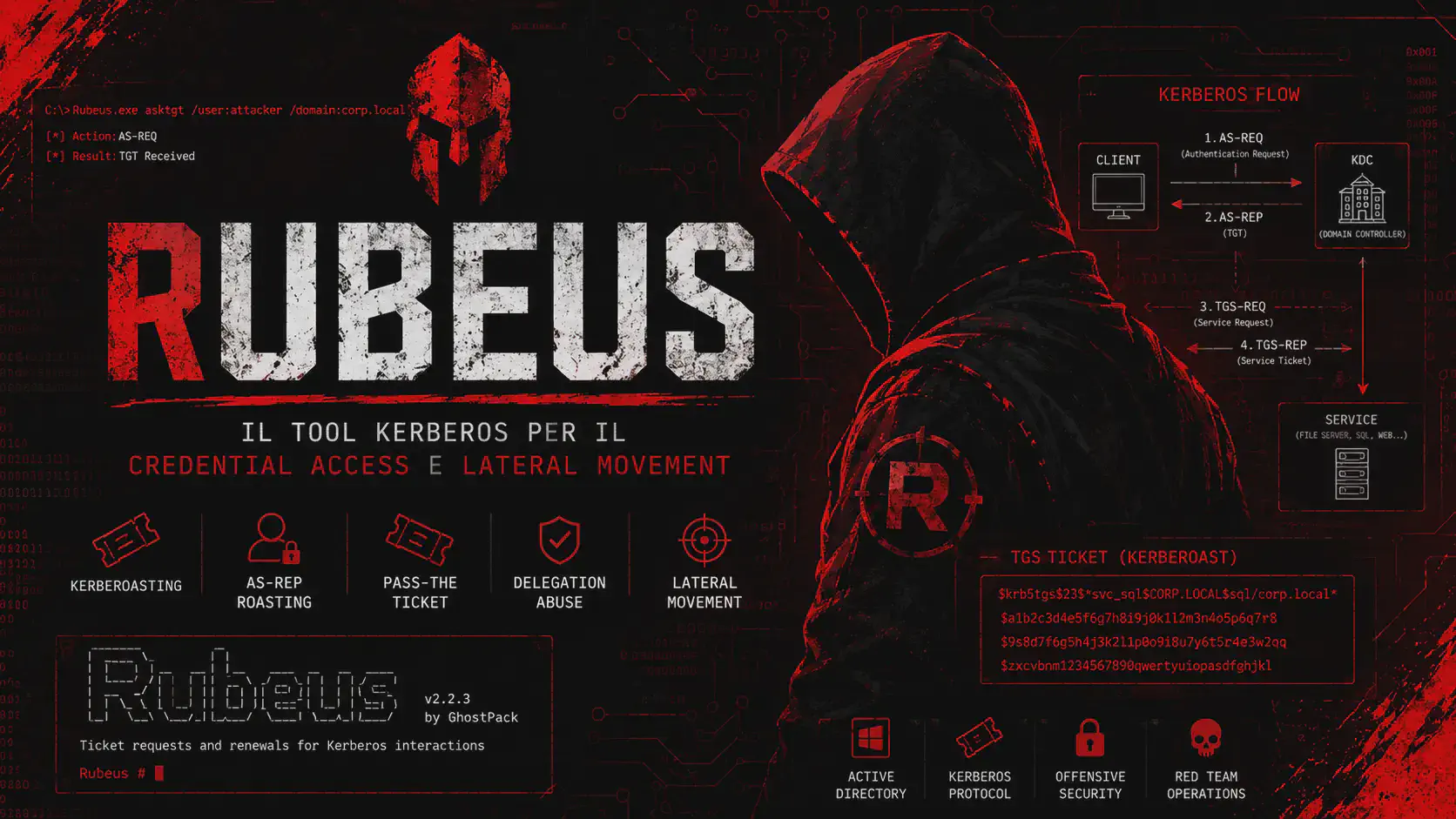
Kerberos is the primary authentication protocol in Active Directory. It's the world of TGTs , service tickets , delegations , and forged tickets.
If you study AD and don't understand Kerberos, you're just scratching the surface.
DNS #
AD relies on DNS to locate Domain Controllers and services. In many environments, the internal DNS also provides a free map for naming, roles, and segmentation.
SYSVOL #
SYSVOL is a replicated share readable by authenticated users. It contains scripts, policies, and administrative remnants that can still expose sensitive information in vulnerable environments.
Group Policy #
GPOs apply configurations and rules to users and computers. From an offensive perspective, a writable GPO in the right place can become a vector for large - scale code execution.
Kerberos vs. NTLM: The Difference You Need to Understand Right Now #
One of the most common mistakes is confusing the two protocols.
- Kerberos : think about tickets, SPN, delegations, KDC, TGT, TGS
- NTLM : think challenge-response, hash, relay, coercion, Pass-the-Hash
| Appearance | Kerberos | NTLM |
|---|---|---|
| Model | Ticket | Challenge response |
| Offensive mentality | Identity and service abuse | Authentication and transport abuse |
| Typical attacks | Kerberoasting, delegation abuse, ticket forgery | Pass-the-Hash, NTLM Relay, capture |
| Key risk | Poorly managed tickets and trusts | Hash and relay |
If you see Kerberos, you're thinking in terms of tickets and delegation . If you see NTLM, you're thinking in terms of hashes , relays , and lateral movement.
Active Directory Attack Surface #
The AD attack surface isn't a single port. It's an ecosystem of errors that accumulate over time.
Weak credentials #
Predictable passwords, seasonal patterns, unrotated service accounts, and weak policies still make password spraying effective.
Service Account with SPN #
Any account with an SPN can become a Kerberoasting target . If the password is weak and the privileges are high, the attack value increases immediately.
Mismanaged ACLs #
Permissions such as GenericAll , GenericWrite , WriteDACL , WriteOwner , and ForceChangePassword are among the most common causes of real privilege escalation.
Unsafe delegations #
Unconstrained Delegation, Constrained Delegation, and RBCD remain among the most powerful surfaces for building attack paths to high-value accounts.
Writable GPOs #
A GPO controllable from a low account is often a shortcut to distributed remote execution.
AD CS #
If an internal CA is present, Certipy and template analysis become essential. Overly permissive templates and weak enrollment can open up highly impactful impersonation opportunities. Read the complete guide on AD CS and ESC1-ESC16 with the related priv-esc on all 16 templates!
Trust and hybrid environments #
A weak domain can become a springboard to a stronger one. The problem isn't just the single object, but the chain.
Most Common Active Directory Attacks in Real-World Pentests #
| Connection | Requires credentials | Impact | Target |
|---|---|---|---|
| Password Spraying | No or minimal | Medium | First access |
| Kerber-roasting | Yes | High | Service account credentials |
| AS-REP Roasting | No | Medium | Offline crackable material |
| NTLM Relay | No, but relayable traffic is needed | High | Impersonation and escalation |
| Pass the Hash | Yes, just the hash | High | Lateral movement |
| ACL Abuse | Yes | Very high | privilege escalation |
| Delegation Abuse | Yes | Very high | Impersonation |
| AD CS Abuse | Yes | Critical | High-privilege identity |
| DCSync | Adequate privileges | Critical | Domain hash |
Password Spraying #
Password spraying tests a common password across many accounts while staying below the lockout threshold. It works because companies still use human-like patterns, not truly random ones.
Kerber-roasting #
Kerberoasting is one of the most common attacks in AD pentests because it is simple, silent, and often effective.
An authenticated user can request a service ticket for an account with an SPN. That ticket could become material for an offline attack. If the service account uses a weak password, you have a concrete path to stronger credentials.
AS-REP Roasting #
AS -REP Roasting affects accounts with pre-authentication disabled. It's not always present, but when it is, it's a great starting point for obtaining crackable material offline without starting from a domain account.
NTLM Relay #
The NTLM Relay intercepts an NTLM authentication and forwards it to another service that accepts it.
The point isn't to immediately steal the password. The point is to authenticate as the victim on a different target. In environments that still accept NTLM without adequate protection, relaying remains a viable escalation and lateral movement technique.
Pass the Hash #
Pass -the-Hash uses the hash as a credential. You don't need to know the cleartext password: if the protocol accepts that material, you can authenticate directly.
This is why it is a key technique in lateral movement.
ACL Abuse #
ACL Abuse is one of the most underrated forms of privilege escalation in AD.
If you control the permissions of a high-value object, there's often no need to exploit anything. Just use the relationship wisely:
- change password of a target account
- add SPN to an account
- rewrite a DACL
- take possession of an object and then modify its permissions
Delegation Abuse and RBCD #
Delegations exist to allow services to communicate with each other. If misconfigured, they allow an attacker to impersonate highly privileged users.
In modern environments, the most important concept to understand is often RBCD.
AD CS Abuse #
If an internal CA exists, certificate templates become a serious attack surface. In many "hard" environments, AD CS is the point that breaks everything.
For this part, the natural connection is Certipy.
DCSync #
DCSync simulates directory replication and allows you to retrieve critical domain material if you have the correct rights.
It is one of the attacks that mark the transition from simple compromise to domain control.
Golden Ticket, Silver Ticket and Shadow Credentials #
This is the area where pentesting stops being access and becomes the domain of identity.
- Golden Ticket : forged ticket with domain-wide impact
- Silver Tickets : ticket forged for a specific service
- Shadow Credentials : abuse of attributes related to key-based authentication
BloodHound and Attack Path: How AD Really Thinks #
The wrong way to look at AD is this: “who has local admin where?”
The right way is this: what chain of relationships takes me from where I am now to a high-value account or group?
This is where BloodHound comes in.
BloodHound isn't just a tool. It's a way of thinking. It transforms the directory into a graph and shows relationships like:
- group memberships
- user sessions
- local admins
- ACL rights
- control over GPO
- proxies
- relationships with certificate services
The offensive value isn't in the individual permit. It's in the sum of the permits along the route.
Tool for Active Directory Pentesting #
This section also intercepts tool-based queries without losing focus on the main keyword.
| tool | What is | When it really matters |
|---|---|---|
| blood hound | Attack path analysis | When you want to see relationships and paths |
| SharpHound | Data collection for BloodHound | During the enumeration |
| NetExec | Access validation and lateral movement | When you need to quickly test services and credentials |
| Packet | Multipurpose Offensive Toolkit | When working on AD protocols |
| The red | Ticket and Kerberos abuse | When working on TGT, TGS and delegations |
| Certipy | AD CS enumeration and abuse | When there is an internal CA |
| Mimikatz | Credentials, tickets, memory | When you have local access |
Tools accelerate. But if you don't understand why a relationship is dangerous, you won't recognize the path even when it's right in front of you.
Minimum Lab for Studying Active Directory Pentesting #
If you really want to learn, all you need is a small but sensible lab:
- 1 Domain Controller
- 1 Windows client joined to the domain
- 1 Linux or Kali machine for tools
- standard users, a couple of groups, a few SPNs and at least one misconfiguration
With this basis you can already study:
- LDAP enumeration
- difference between Kerberos e NTLM
- data collection with SharpHound
- graphical analysis with blood hound
- attacks like Kerber-roasting , AS-REP Roasting e NTLM Relay
You don't need to start with a gigantic domain. You need a domain that shows you relationships, errors, and paths.
Typical Path: From Standard User to Domain Control #
This is the most useful mental model to establish:
- Get an initial foothold A valid credential, an internal shell, or limited access.
- Read the directory Use LDAP and data collection to understand users, groups, SPNs, ACLs, GPOs, delegations, and trusts.
- Build the attack path You don't look for "the bug." You look for the sequence: a low-value permission that opens a jump, then another, all the way to a high-value item.
- Exit the privileges Who enters in gioco Kerber-roasting , ACL Abuse , RBCD o AD CS .
- You move sideways With Pass the Hash , remote access, tickets or recovered credentials.
- Achieve logical domain control The typical arrival point is DCSync , Golden Ticket or equivalent identity and authentication control.
In AD, you rarely win with a single shot. You win with a consistent chain.
How a Pentester Thinks Inside Active Directory #
The effective pentester doesn't think in terms of isolated exploits. They think in terms of identities, relationships, journeys, and impact.
The correct questions are:
- Who can authenticate where?
- Who controls who?
- Which ACLs trigger a privilege jump?
- Where are there high-value sessions?
- Which account has a small but strategic right?
- Which combination of permissions gives me maximum impact?
In AD, the single bug matters less than the right chain.
Active Directory Real Defense #
Those who defend AD must think like those who attack it. The measures that really matter are those that disrupt attack paths.
Reduce privileges #
The fewer useless permissions, the fewer edges the attacker's graph has. The least privilege in AD closes more attack paths than almost any other measure.
Separate the administration #
The most critical accounts shouldn't be hosted on regular hosts. If a high-value account ends up on a weak workstation, its credentials become an immediate target.
Reduce NTLM #
Every unnecessary NTLM flow is one less relay surface.
LDAP Hardening and Authentication #
LDAP signing, channel binding, and consistent configurations can block entire classes of attacks that otherwise remain open due to administrative inertia.
Protect Domain Controllers #
DCs should be treated as top-tier assets: limited access, segmentation, minimal roles, and tight control.
Securing AD CS #
If you have an internal CA, you must audit it as a critical component. Templates, enrollment, and mappings must be checked with the same rigor as a DC.
Tracking What Matters #
Modern attacks often generate successes , not just failures. You should observe:
- unusual ticket requests
- privileged memberships changed
- ACL changes on sensitive objects
- new delegation relationships
- requests for out-of-profile certificates
Conceptual Errors That Cause You to Poorly Study Active Directory #
“AD is just a server” #
No. It's a distributed system of identity and control.
“Just be in the domain” #
No. Being a domain user simply means having a valid identity. The real work is building the path to higher privileges.
“OUs are security borders” #
No. They are organizational containers, not defensive walls.
“Kerberos and LDAP are the same thing” #
No. One authenticates. The other describes and queries the directory.
“GPOs are only for desktop settings” #
No. If you control a GPO in the right place, you are controlling execution, configuration, and deployment.
“AD and Microsoft Sign In ID are the same thing” #
No. They're different worlds. They can coexist in hybrid environments, but they have different attack surfaces.
FAQ Active Directory Pentesting #
What is Active Directory Pentesting? #
Active Directory Pentesting is the offensive analysis of users, groups, computers, ACLs, trusts, delegations, GPOs, and authentication protocols to find a path from low access to domain control.
What is Kerberoasting in Active Directory? #
Kerberoasting is a technique whereby an authenticated user requests service tickets associated with accounts with SPNs to obtain attackable material offline and attempt to recover the service account password.
When to use BloodHound in an AD pentest? #
BloodHound is used when you want to transform raw enumeration into real attack paths . It's not just useful for seeing who's an admin, but also for understanding which relationships lead to impact.
What is the difference between DCSync and Golden Ticket? #
DCSync is used to obtain critical domain material by simulating directory replication. The Golden Ticket is the next abuse, where you forge a ticket with domain-wide impact.
Does NTLM Relay still work in 2026? #
NTLM Relay remains relevant when there are still services that accept NTLM without adequate protections and when the attacker is able to force or lure authentication to himself.
Do you need a lab to learn Active Directory security? #
Yes. Without labs, you learn the names, but you don't understand the flows. A small domain with a DC, a Windows client, and a Linux machine is enough to get you started.
Where should you start? #
Start with three basics:
- AD structure
- Kerberos vs NTLM
- attack path with blood hound
If you skip these basics and go straight to the tools, you only learn how to copy output.
External References #
- Microsoft - Active Directory Domain Services overview
- Microsoft - Kerberos authentication overview in Windows Server
- Microsoft - NTLM overview in Windows Server
- Microsoft - Active Directory Certificate Services overview
- SpecterOps - BloodHound introduction
- RFC 4120 - The Kerberos Network Authentication Service
Conclusion #
Active Directory isn't difficult because it has too many tools. It's difficult because it's a system of relationships.
Users, groups, computers, ACLs, GPOs, delegations, certificates, and trusts: everything is connected. A pentester who understands these connections sees paths that others don't.
This is why Active Directory Pentesting isn't just about issuing commands. It means understanding:
- How an identity is authenticated
- How permits are assigned
- where privileges accumulate over time
- which chain leads from standard user to domain control
Study the model first. Then the attacks. Then the tools. This is the order that separates those who execute commands from those who actually compromise a domain.
Want to support the project? Support HackIta . Are you stuck on AD, OSCP, CRTP, CRTE, or OSCE3? 1:1 training . Want to understand if your domain hides paths to Domain Admin? Services for businesses.